DrillPre-K to KGrades 1 to 2Grades 3 to 4
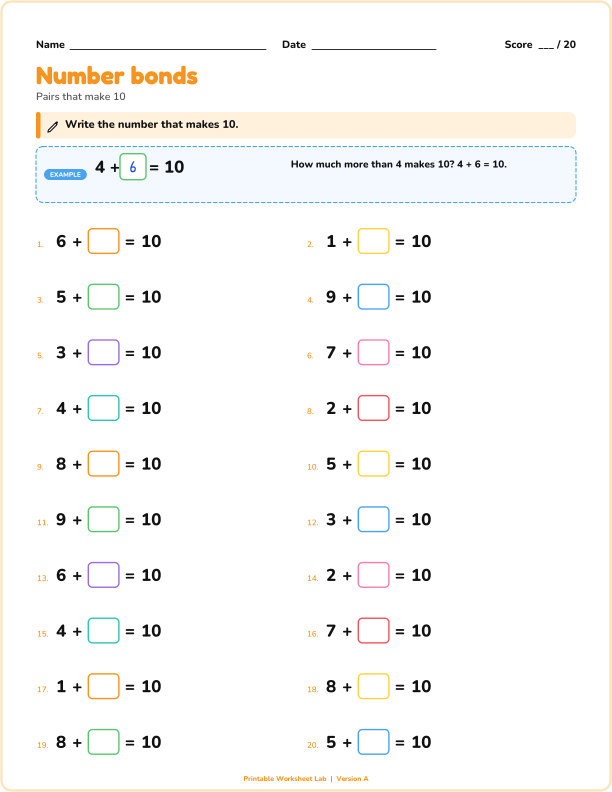
Number bonds and complements
Pairs that make 10, 20, 100 or 1000 (and the 9s, 99s and 999s), as missing-number sums or as subtraction.
Each card shows a numeral from 1 to 10 and a row of cars: children color exactly that many cars.
Each card shows a numeral from 1 to 10 and a row of cars: children color exactly that many cars.
You can change any of these settings above. Press "New problems" for a fresh set with the same settings, or pick Version A to Z to print different sheets for neighboring desks. The answer key always matches.
Each card shows a numeral and a group of empty shapes. Children color exactly as many shapes as the numeral says, starting at the top left. It connects the written number to a quantity, which is the other direction from counting a group.
Choose the largest number (3 to 20) and the shape. The groups are laid out in rows of five so each one can be checked at a glance. Every sheet has a solved example and an answer key that shows the colored shapes.
US Letter or A4, portrait: choose your paper size above. Print at 100 percent (actual size). Use "Black and white" for the copier, or "Color" for display pages and mini books.
Pairs that make 10, 20, 100 or 1000 (and the 9s, 99s and 999s), as missing-number sums or as subtraction.
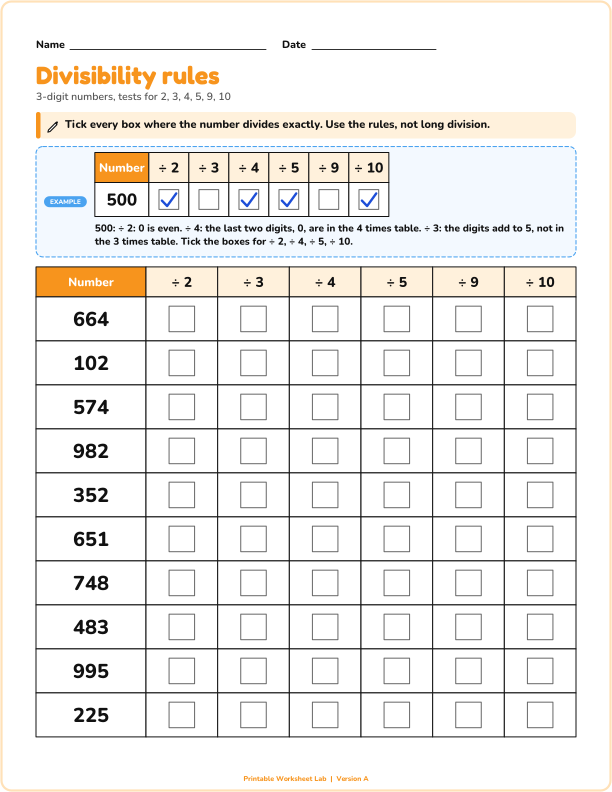
Tick the boxes for every number a given number divides by, using the rules for 2, 3, 4, 5, 6, 8, 9 and 10.
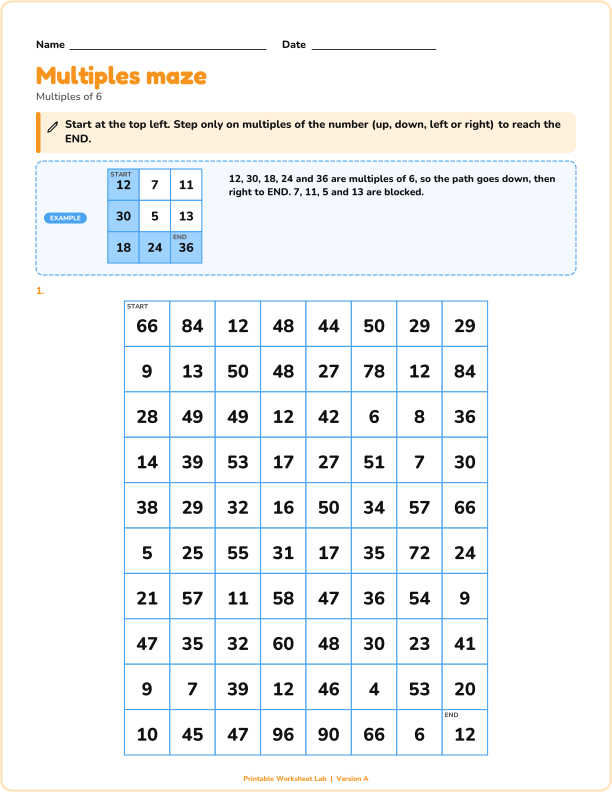
Mazes where you may only step on multiples of a chosen number. One route, no guessing.