DrillGrades 1 to 2Grades 3 to 4
Addition worksheets
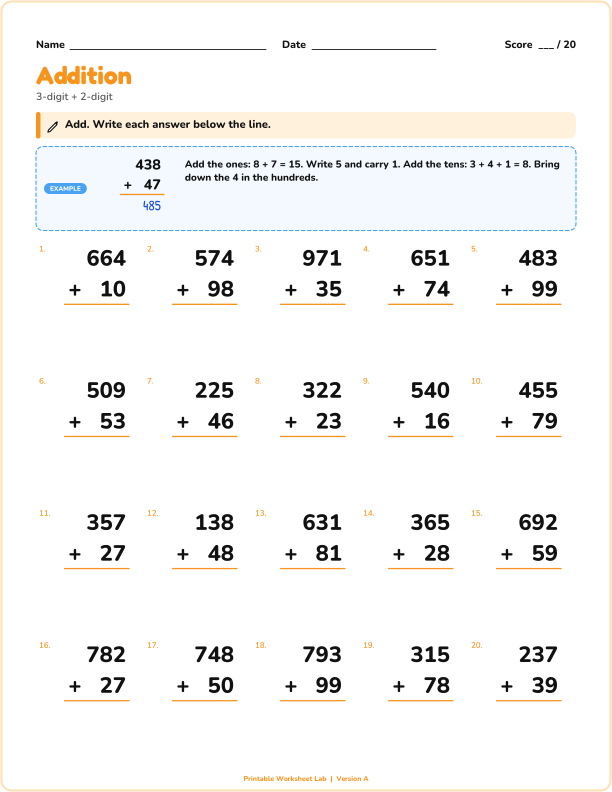
Printable addition practice with control over digits, regrouping and layout.
Pick a worksheet, change the options, and print it. Each one comes with an answer key.
Printable addition practice with control over digits, regrouping and layout.
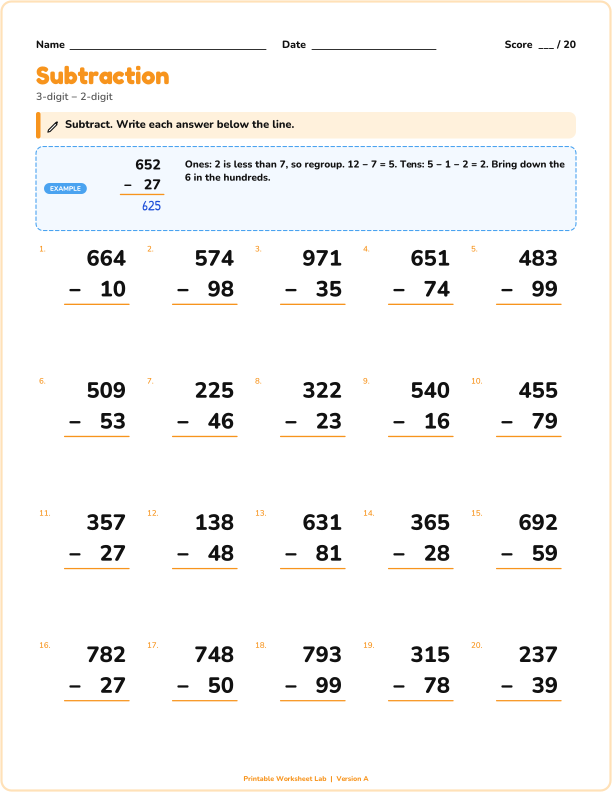
Printable subtraction practice with control over digits, borrowing and layout.
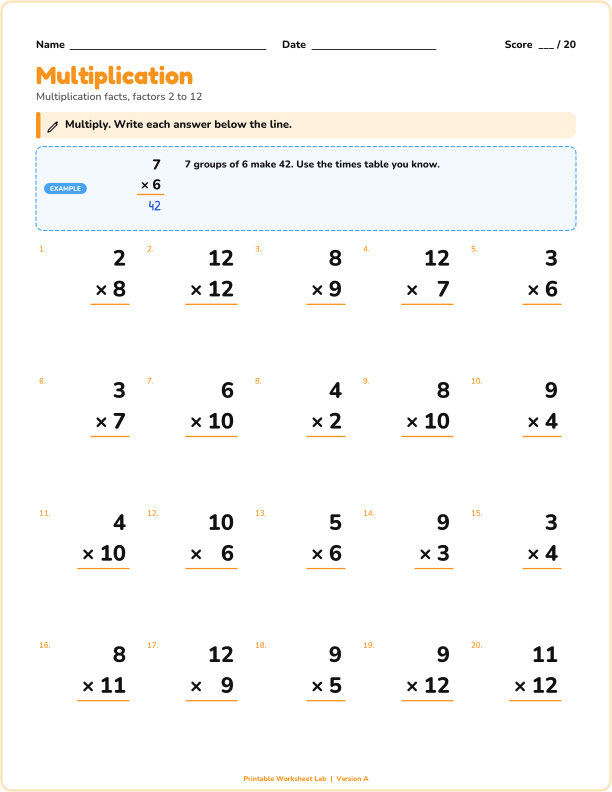
Times-table drills: one table, a range of tables, squares or anchor facts, in order or shuffled.
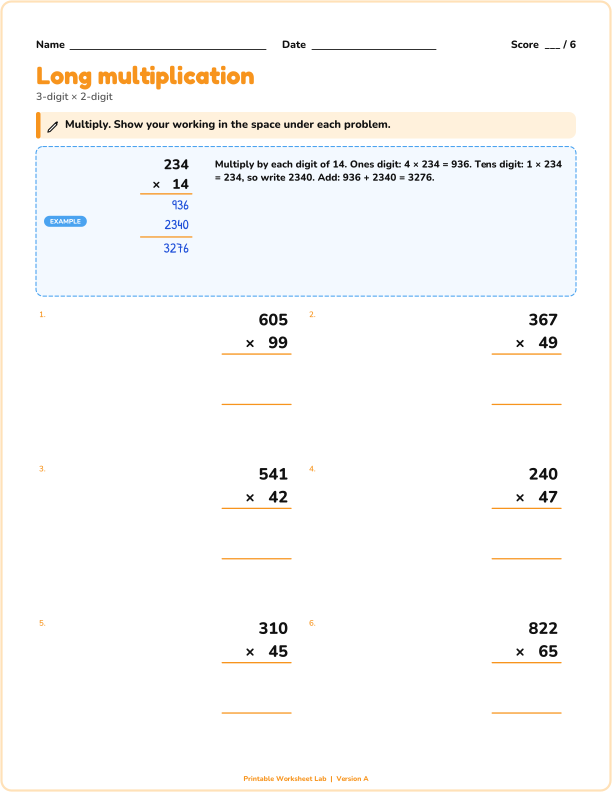
Multi-digit multiplication with room to show every partial product, from 2 × 1 digits up to 5 × 3.
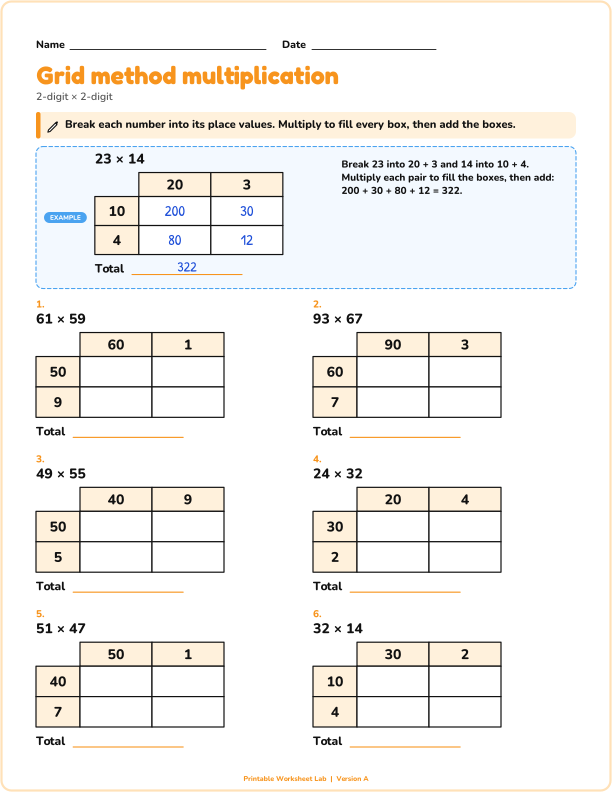
The area model: break each number into place values, fill the boxes and add them up.
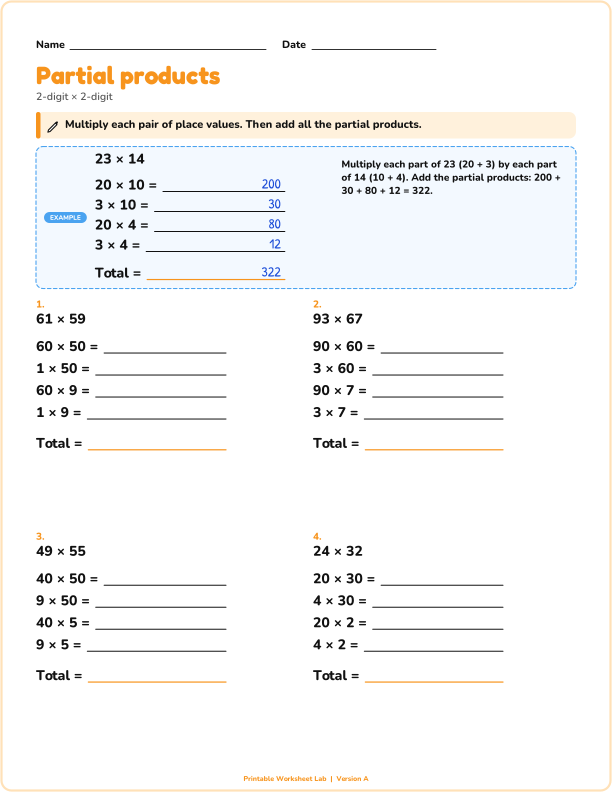
Multiply each place value pair on its own line, then add the partial products.
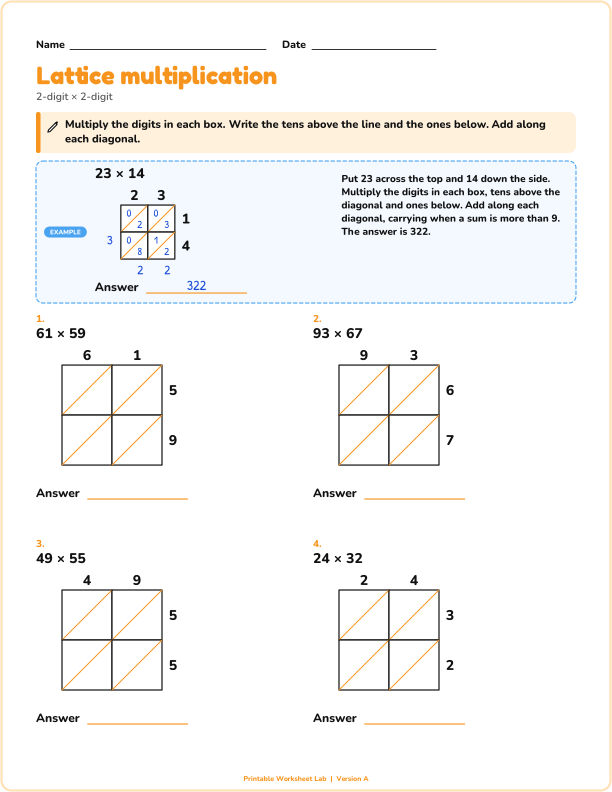
The lattice (gelosia) method: one small multiplication per box, then add along the diagonals.
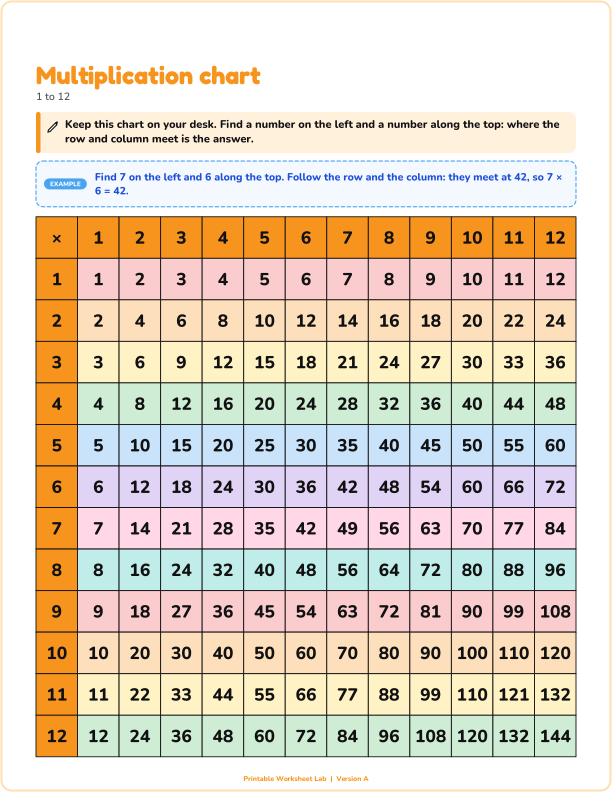
A printable times-table chart in color-coded rows, Montessori bead colors or plain, up to 12 × 12.
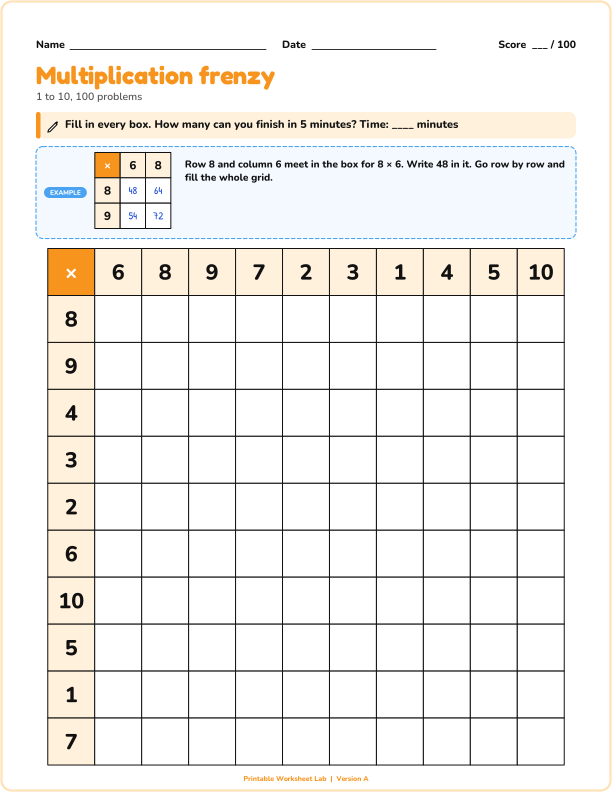
A timed times-table grid: fill in all 100 products. Headers are shuffled so every version is different.
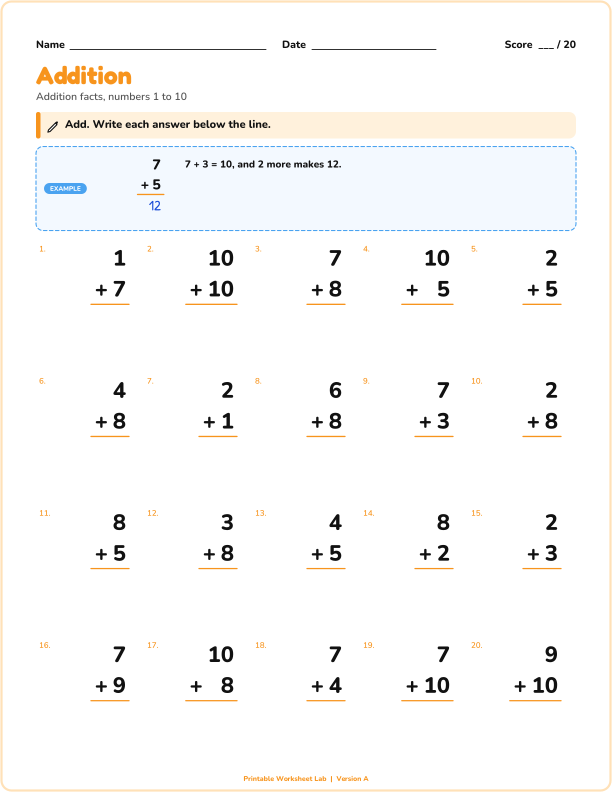
Practice one number at a time (+7, +8), doubles, near doubles, or all the facts, with the sums kept as small as you like.
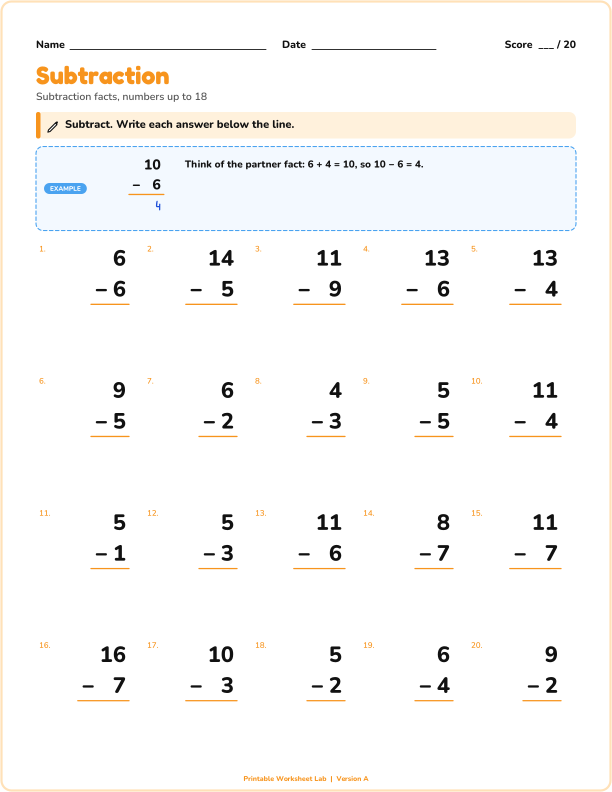
Practice taking away one number at a time, or all the facts, with answers from 0 to 9 so each fact has a partner addition fact.
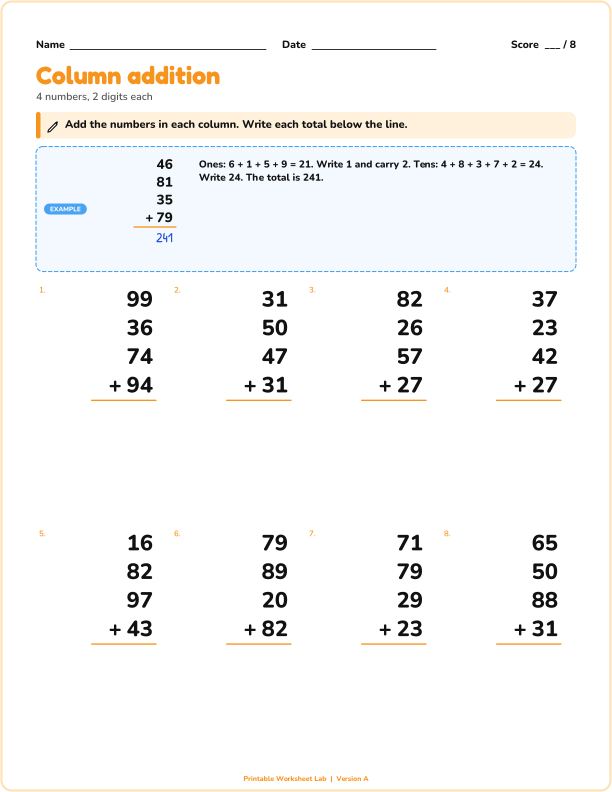
Add three to six numbers stacked in a column, with one to five digits each.
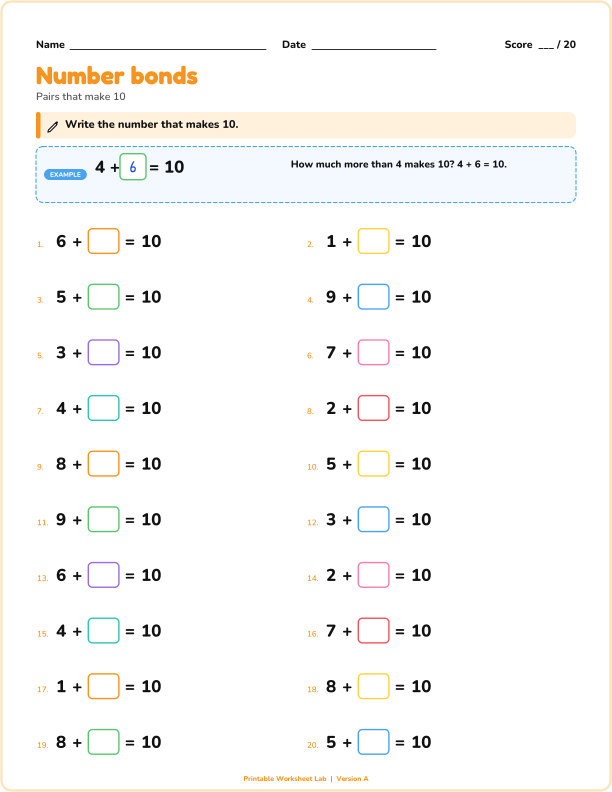
Pairs that make 10, 20, 100 or 1000 (and the 9s, 99s and 999s), as missing-number sums or as subtraction.
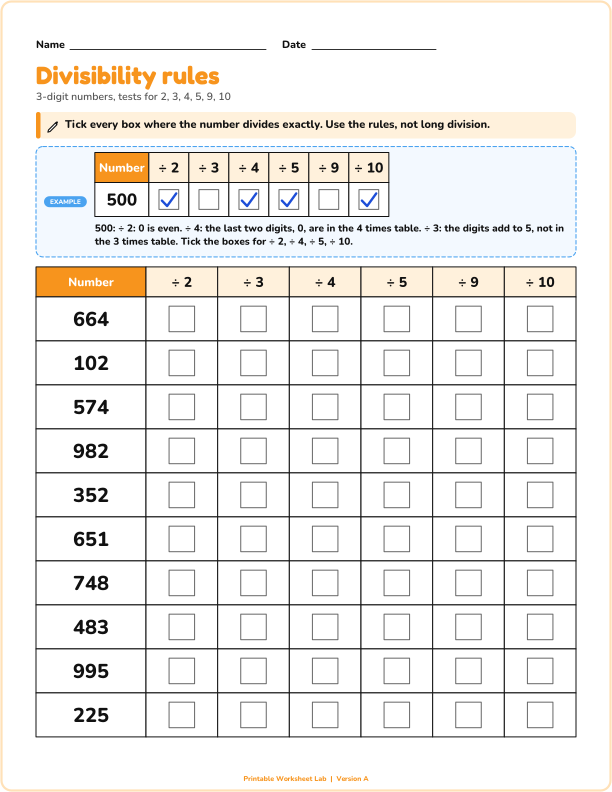
Tick the boxes for every number a given number divides by, using the rules for 2, 3, 4, 5, 6, 8, 9 and 10.
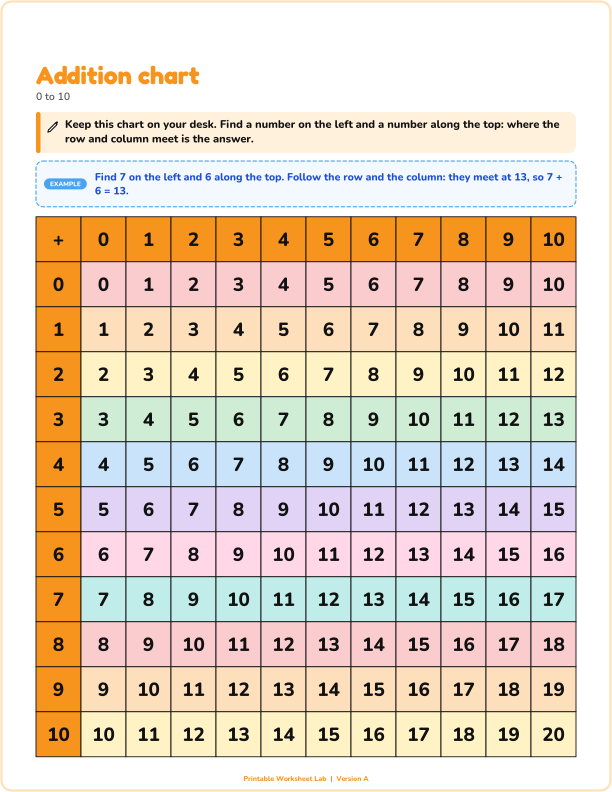
A printable addition chart up to 20 + 20, in color-coded rows or plain.
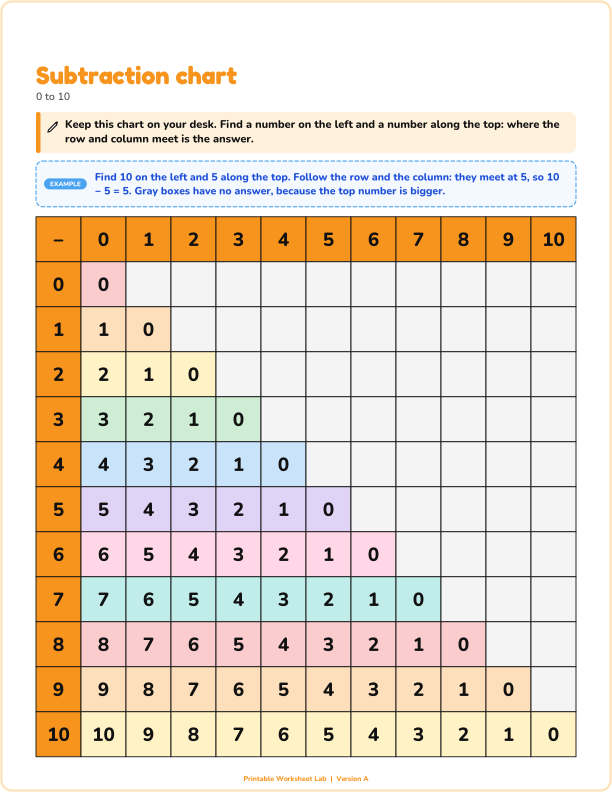
A printable subtraction chart (row minus column) up to 20, with the impossible boxes grayed out.
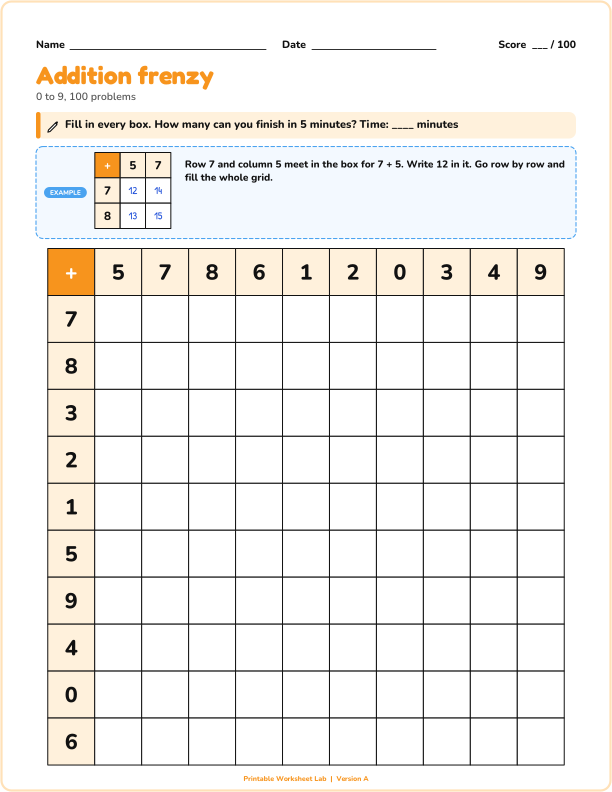
A timed addition grid: fill in all 100 sums. Headers are shuffled so every version is different.
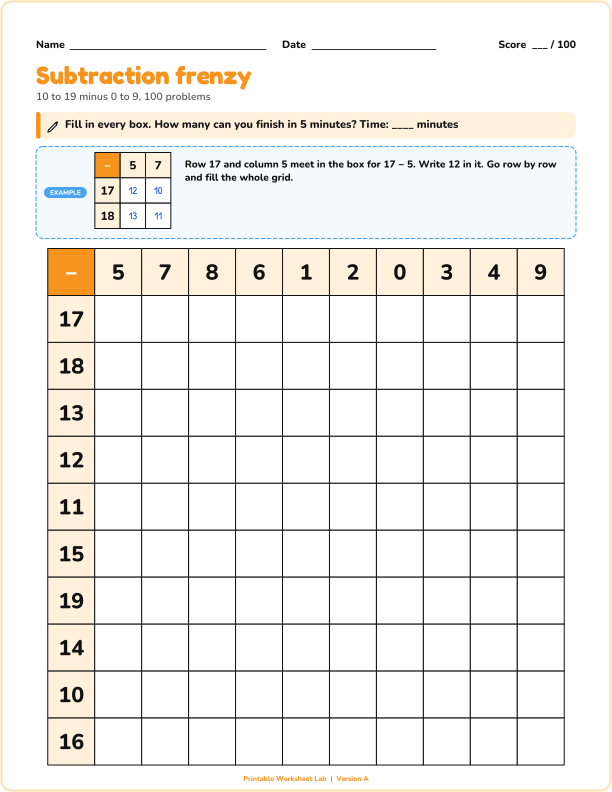
A timed subtraction grid: fill in all 100 differences. Headers are shuffled so every version is different.
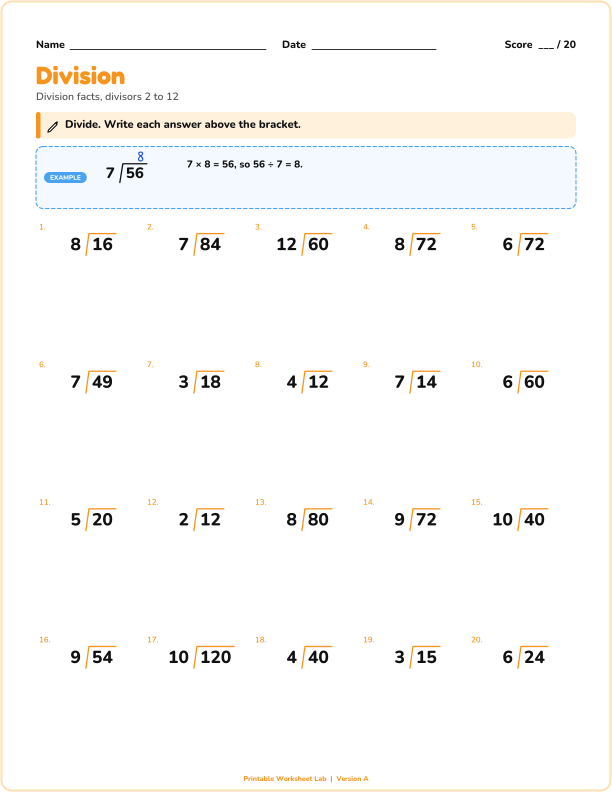
Division facts and long division with or without remainders, in bracket or inline layout.
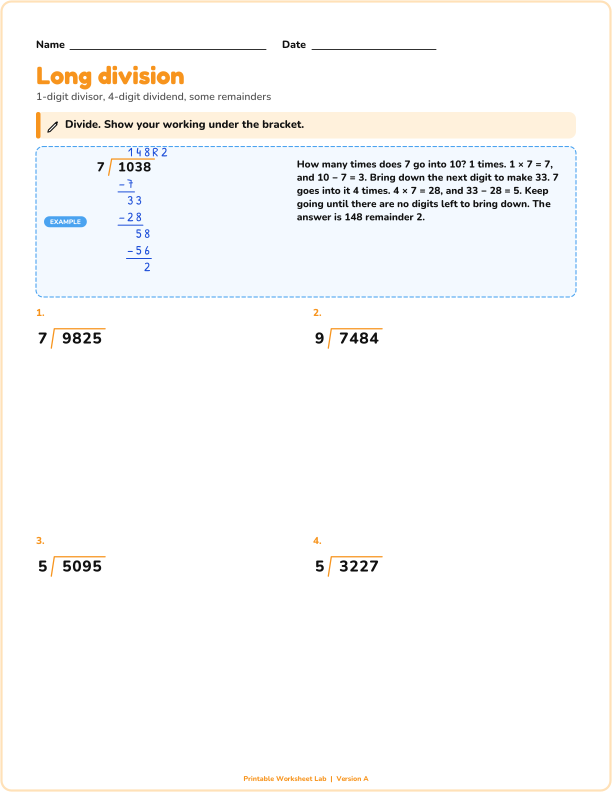
Long division with one, two or three-digit divisors, with or without remainders or decimal answers, and every step shown on the answer key.
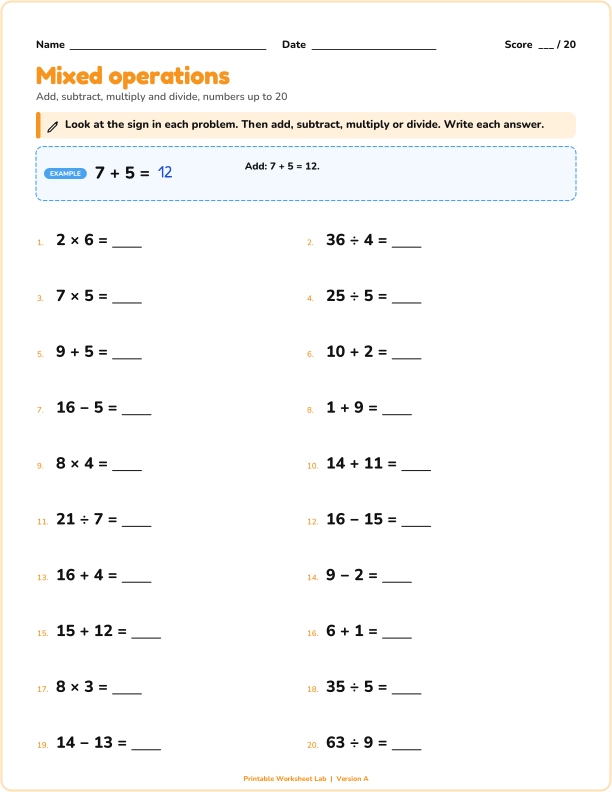
Addition, subtraction, multiplication and division on the same page: read the sign, then work the problem.
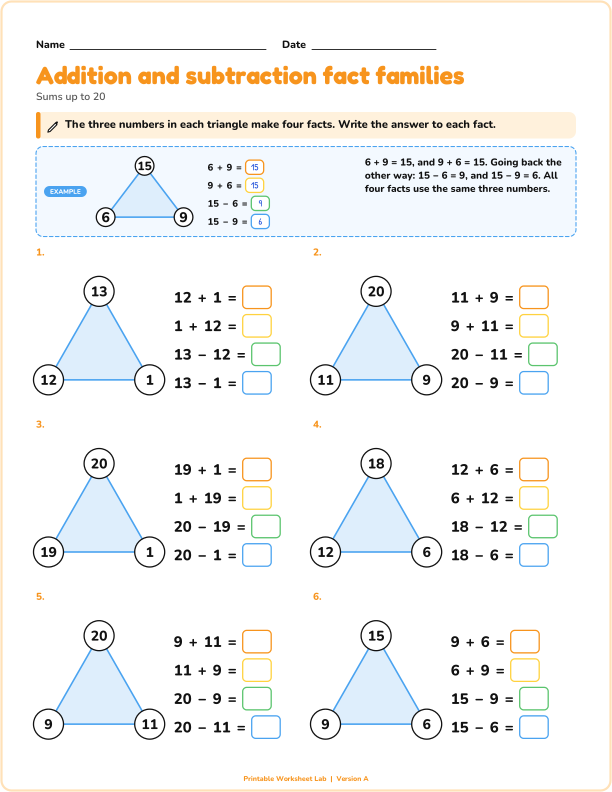
Three numbers in a triangle make four facts: two to add or multiply and two to subtract or divide.
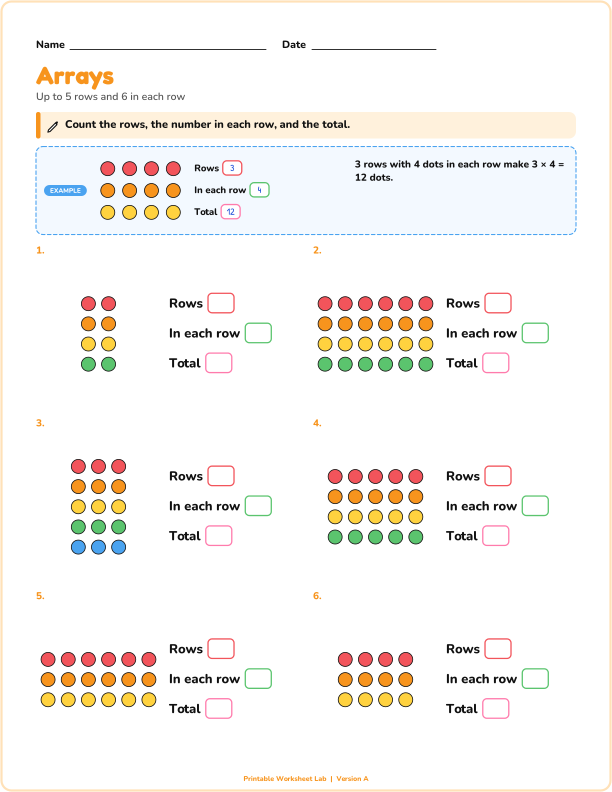
Count rows and columns of dots, or equal groups, and write the multiplication sentence that matches.
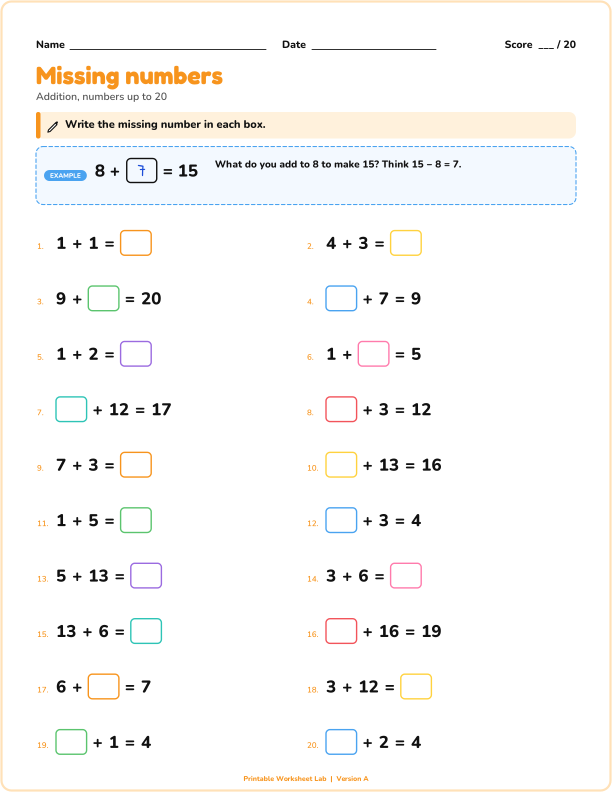
Equations with one empty box, for addition, subtraction, multiplication, division or a mix.
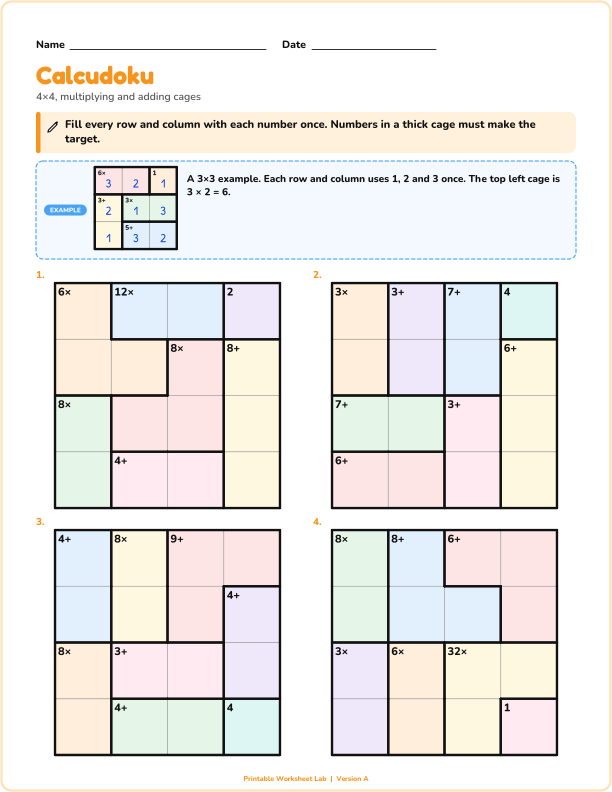
Arithmetic Latin-square puzzles: fill the grid so every cage hits its target. Each puzzle has exactly one solution.
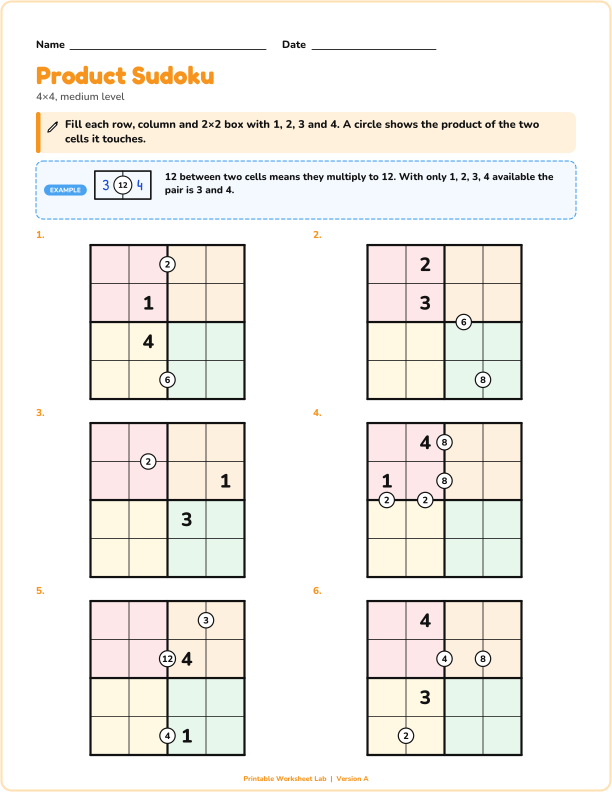
A 4×4 sudoku where circles show the product of two neighboring cells. Practices factors and logic together.
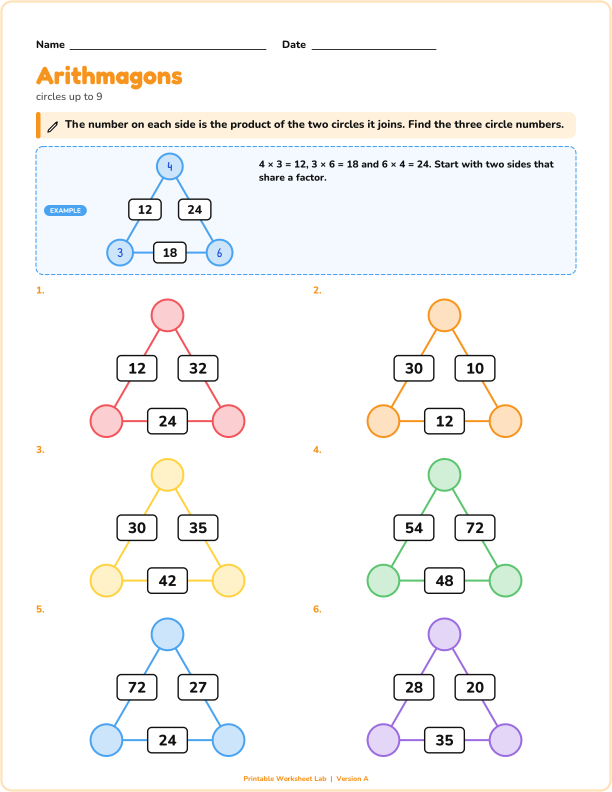
Triangles where each side is the product of two circles. Find the circle numbers.
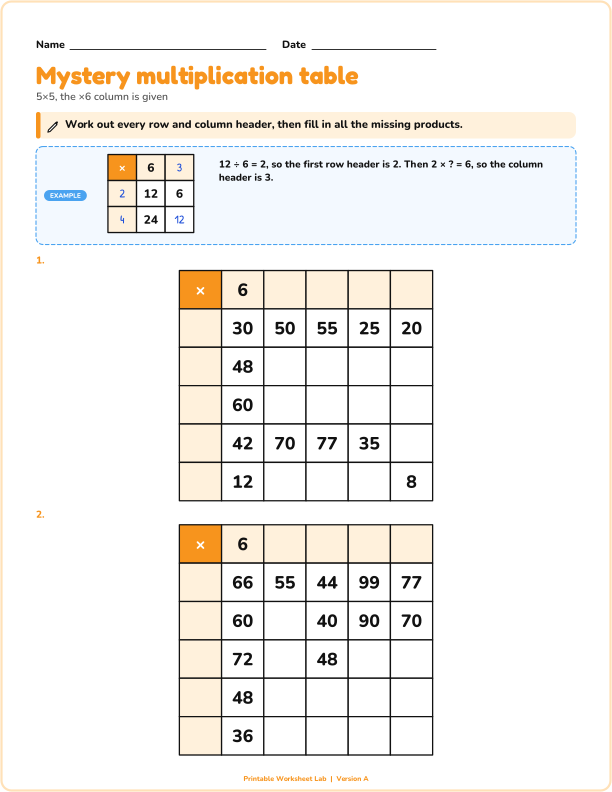
Multiplication tables with the headers hidden. Work out the headers, then fill the table.
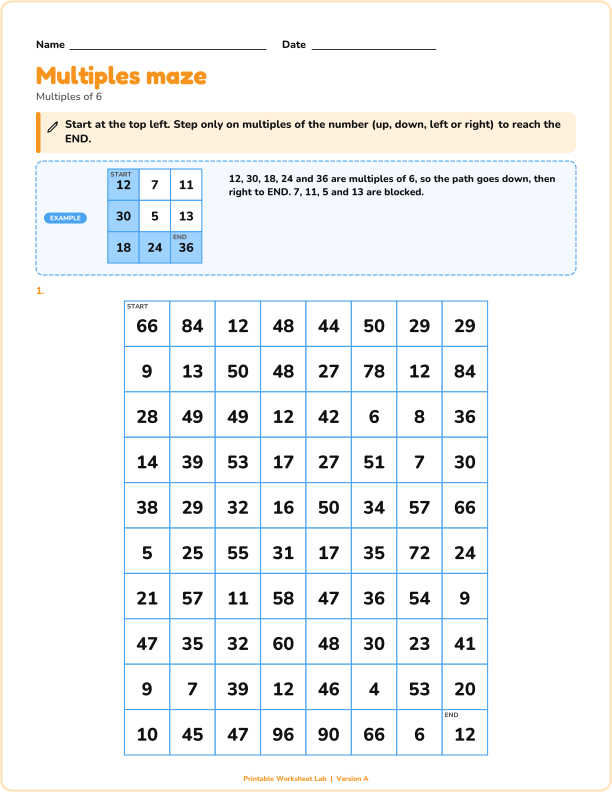
Mazes where you may only step on multiples of a chosen number. One route, no guessing.
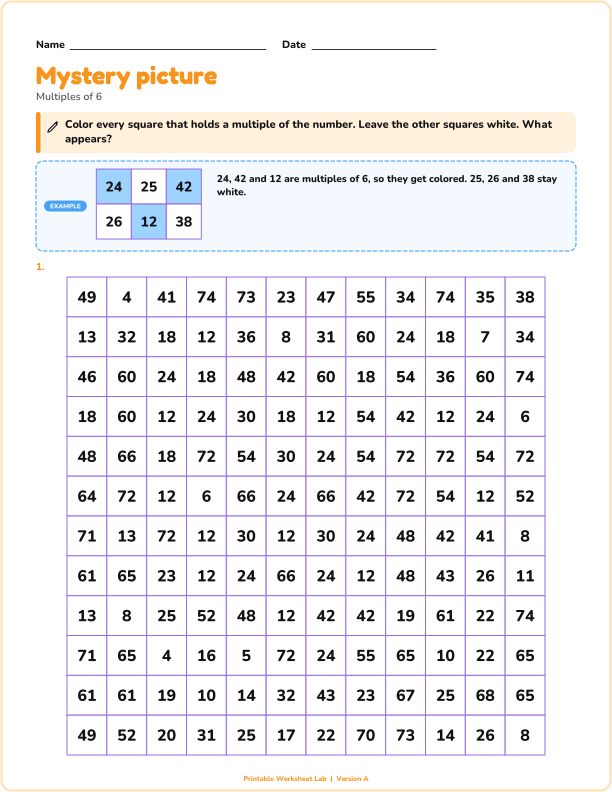
Color every multiple of a number to reveal a hidden picture.
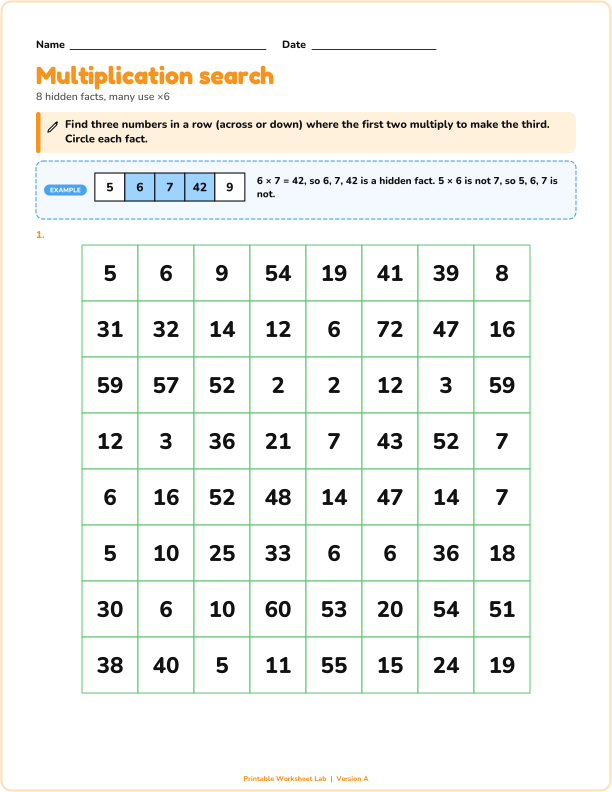
Find hidden multiplication facts in a grid of numbers: two factors followed by their product.
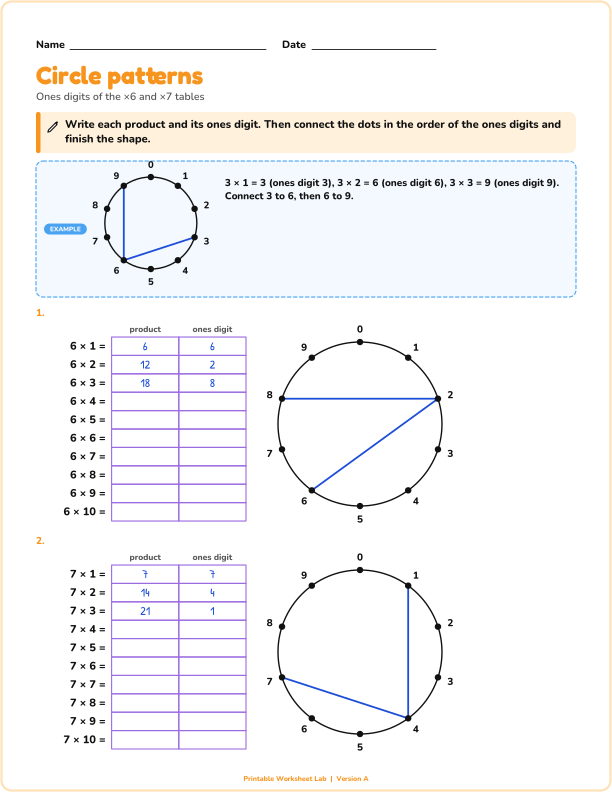
Connect the ones digits of a times table around a circle to draw a star or polygon.
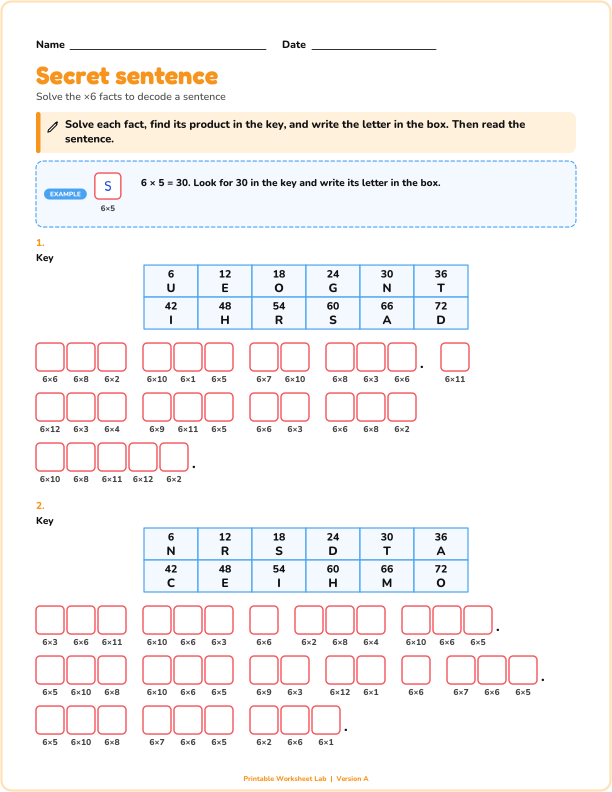
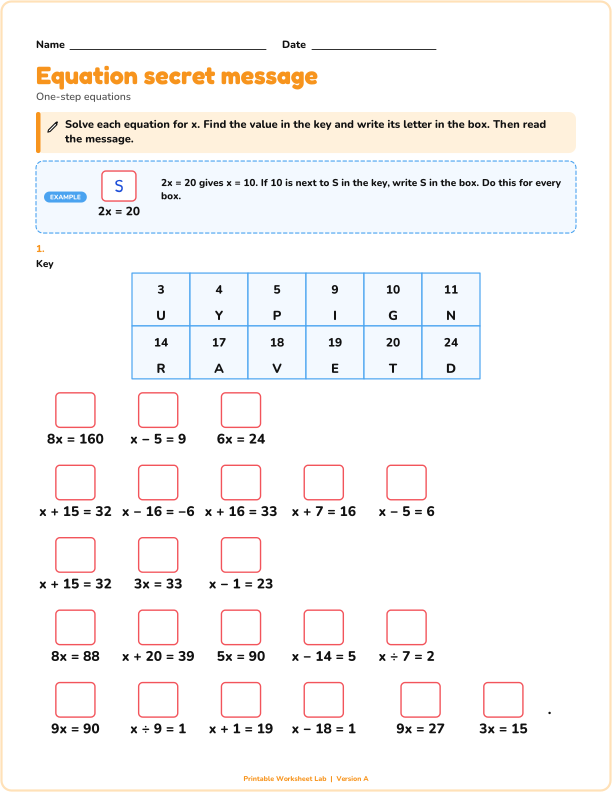
Solve multiplication facts to decode a short, readable sentence.
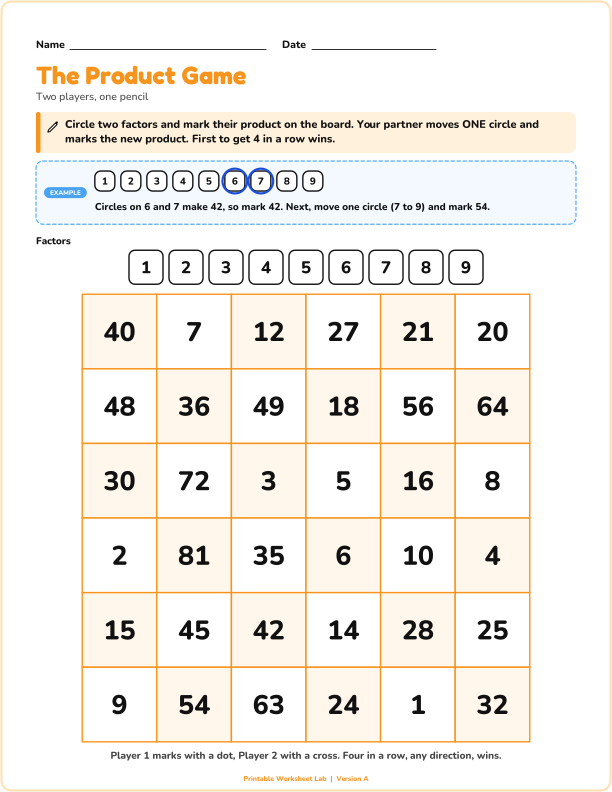
A classic two-player multiplication strategy game. All you need is a pencil.
A complete 18-page print-and-fold puzzle booklet for one times table: a warm-up, eleven puzzles, a game, answer key and progress tracker.
A 14-page print-and-fold booklet about one number from 1 to 20: tracing, counting, ten frames, connect-the-dots and more.
A 14-page print-and-fold booklet for one addition family, such as +3: ten activities, an answer key and a progress tracker.
A 14-page print-and-fold booklet for dividing by one number, such as ÷4: ten activities, an answer key and a progress tracker.
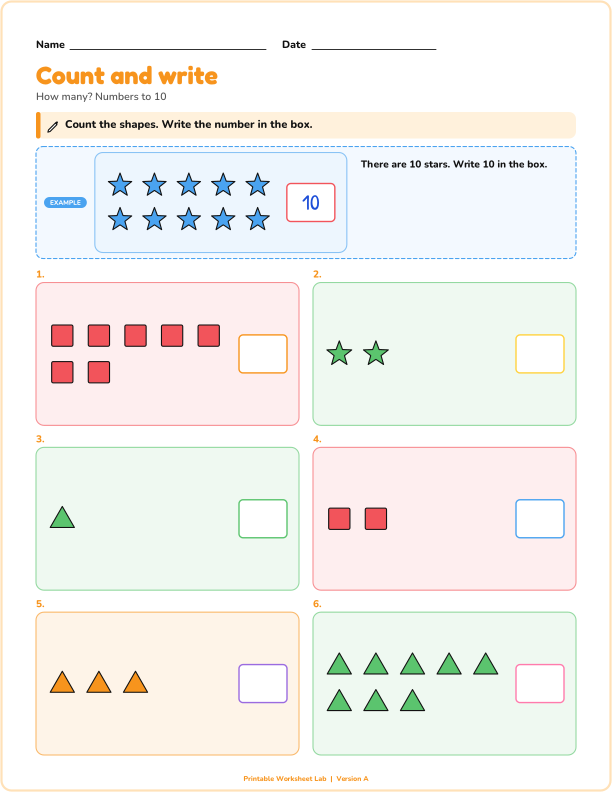
Count a group of shapes and write the number, or circle the right number, for any total from 3 to 20.
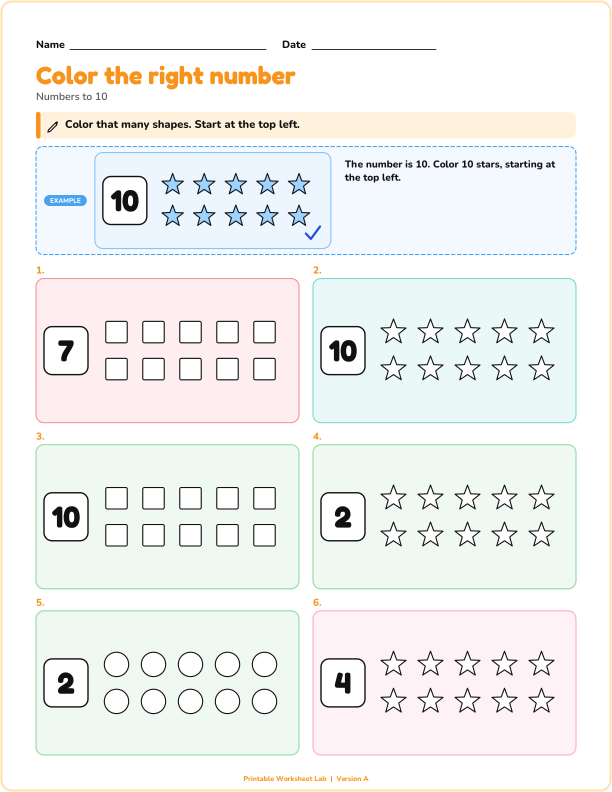
Read a numeral and color that many shapes in a row of up to 20.
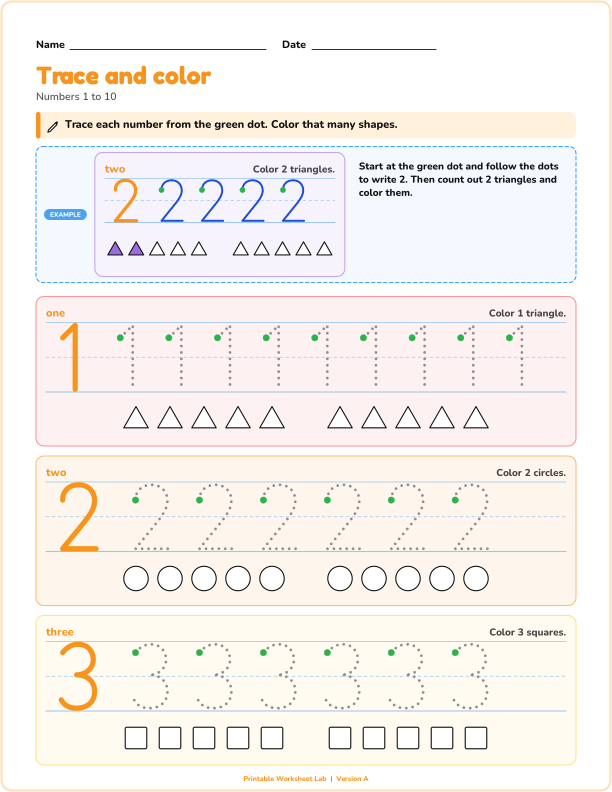
Trace dotted numerals from a green start dot, then count and color that many shapes.
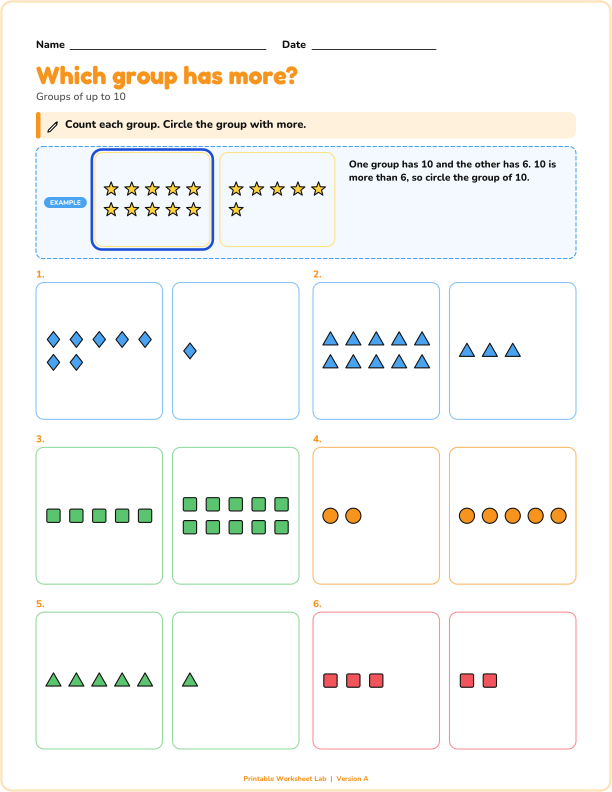
Count two groups of shapes and circle the group with more, or the group with fewer.
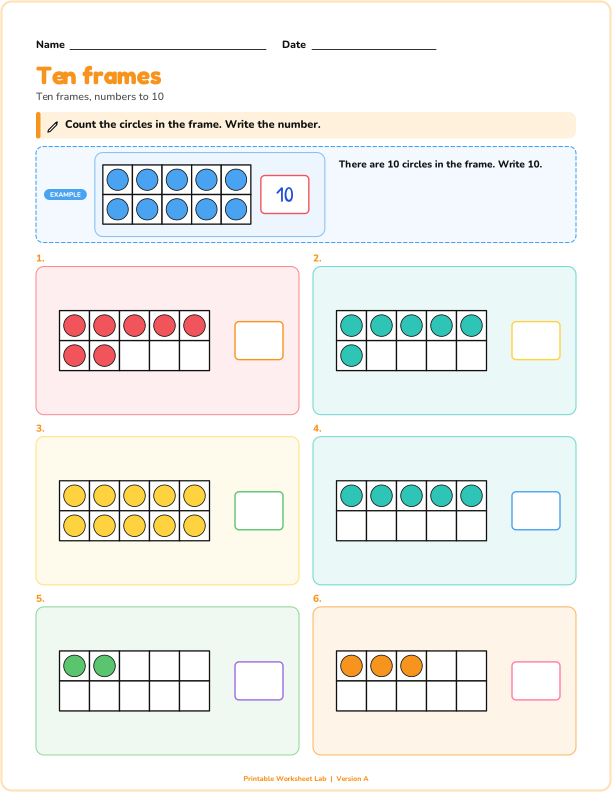
Count the circles in a ten frame, color in a number, or find how many more make ten or twenty.
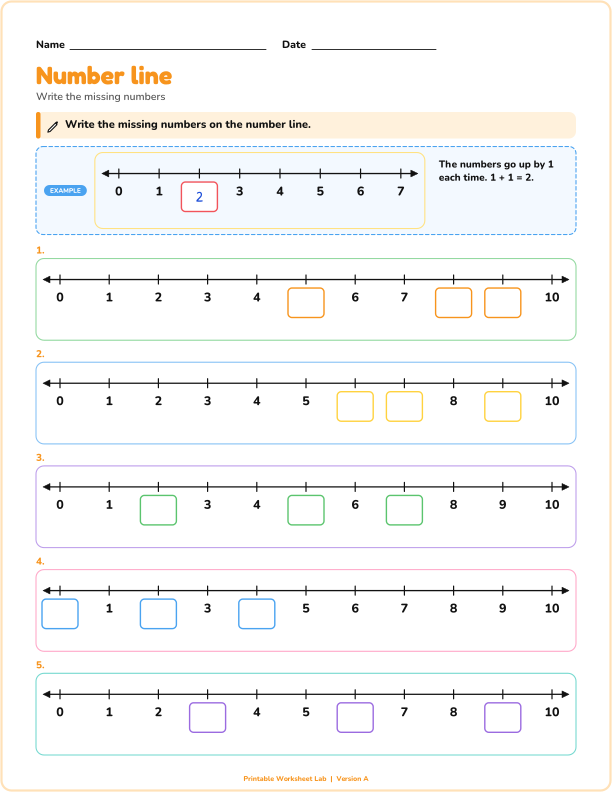
Write the missing numbers on a number line that counts by 1, 2, 3, 4, 5 or 10.
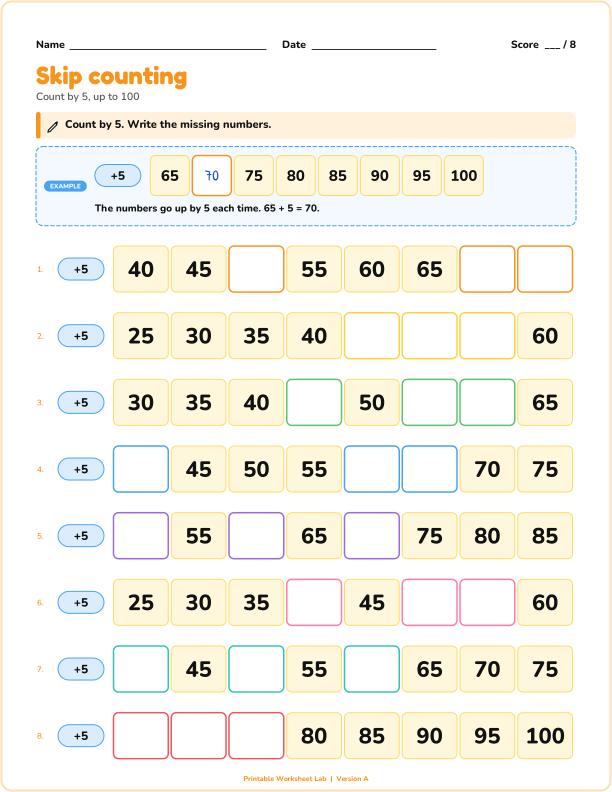
Fill in the missing numbers when counting by 2, 3, 4, 5 or 10, forwards, backwards or both.
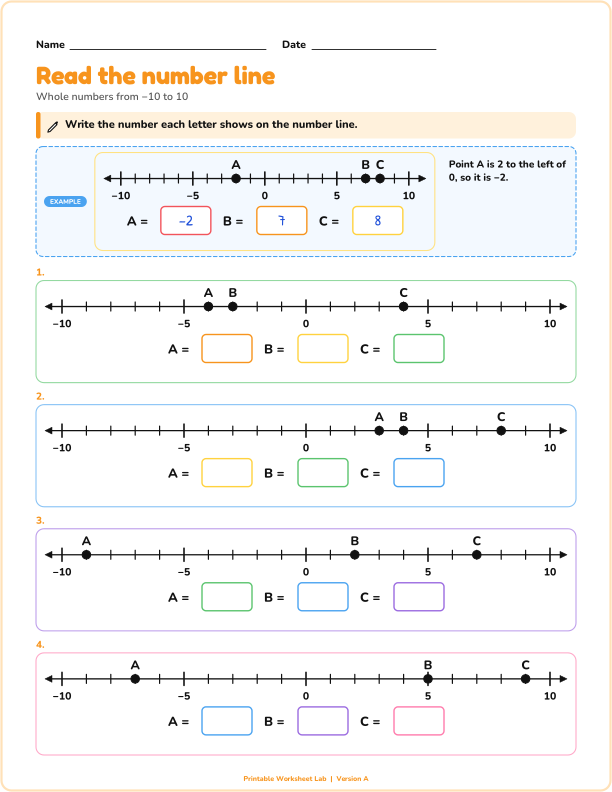
Read whole numbers on both sides of zero from a number line, or plot them, on lines from −5 to 5 up to −50 to 50.
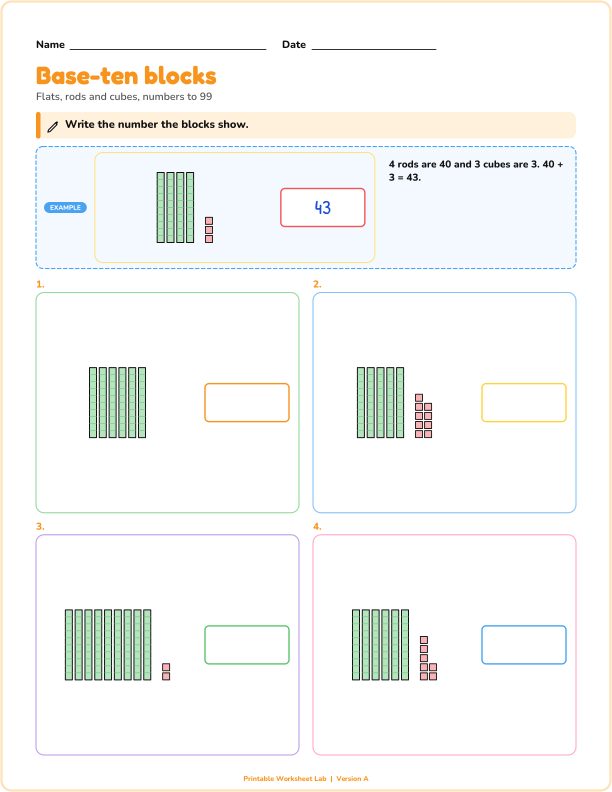
Read the number shown by hundreds flats, tens rods and ones cubes, up to 99 or 999.
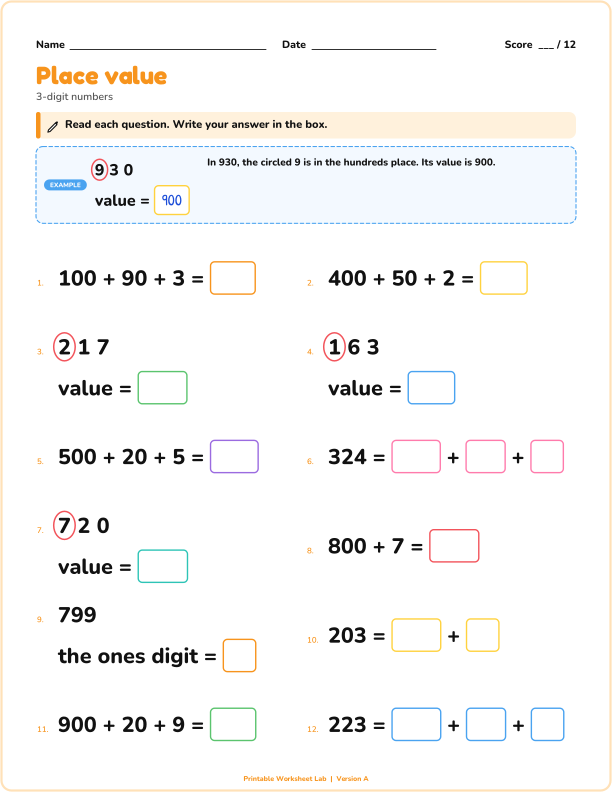
The value of a digit, the digit in a place, and expanded form both ways, for numbers from 2 to 6 digits.
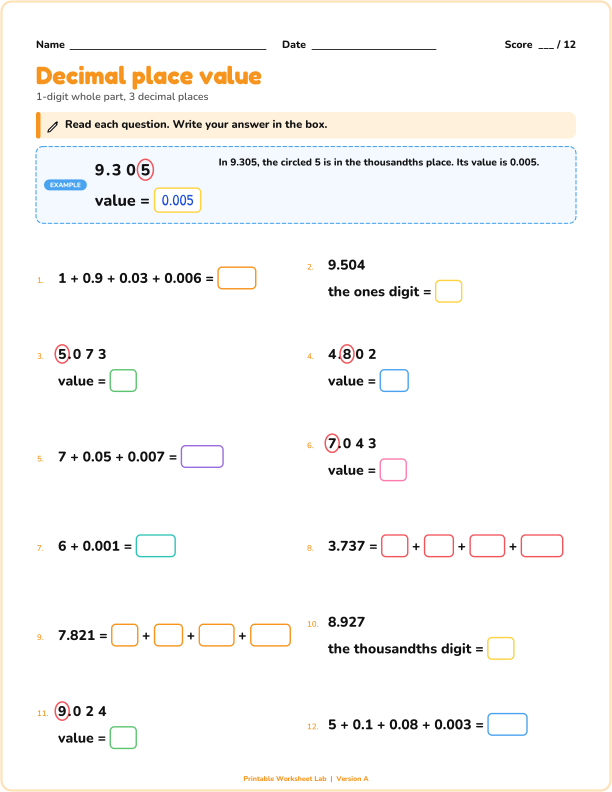
Tenths, hundredths and thousandths: the value of a digit, the digit in a place, and expanded form both ways.
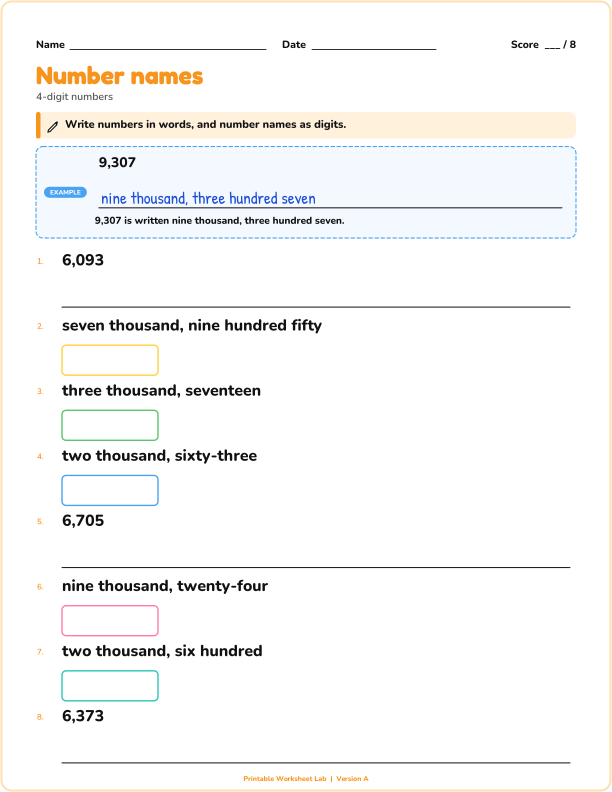
Write numbers in words and number names as digits, from 3 digits up to millions.
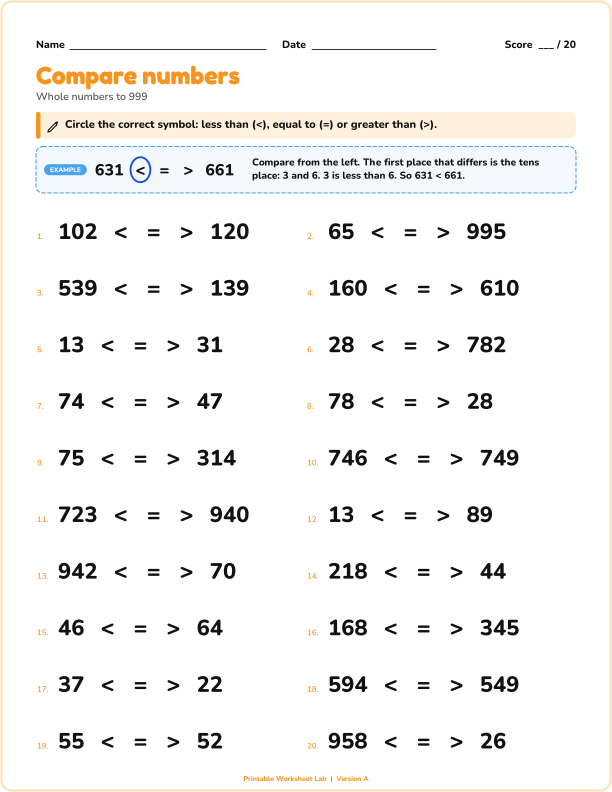
Circle <, = or > to compare whole numbers, decimals or integers, from numbers to 99 up to 999,999.
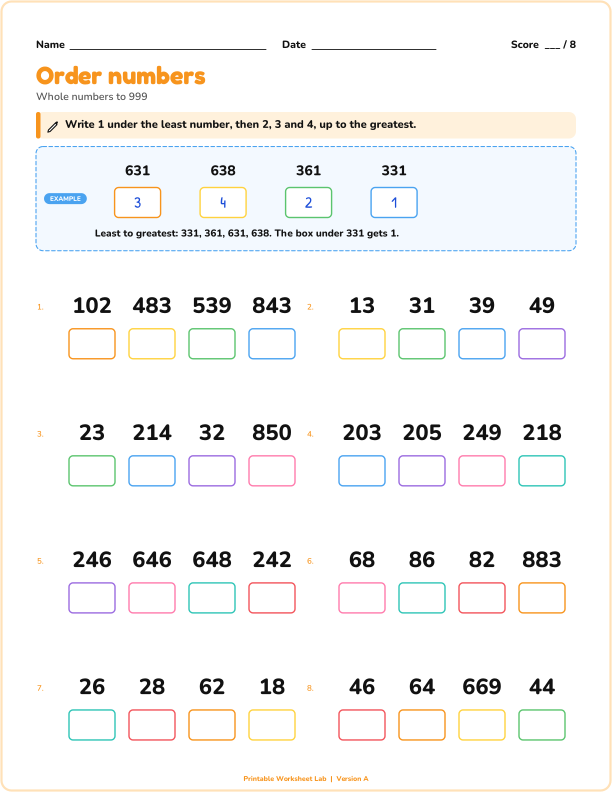
Put three, four or five numbers in order from least to greatest, or greatest to least, by numbering the boxes.
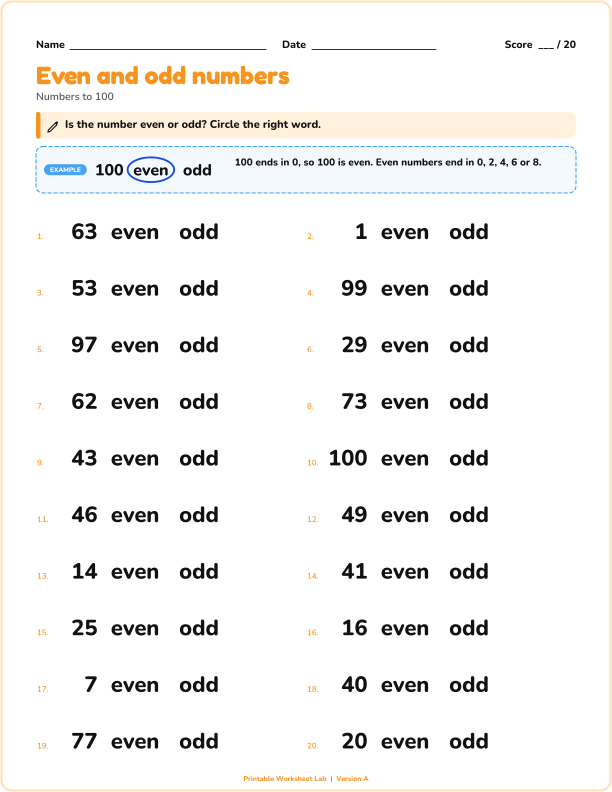
Circle even or odd for each number, or find and circle every even (or odd) number in a grid.
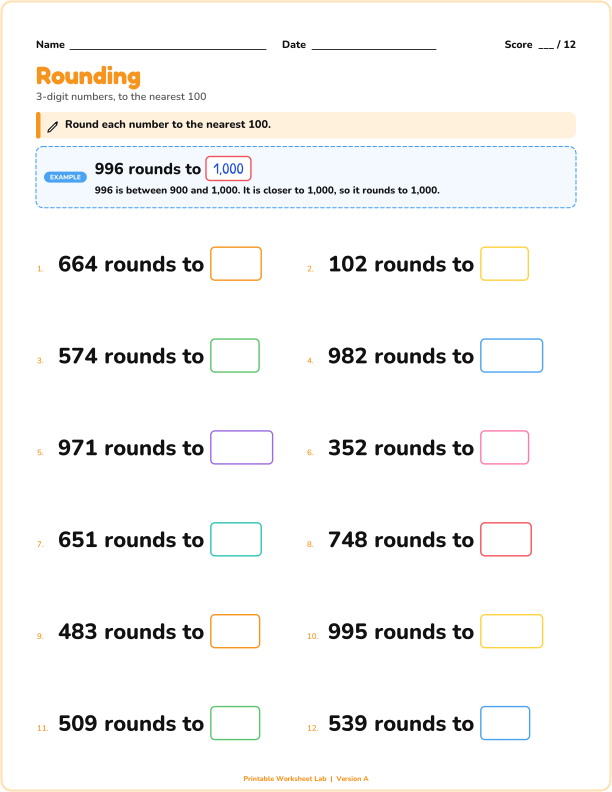
Round whole numbers to the nearest 10, 100, 1,000 or 10,000, or decimals to the nearest whole number, tenth or hundredth, with an optional number line.
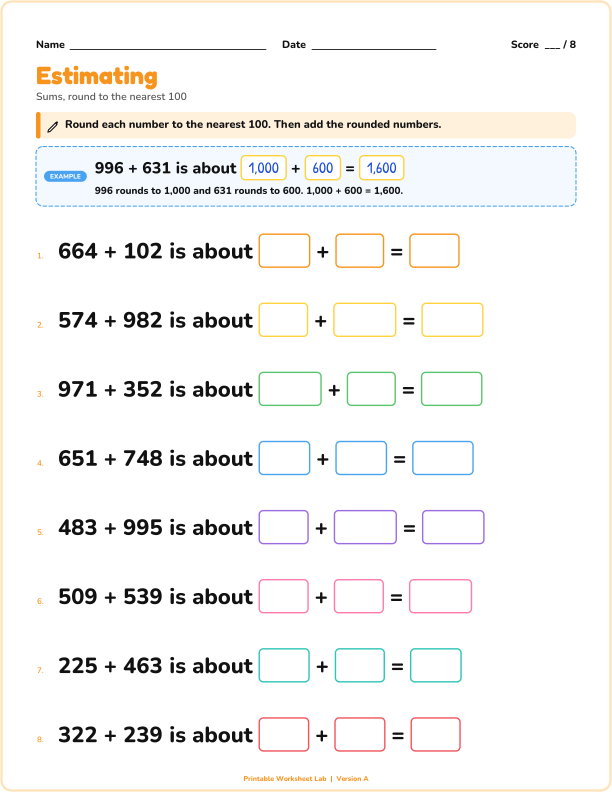
Estimate sums and differences by rounding each number first, to the nearest 10, 100, 1,000 or 10,000.
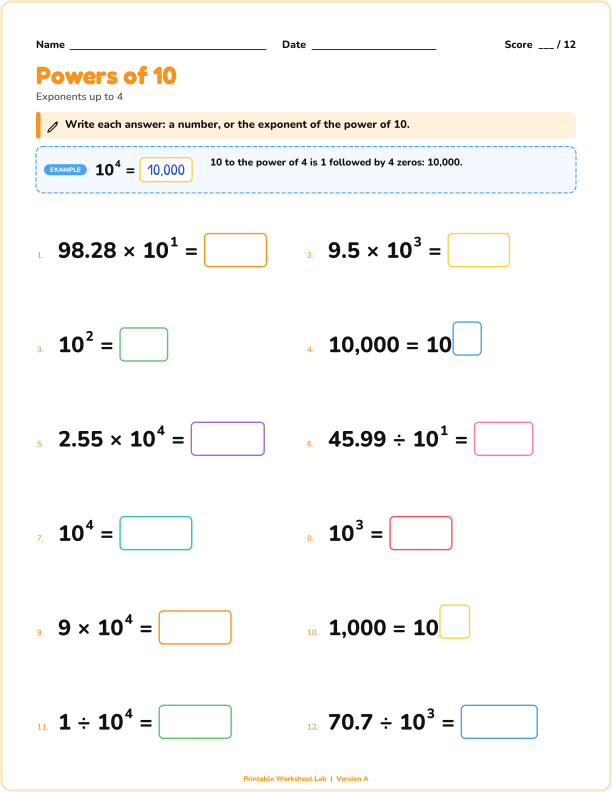
Write powers of 10 as numbers and numbers as powers of 10, and multiply or divide by powers of 10 by moving the decimal point.
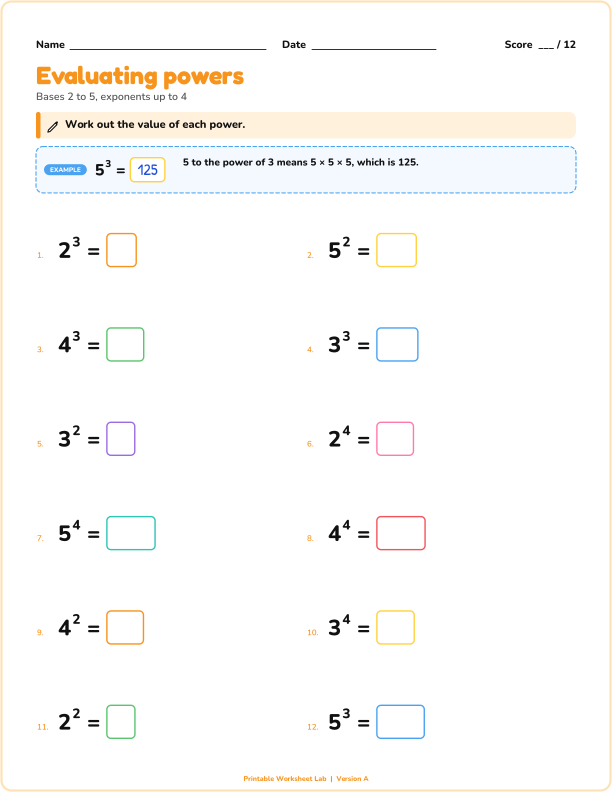
Evaluate powers, or use the exponent rules for products, quotients and powers of powers.
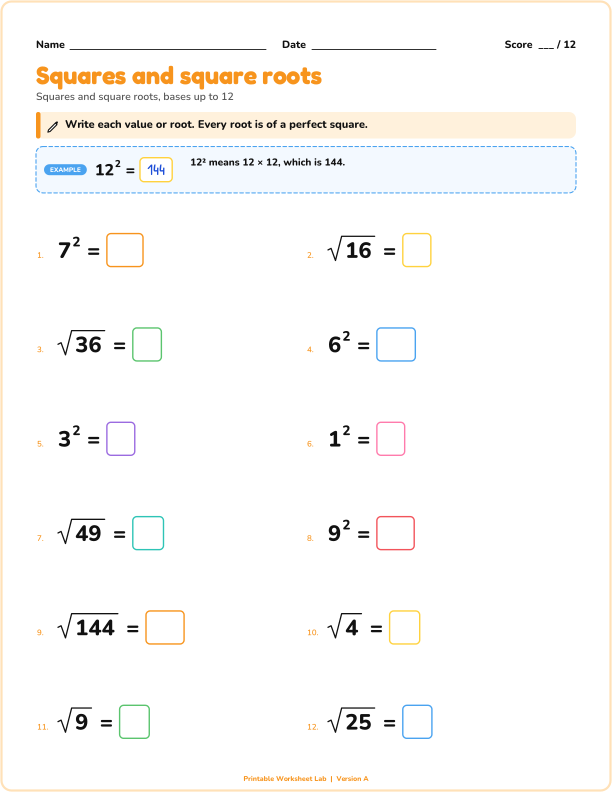
Perfect squares and square roots, cubes and cube roots, and which two whole numbers a root lies between.
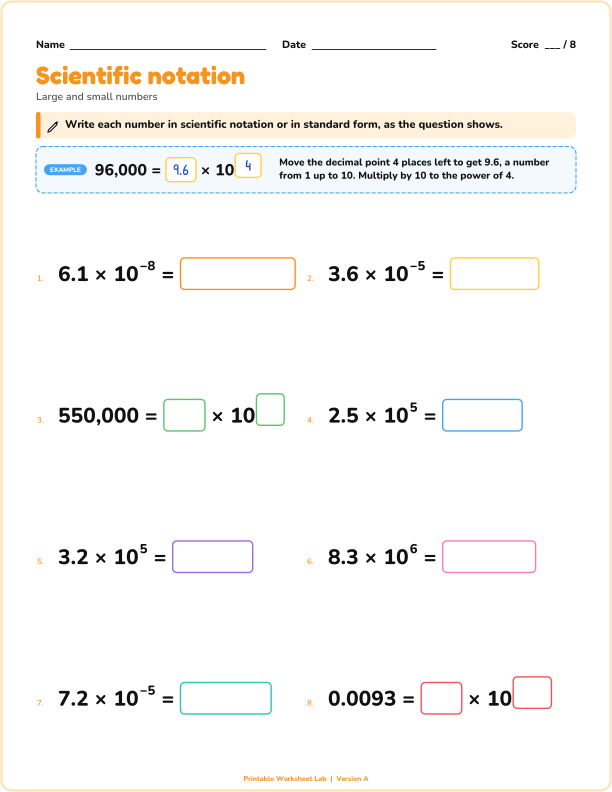
Write large and small numbers in scientific notation, and convert them back to standard form.
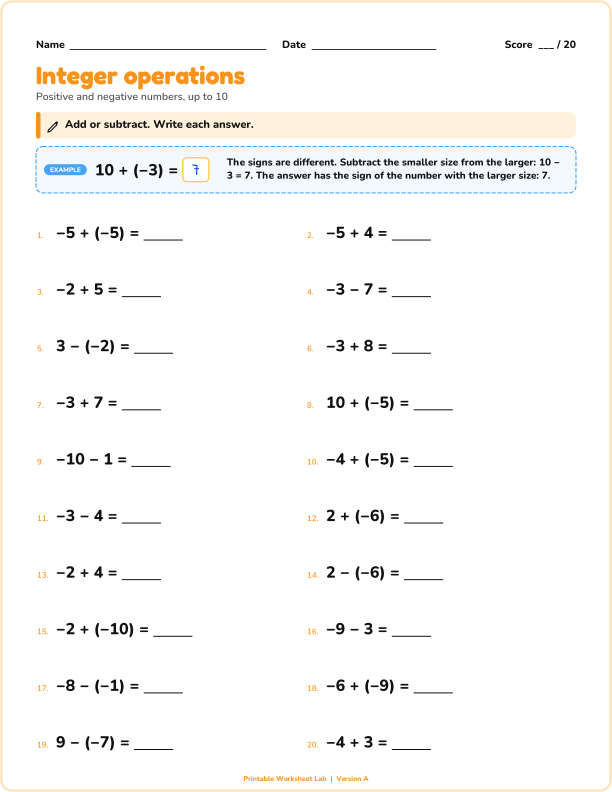
Add, subtract, multiply and divide positive and negative numbers, one operation or all four.
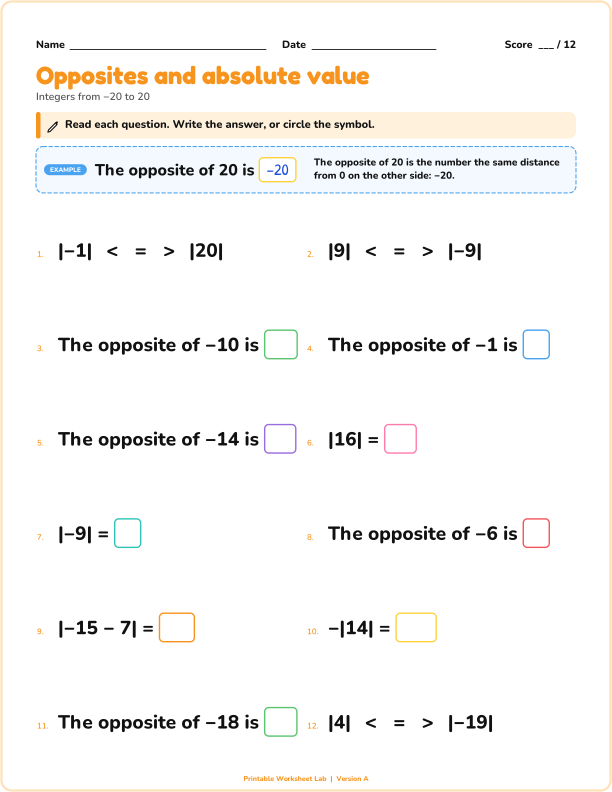
Write the opposite of a number, find an absolute value, compare absolute values and work out expressions with absolute value.
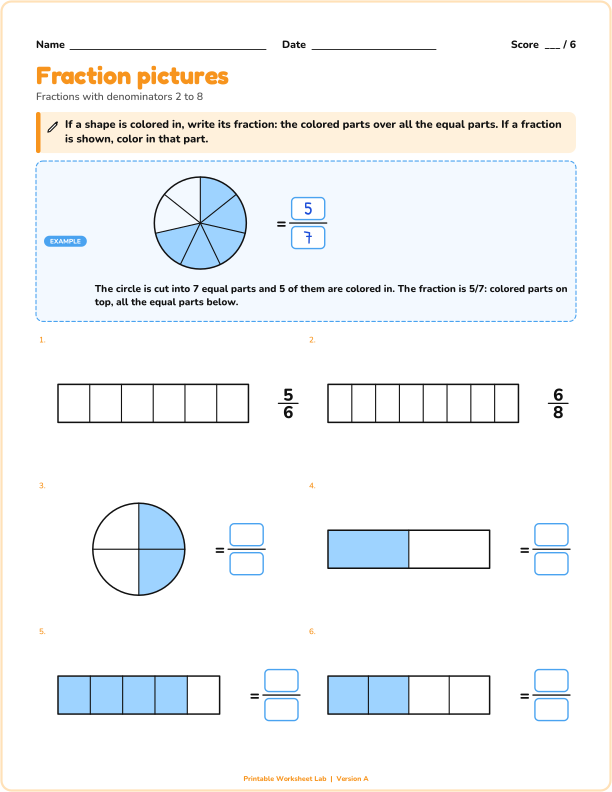
Write the fraction shown on a bar or circle, or color in the fraction named, with denominators from 2 to 12.
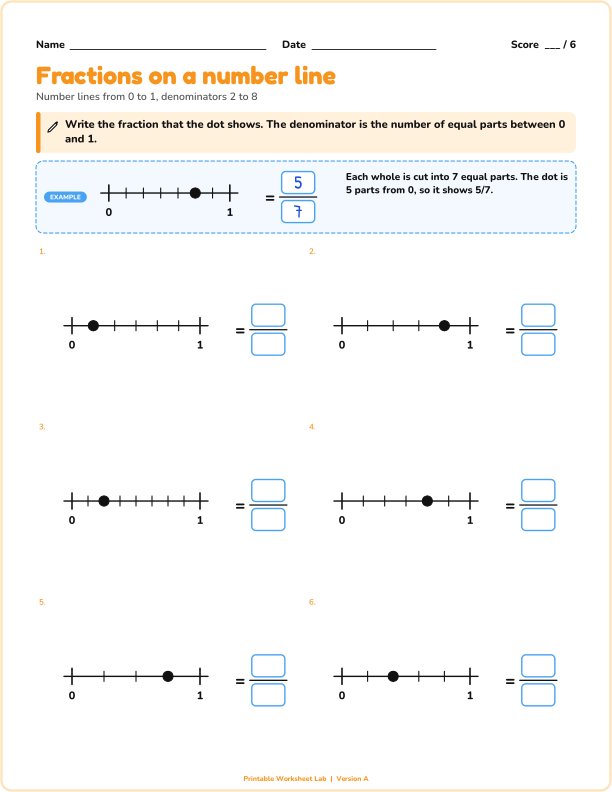
Read the fraction a dot shows on a number line, or mark a named fraction, on lines from 0 to 1 or 0 to 2.
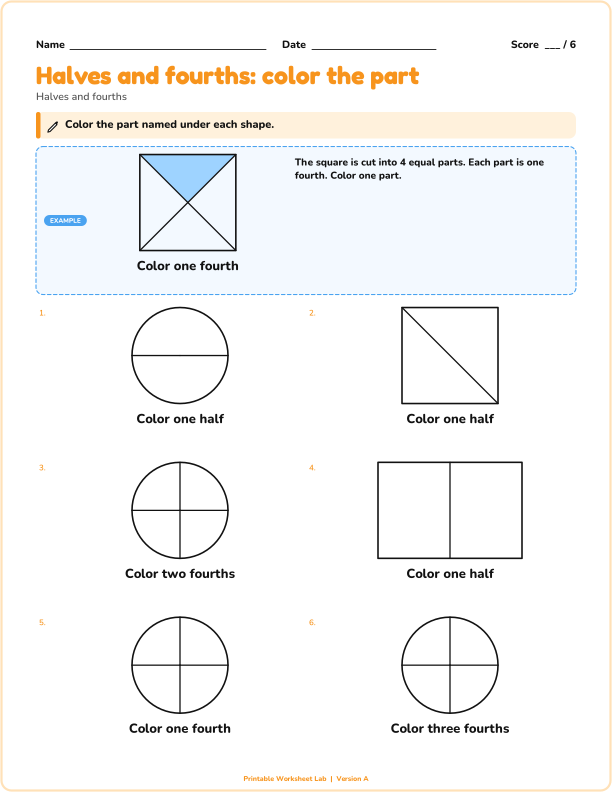
Color the part named, spot the shape cut into equal parts, count the equal shares, or name the colored part, on circles, rectangles and squares.
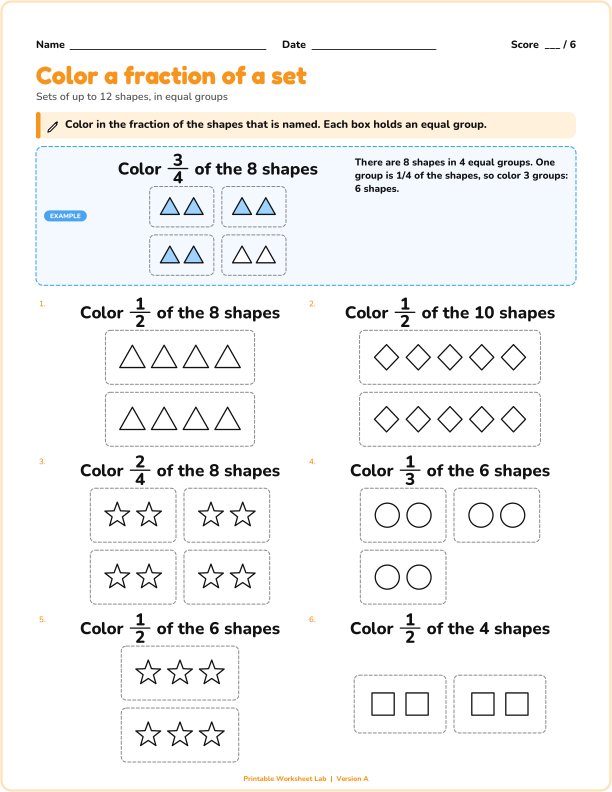
Color a fraction of a group of shapes, write the fraction that is colored, or find a fraction of a number with equal groups to help.
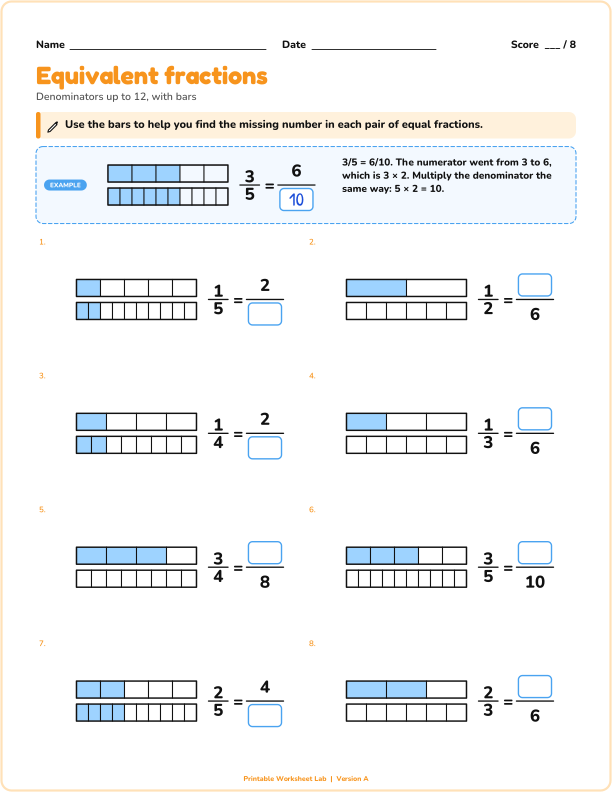
Find the missing numerator or denominator in a pair of equal fractions, with matching bar pictures or without.
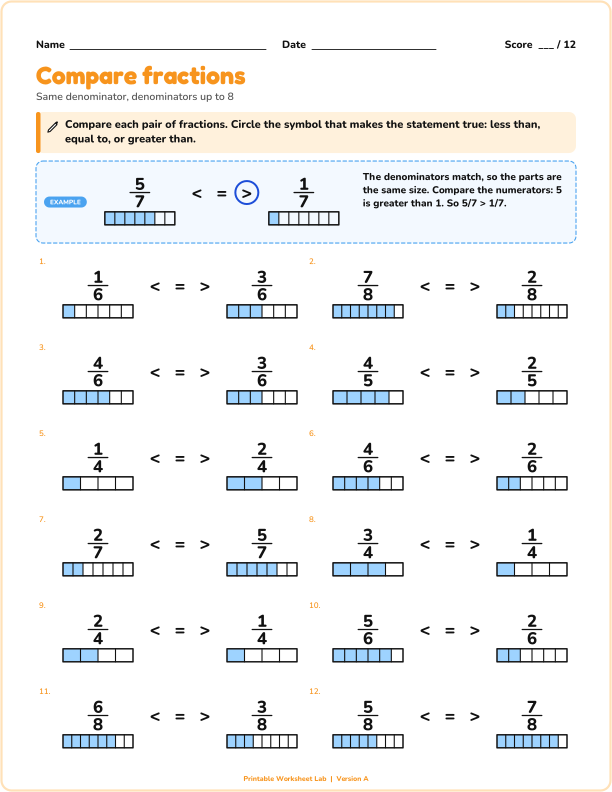
Compare two fractions with the same denominator, the same numerator, a benchmark of one half, or any denominators.
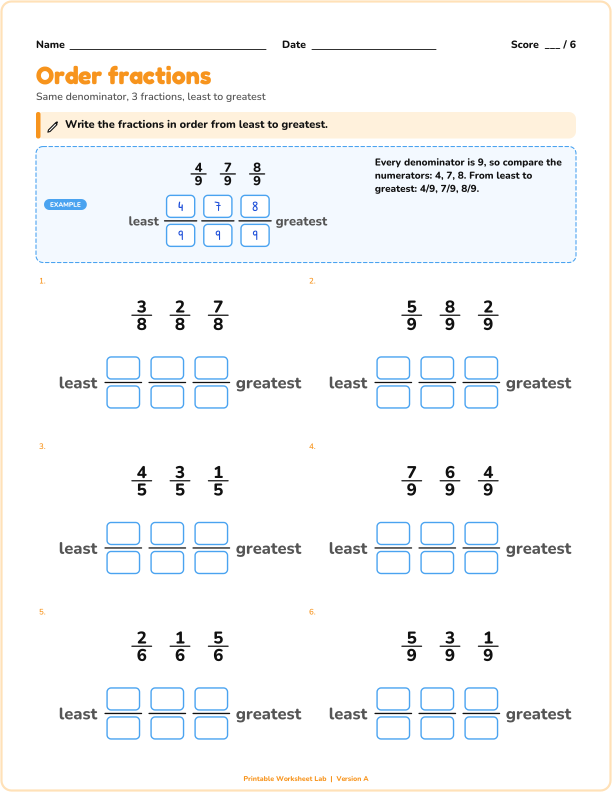
Write three or four fractions in order, least to greatest or greatest to least.
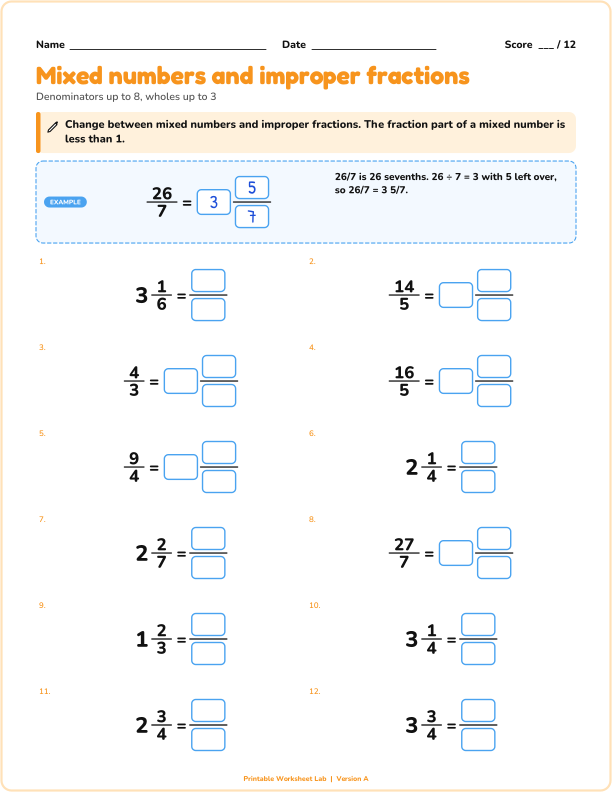
Change improper fractions to mixed numbers and mixed numbers to improper fractions, with optional bar pictures.
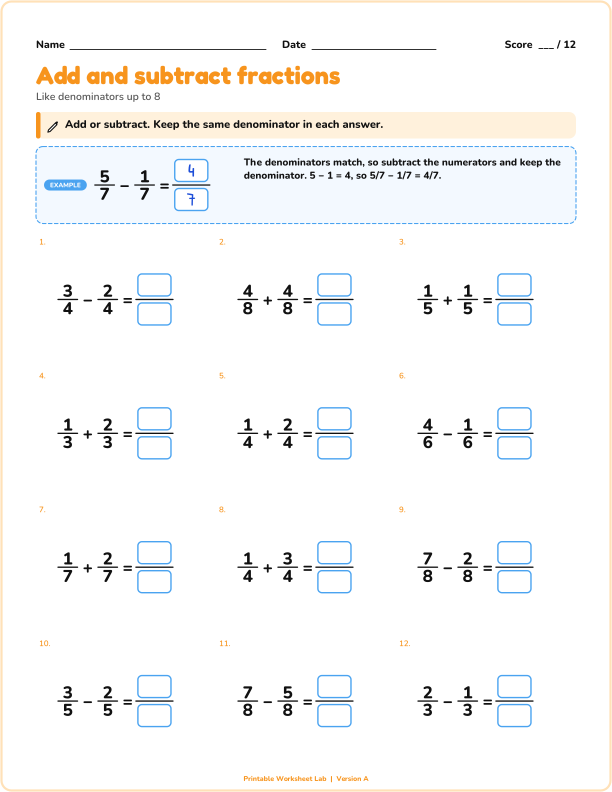
Add and subtract fractions or mixed numbers with like denominators, or with unlike denominators in lowest terms.
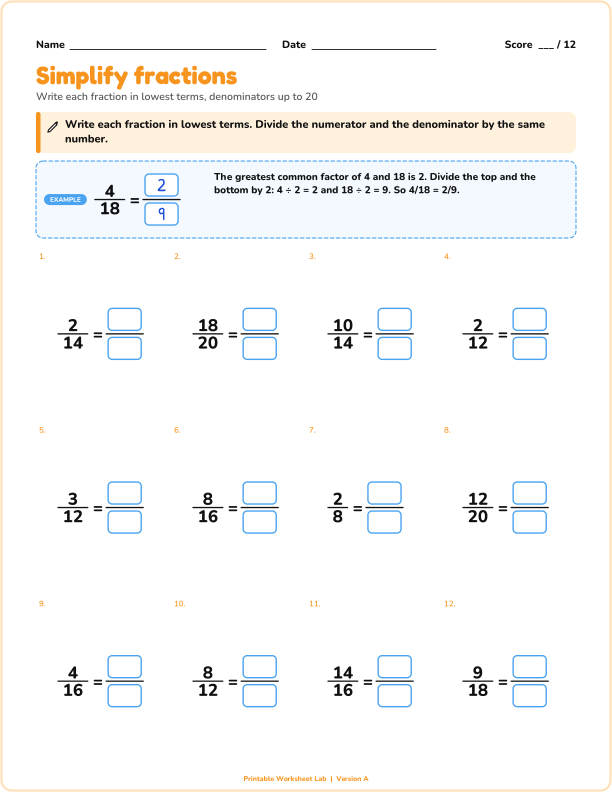
Write fractions in lowest terms by dividing the numerator and denominator by their greatest common factor.
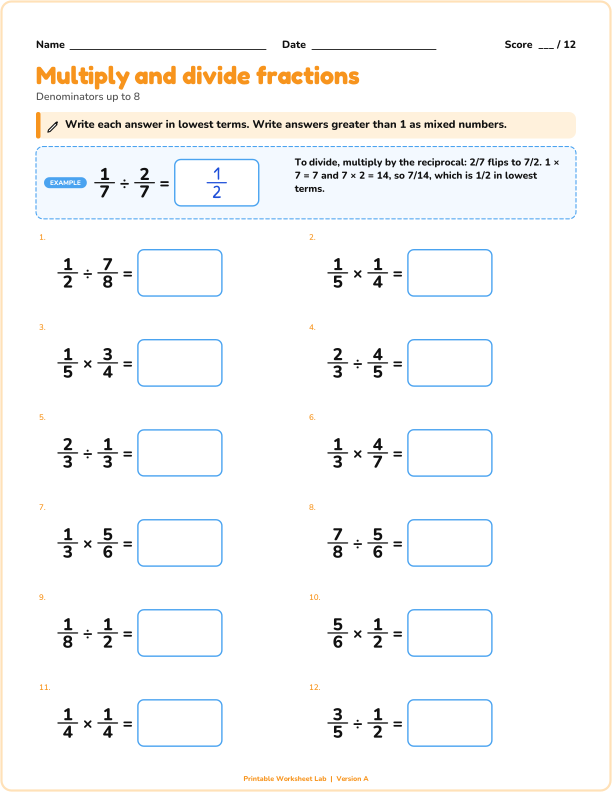
Multiply and divide fractions, fractions with whole numbers, and mixed numbers, with answers in lowest terms.
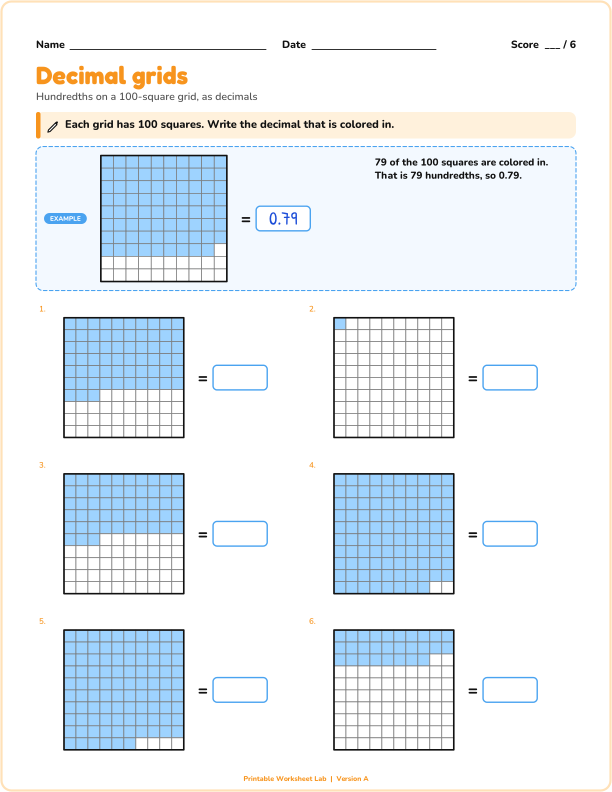
Color in a decimal, fraction or percent on a 100-square grid, or write the decimal, fraction or percent that is colored in.
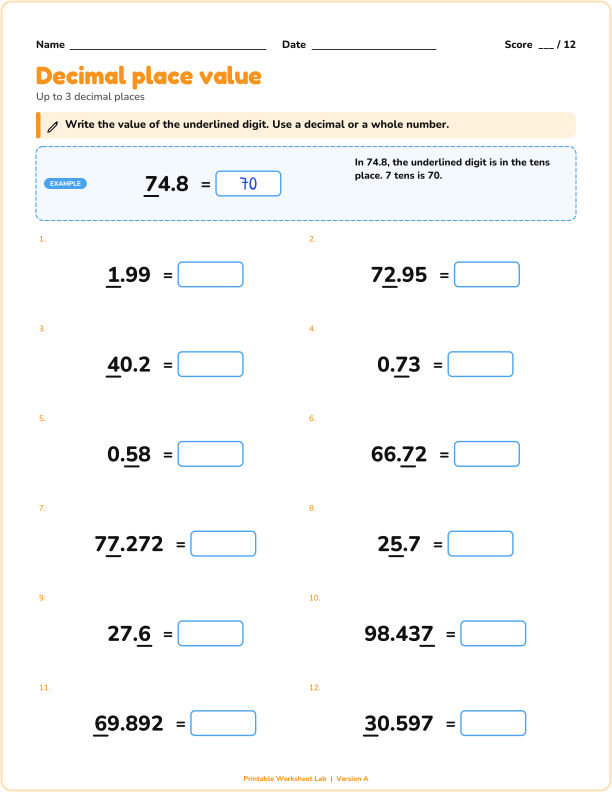
Name the value of a digit, write numbers in standard form, compare, round, and multiply or divide by 10, 100 and 1000.
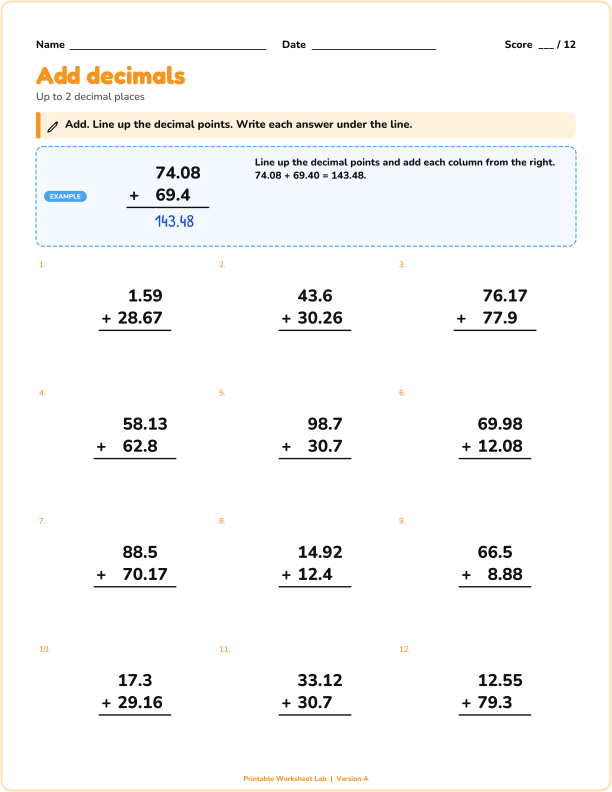
Stacked decimal addition and subtraction with the points lined up, plus multiplying and dividing decimals with exact answers.
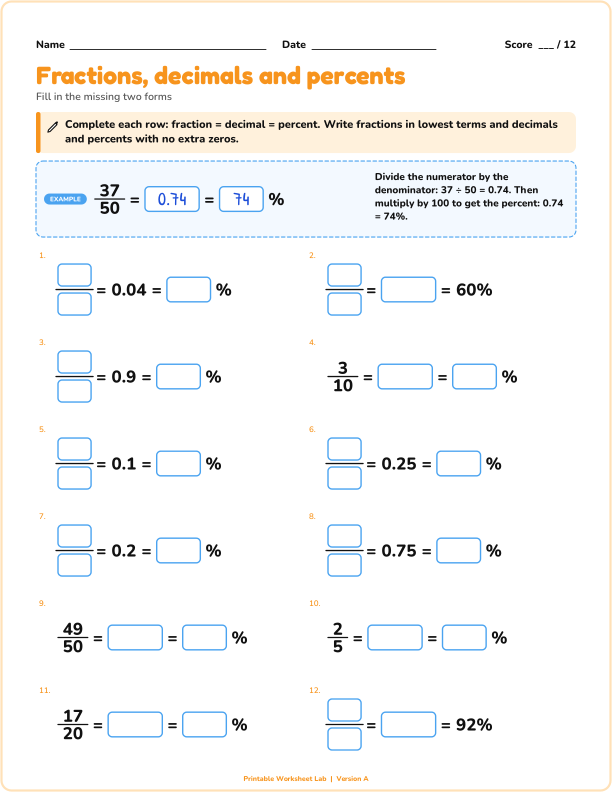
Complete each row of equal fractions, decimals and percents, starting from the fraction, the decimal or the percent.
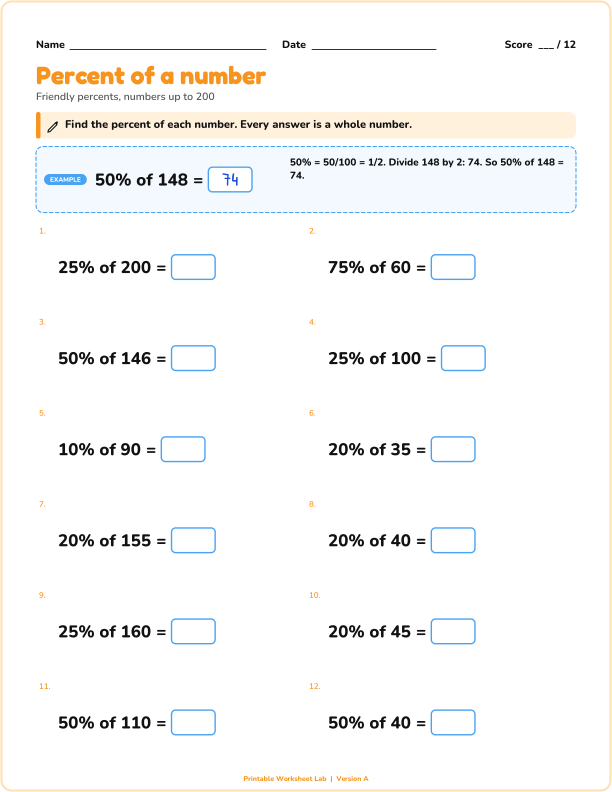
Find a percent of a number, find what percent one number is of another, or find the whole from a percent.
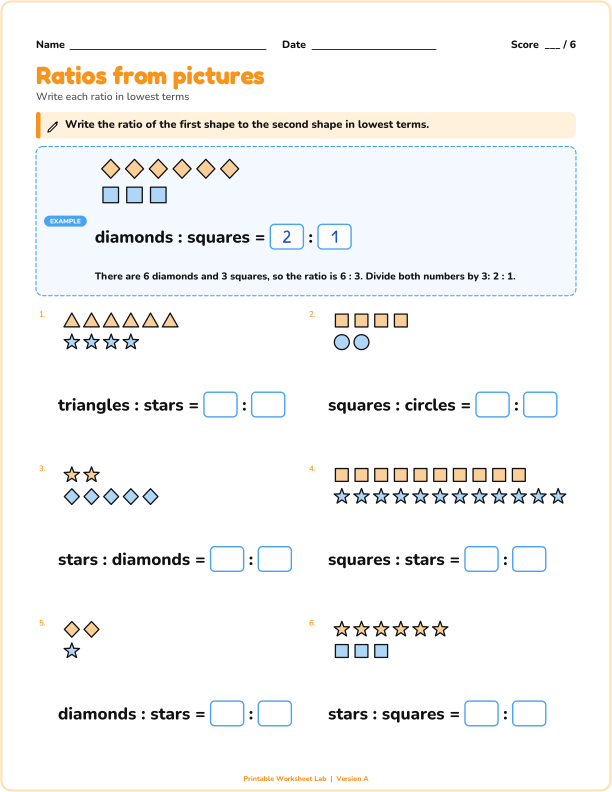
Write ratios from pictures in lowest terms, fill in equivalent ratio tables, or simplify ratios.
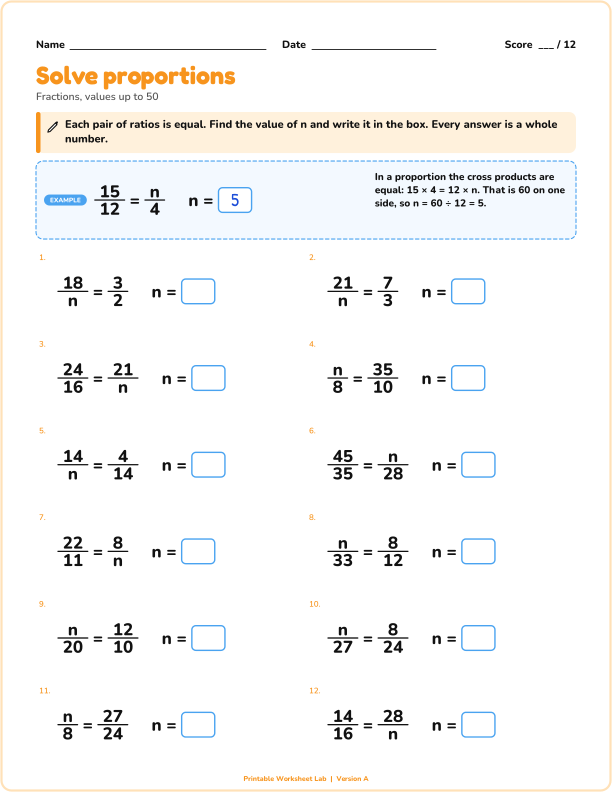
Find the missing value n in a proportion written with fractions or with colons.
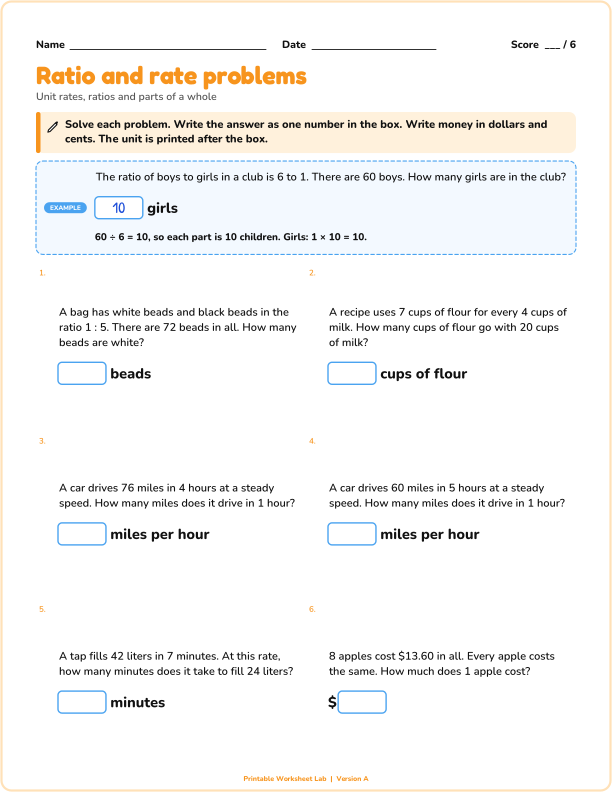
Short word problems on unit rates, equal rates, equivalent ratios and parts of a whole, each with one numeric answer.
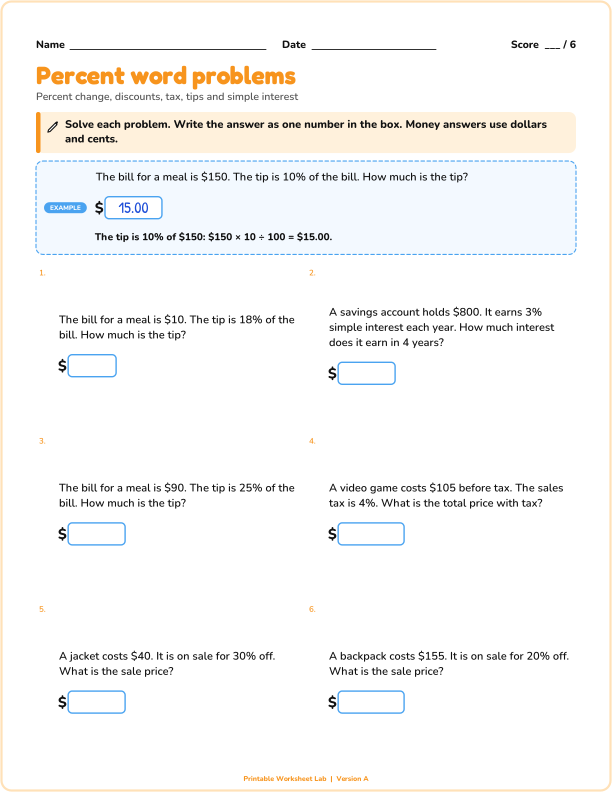
Word problems on percent increase and decrease, sale prices, sales tax, tips and simple interest, each with one answer.
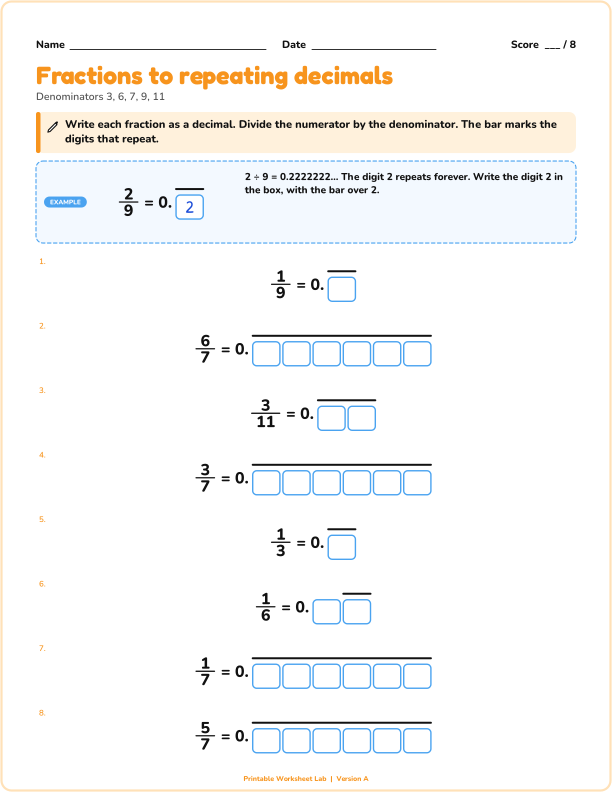
Write fractions with denominators 3, 6, 7, 9 and 11 as repeating decimals, or write repeating decimals as fractions.
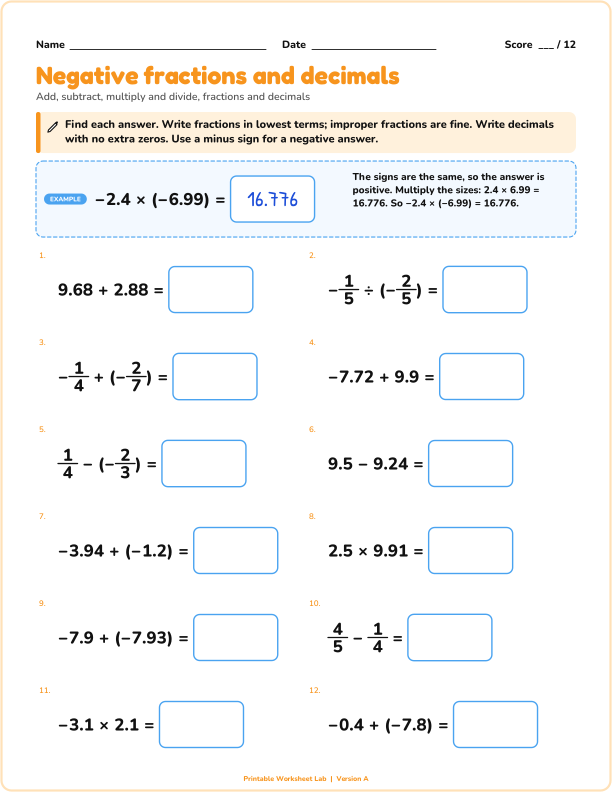
Add, subtract, multiply and divide positive and negative fractions and decimals, with answers in lowest terms.
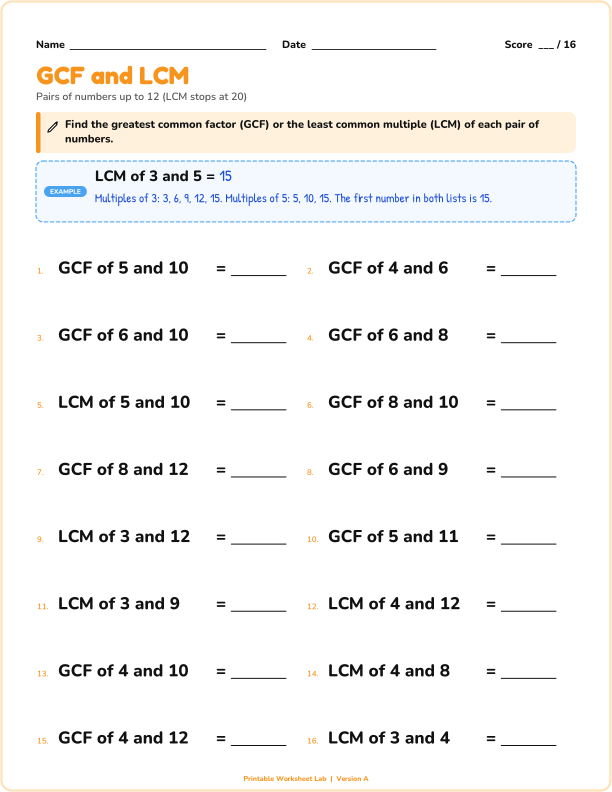
Find the GCF, the LCM, or both for pairs of whole numbers.
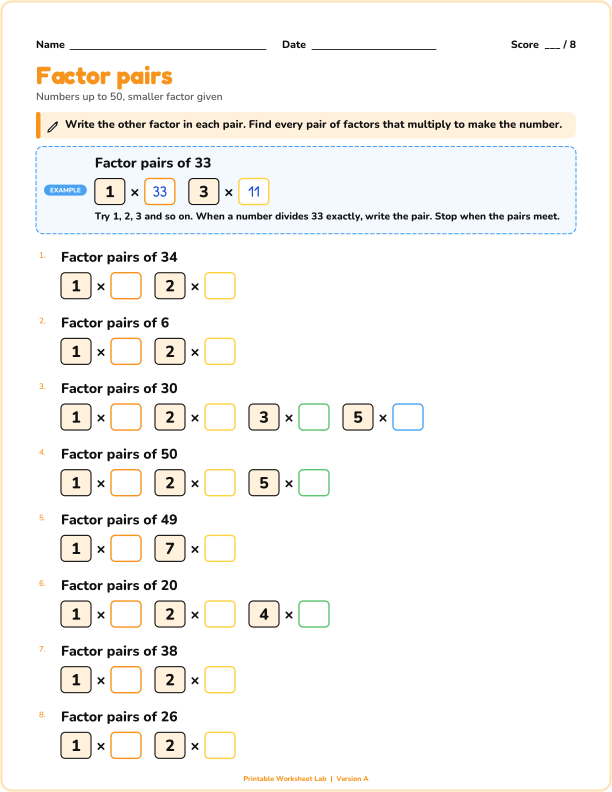
Find every pair of factors that multiply to make a number.
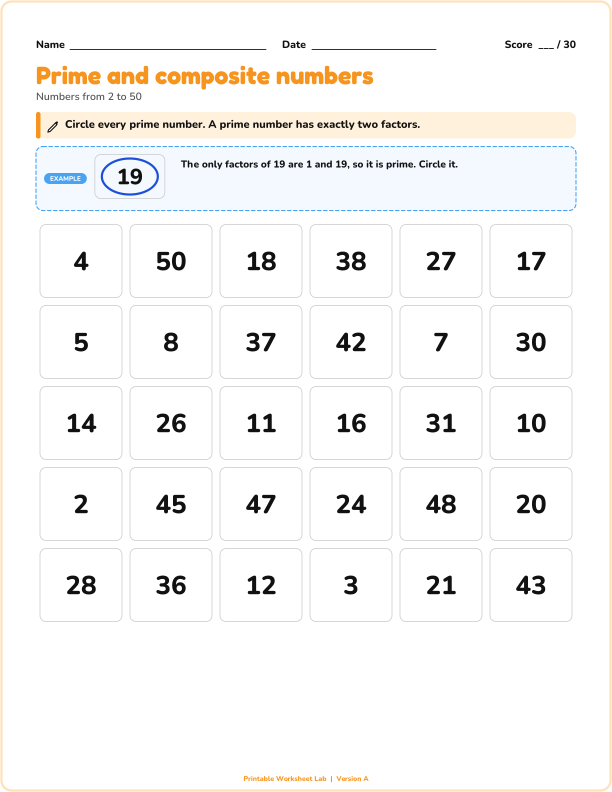
Circle the prime or composite numbers, or tick prime or composite for each number.
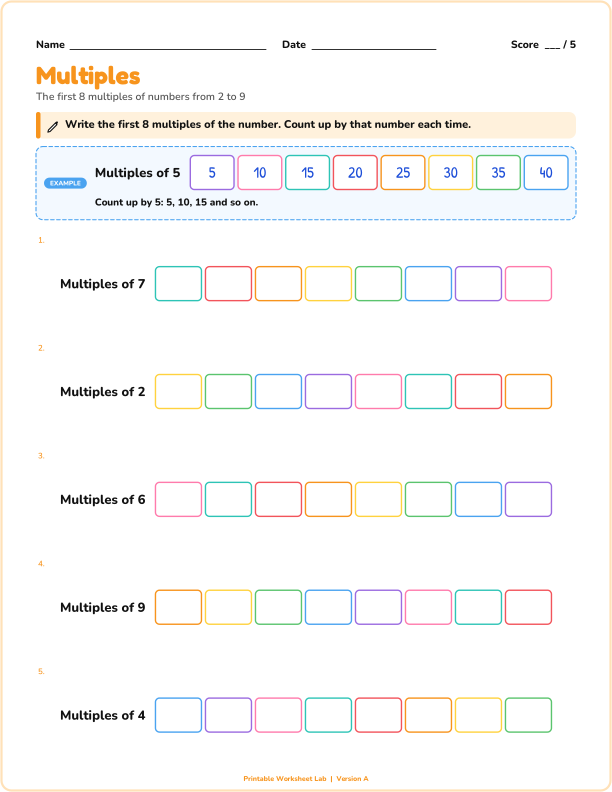
Write the multiples of a number, or the multiples two numbers have in common.
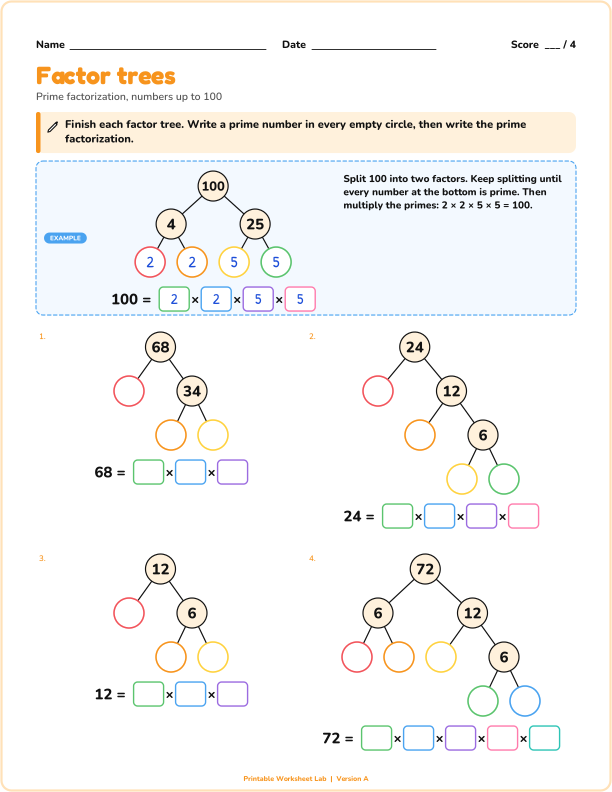
Finish each factor tree, then write the number as a product of primes.
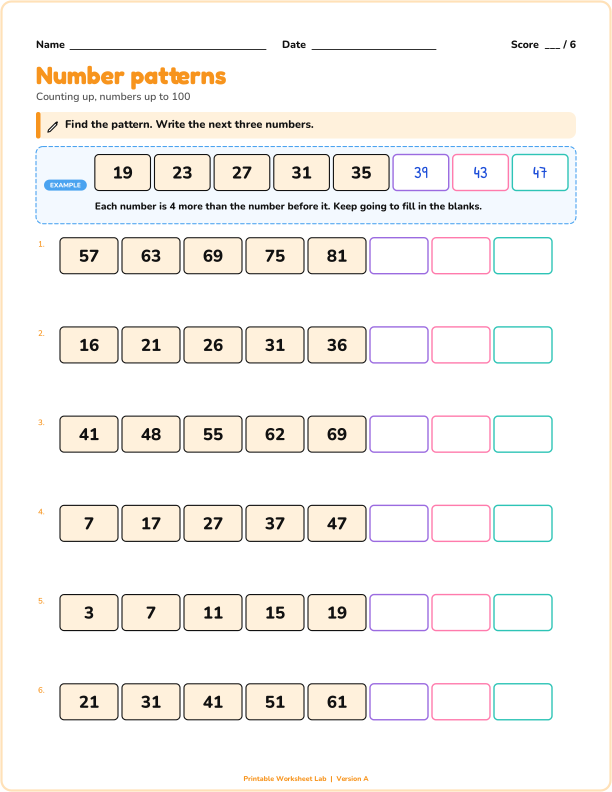
Continue number patterns, fill in missing numbers, or find the rule: counting up, counting down and multiplying.
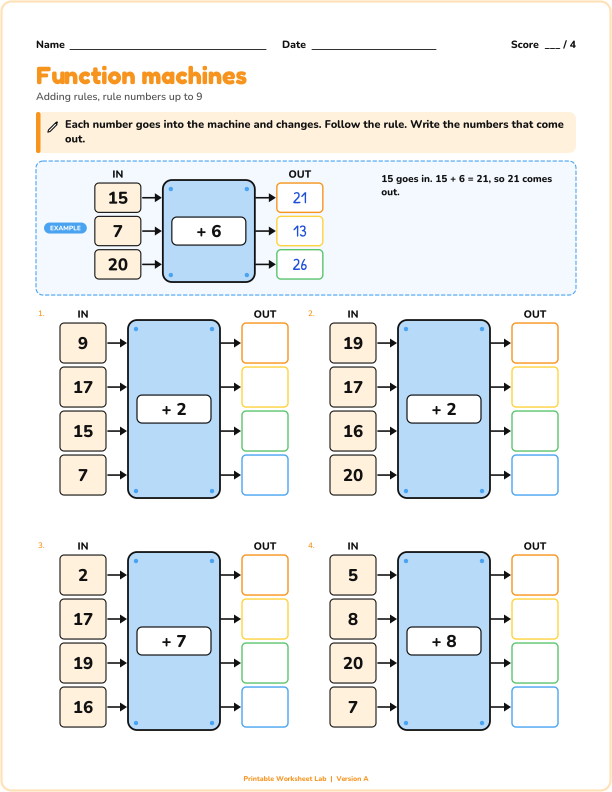
Numbers go into a machine and change by a rule: find what comes out, what went in, or the rule itself.
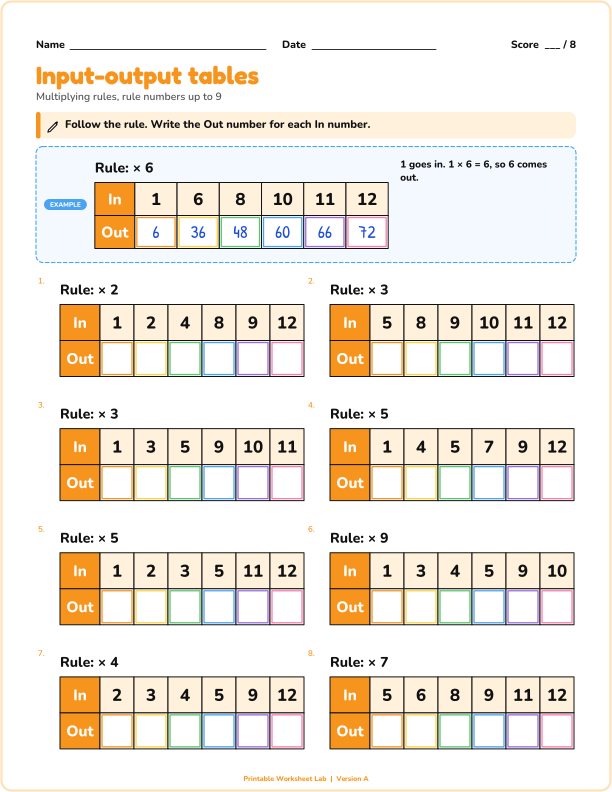
Complete In and Out tables from a rule, work backwards, find the rule, or fill in simple ratio tables.
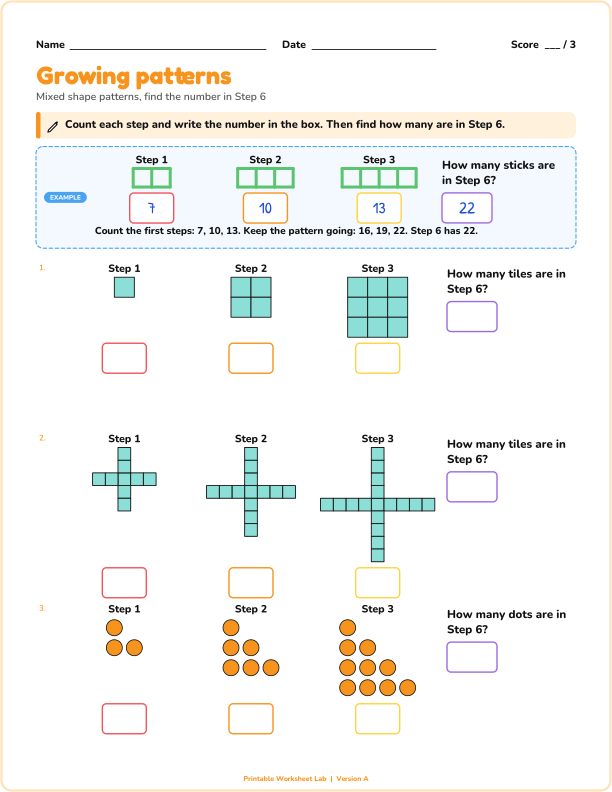
Count the steps of a growing pattern of tiles, dots or matchsticks, then find how many are in a later step.
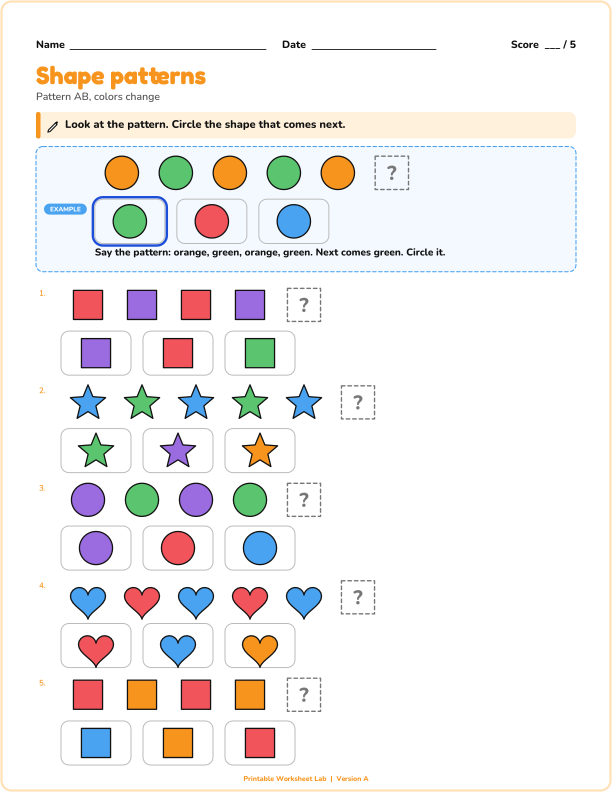
Continue AB, AAB, ABB, ABC and AABB patterns of colored shapes by coloring or circling what comes next.
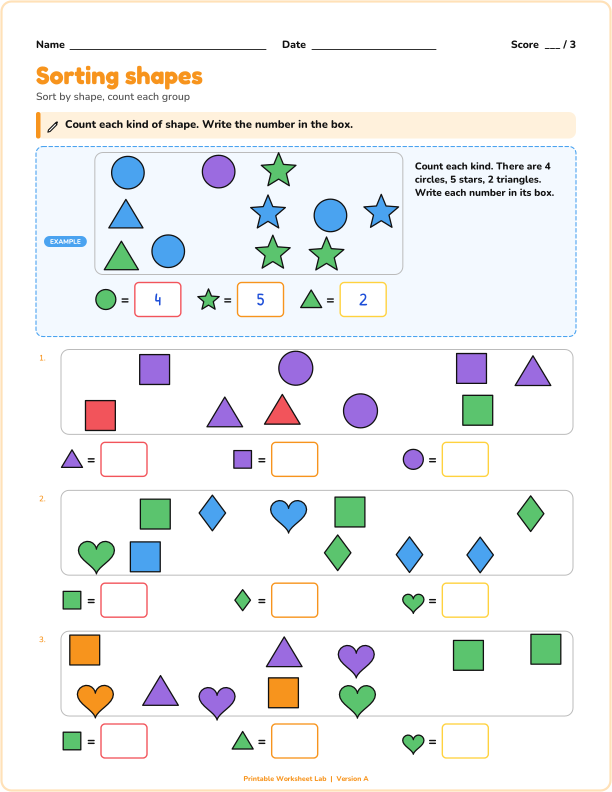
Sort a group of shapes by one attribute: count each kind, or circle every shape that matches.
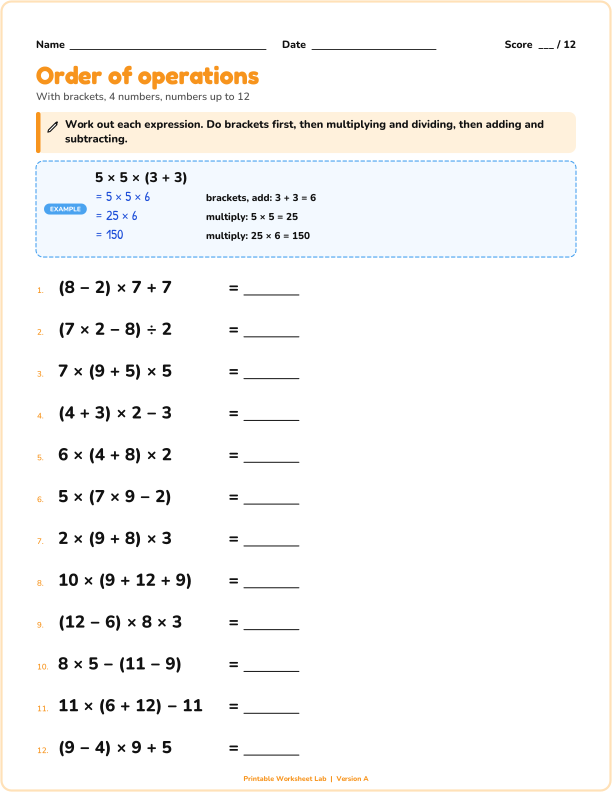
Evaluate expressions with brackets and exponents. Every expression has exactly one value.
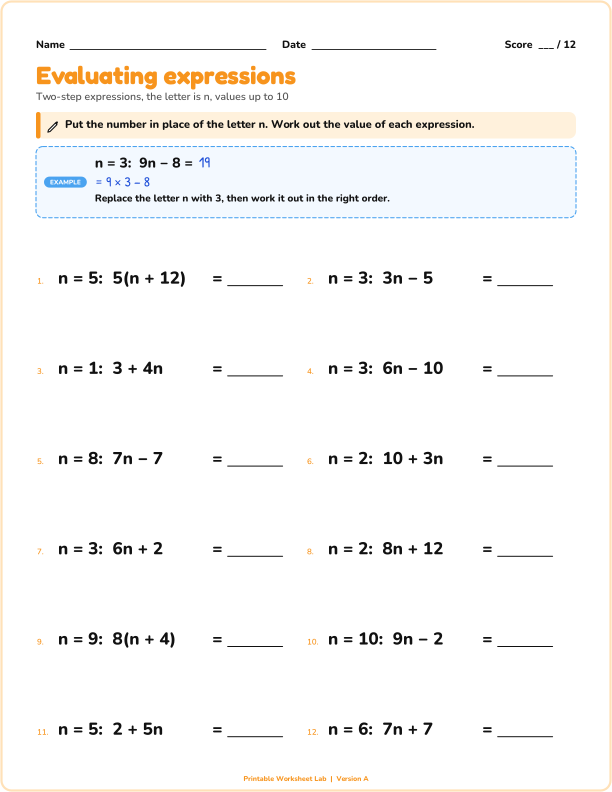
Evaluate expressions by replacing a letter with a number, or match a phrase to the expression it describes.
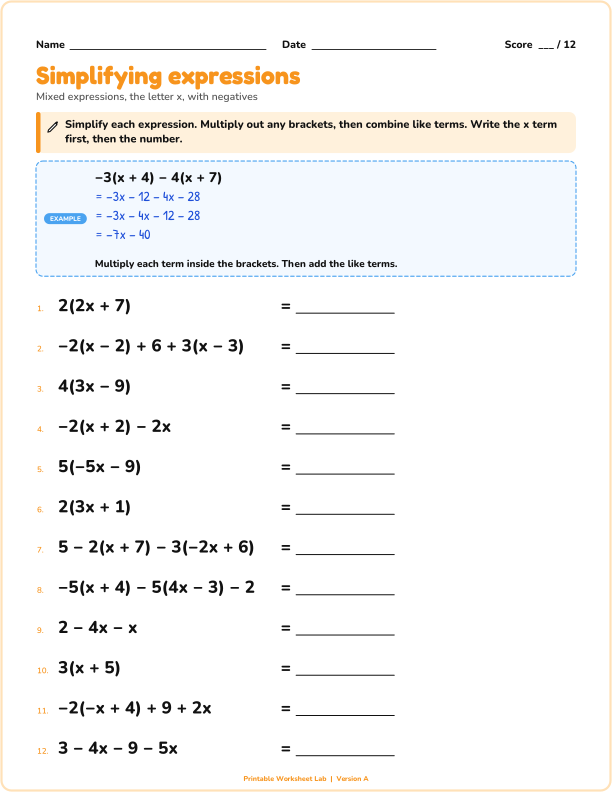
Combine like terms and use the distributive property to write each expression in its simplest form.
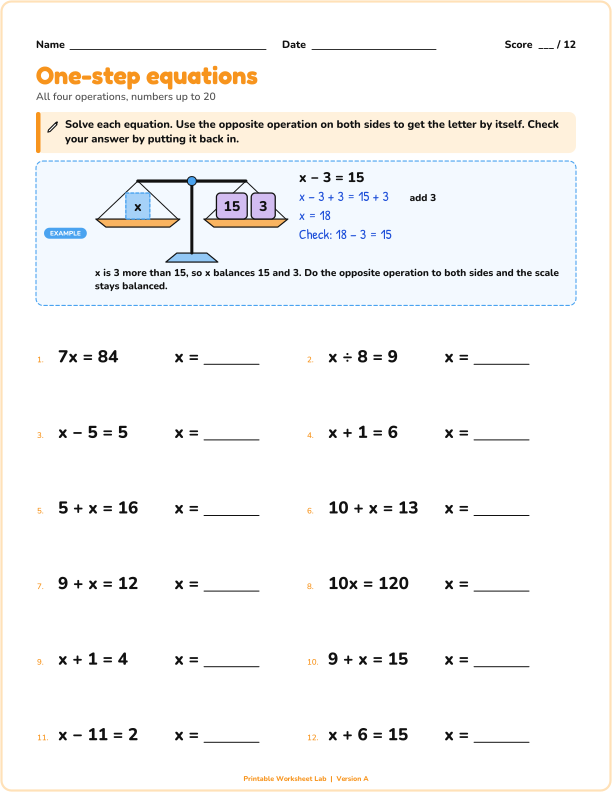
Solve equations with one operation: add, subtract, multiply or divide. The solved example can show a balance scale.
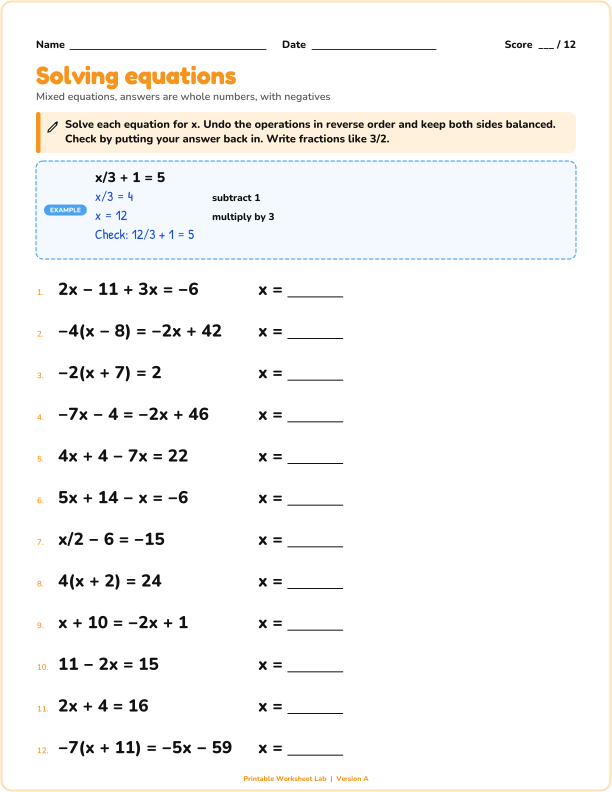
Solve two-step equations, equations with brackets, and equations with the letter on both sides.
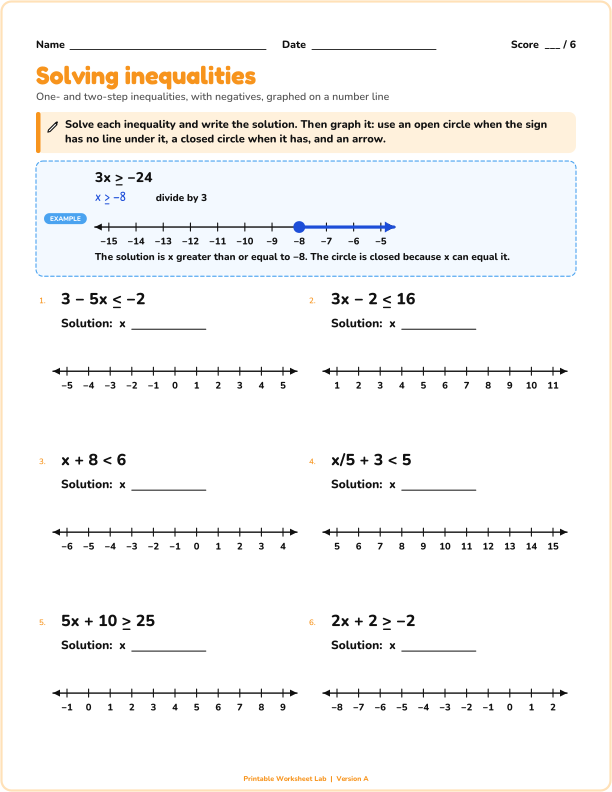
Solve one-step and two-step inequalities and graph the solution on a number line.
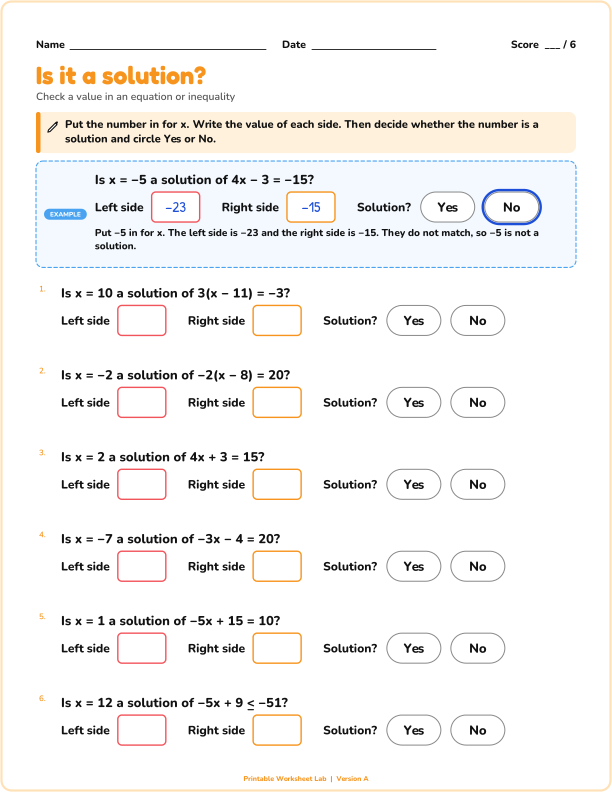
Substitute a number into an equation or inequality, find each side, and decide whether it is a solution.
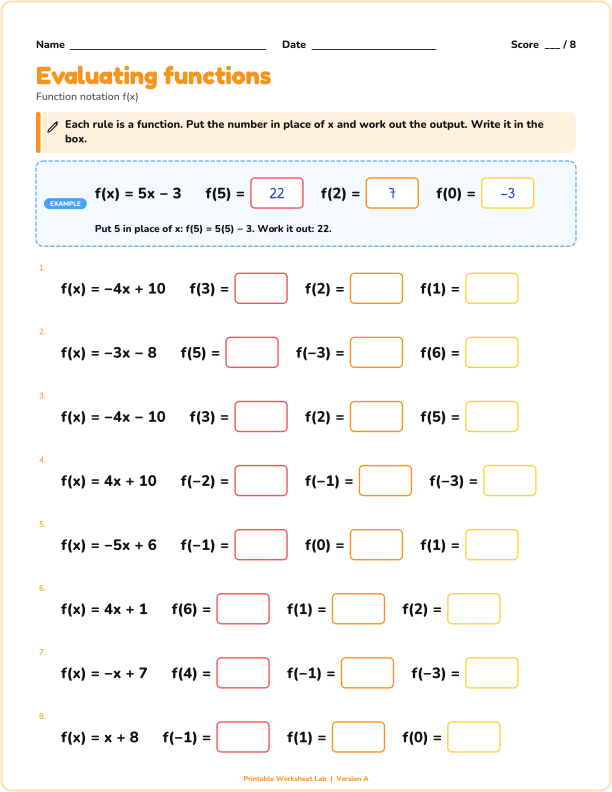
Find outputs of linear functions using f(x) notation, or complete a table from a rule.
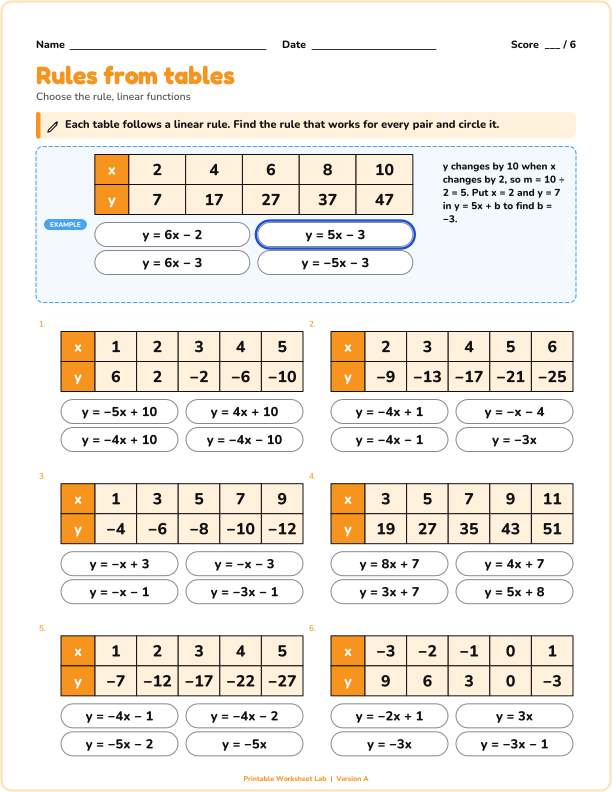
Find the rule y = mx + b from a table: choose it from four, write m and b, or use the pattern to fill in missing values.
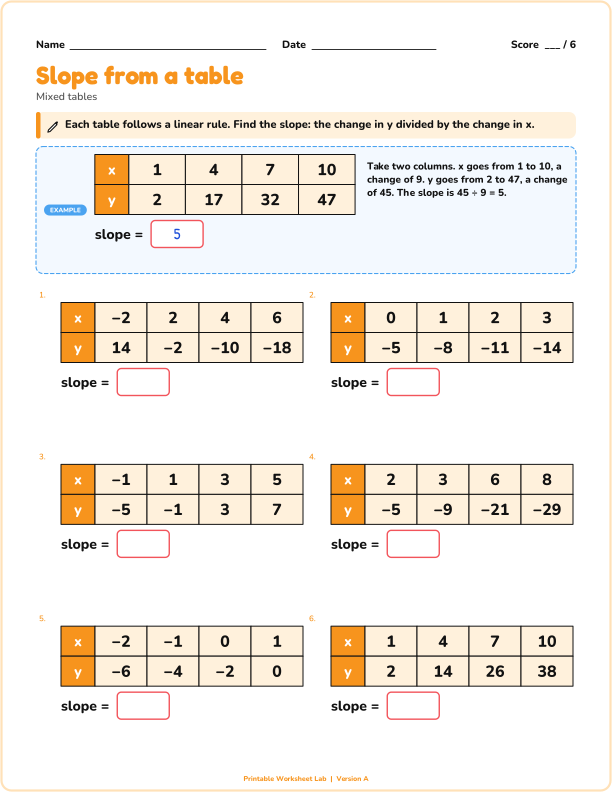
Find the slope of a linear function from a table of values, and optionally the value of y when x is 0.
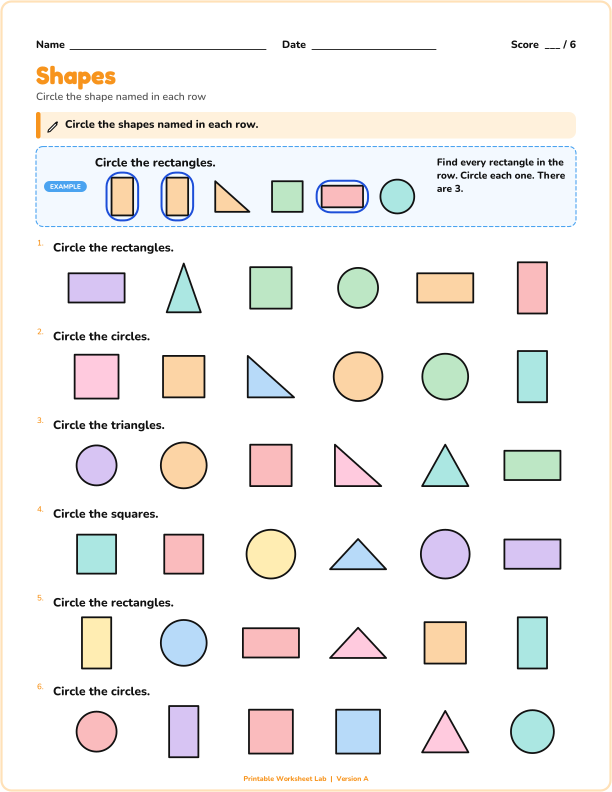
Circle or color the circles, squares, triangles and rectangles hidden in each row.
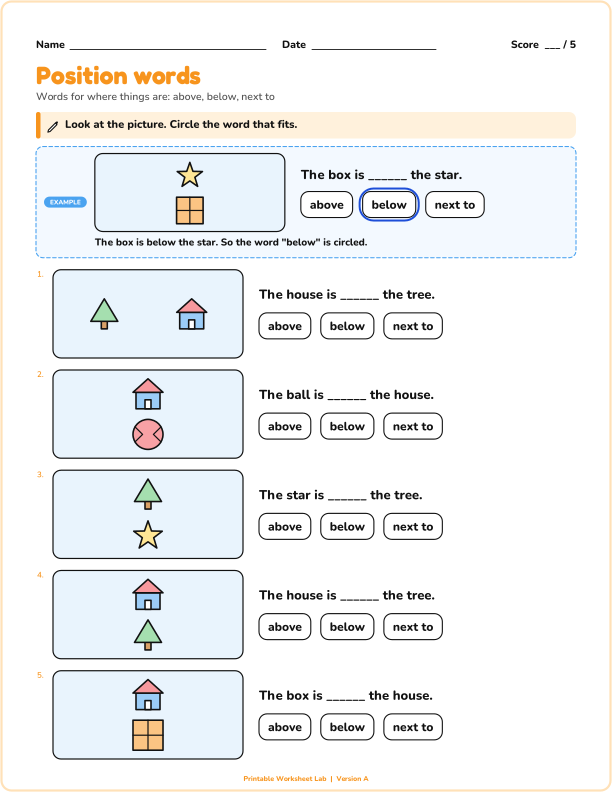
Above, below, next to, left of and right of: read a picture and circle the word that fits.
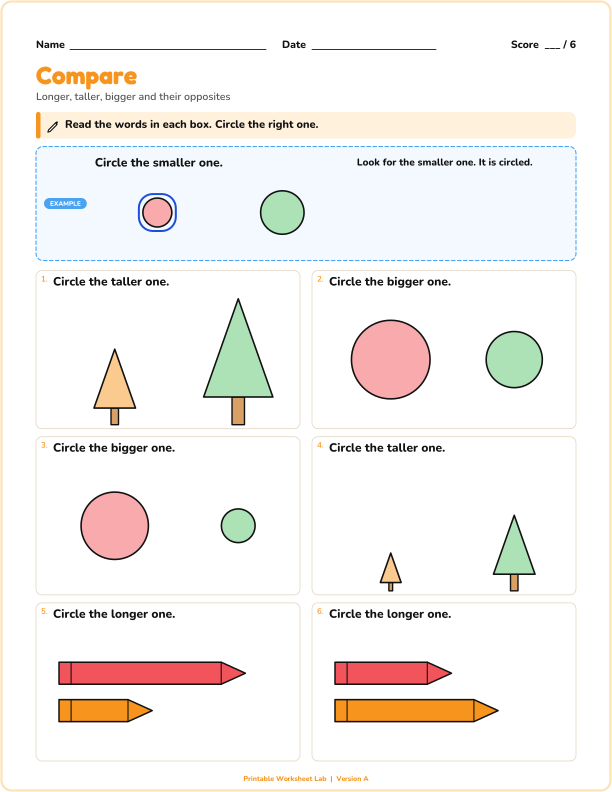
Longer, shorter, taller, bigger: circle the pencil, tree or circle that fits the word.
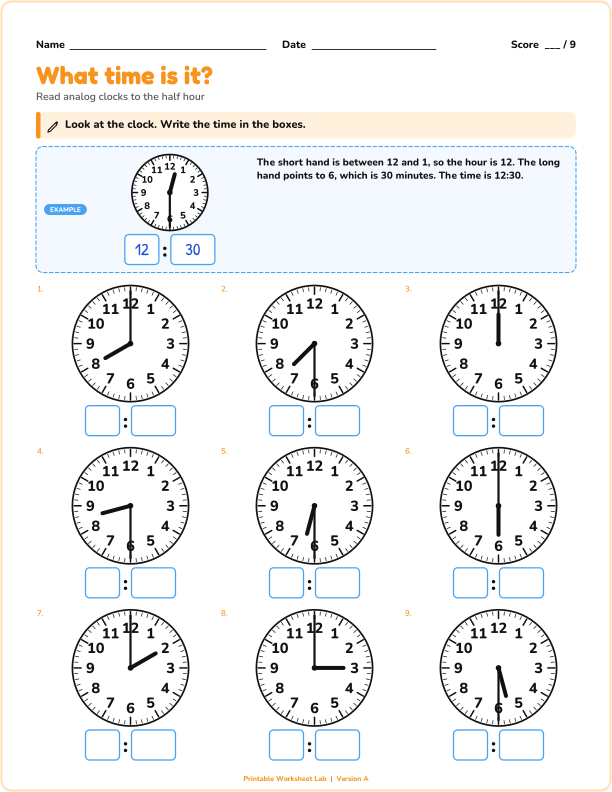
Read analog clocks to the hour, half hour, quarter hour, five minutes or the minute, and write the time.
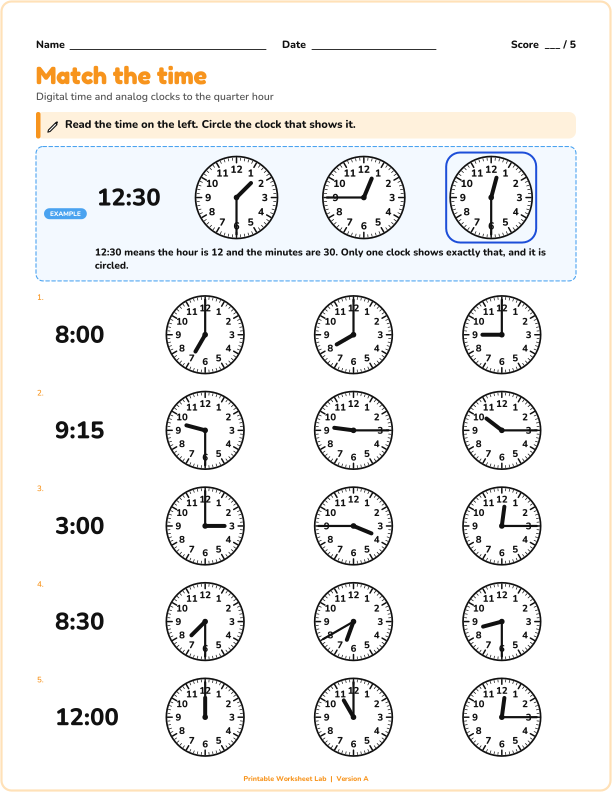
A digital time is given. Circle the analog clock that shows it among near misses.
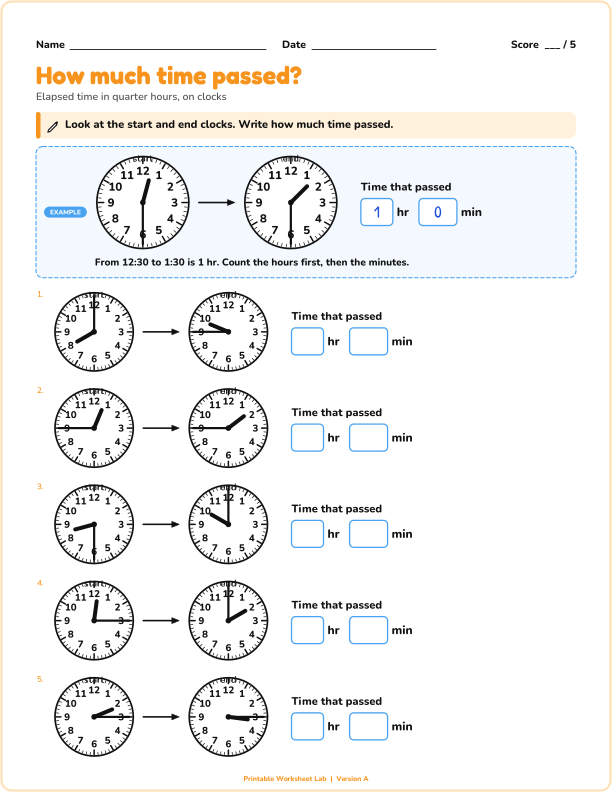
Find how much time passed, or what time it will be, from clocks or a timeline.
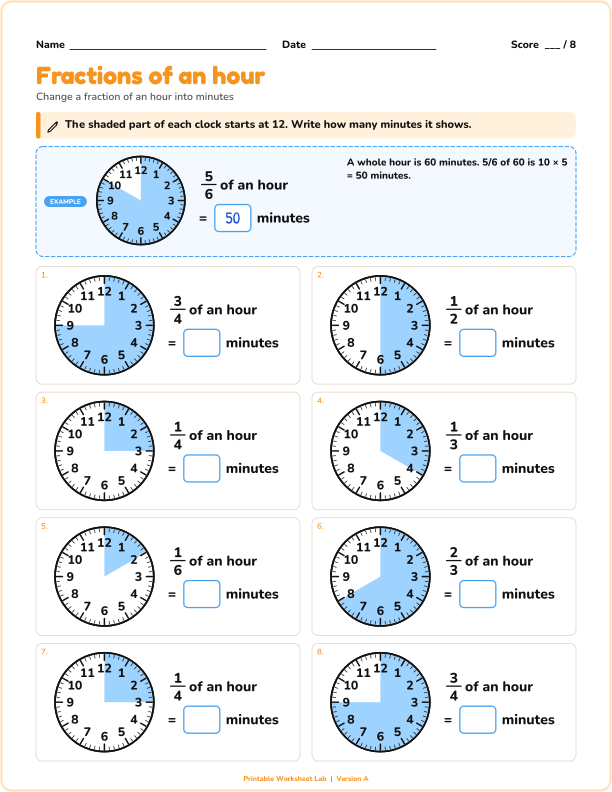
Shaded clocks show a fraction of an hour. Write the minutes, or write the fraction.
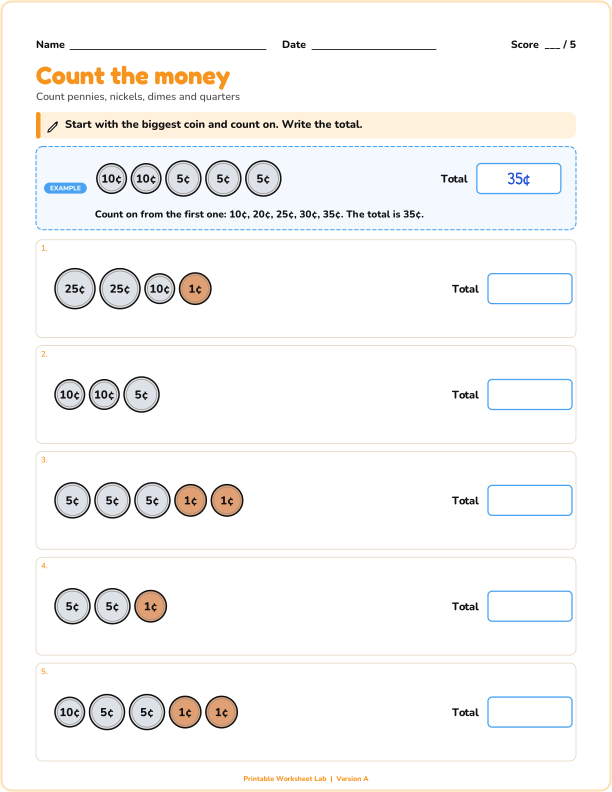
Count a set of coins and bills, circle the coins that make an amount, or find the change.
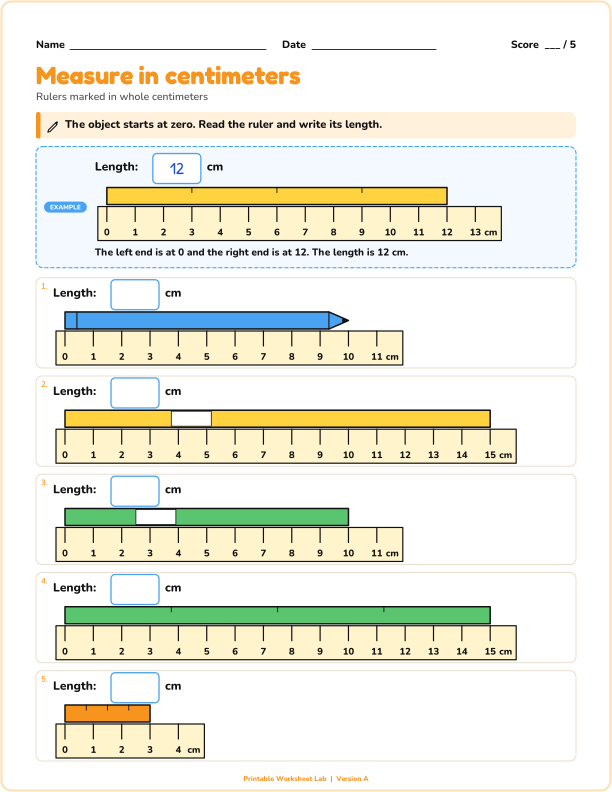
Read the length of a pencil, strip or crayon against a centimeter or inch ruler.
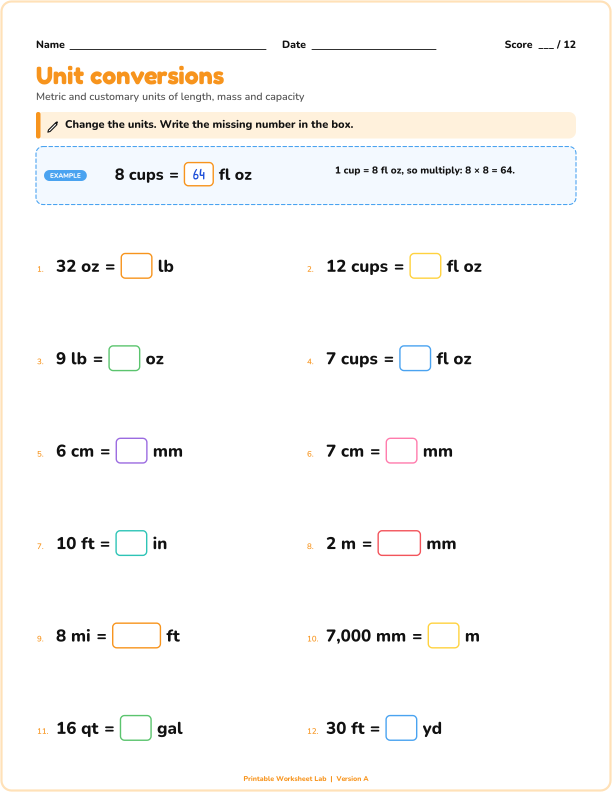
Change between metric or customary units of length, mass and capacity, one fact per row.
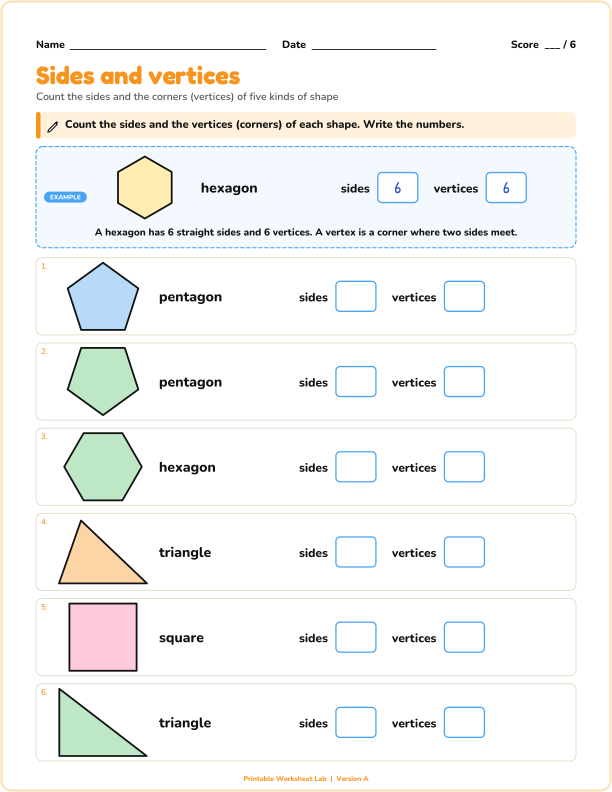
Count the sides and vertices (corners) of triangles, quadrilaterals, pentagons, hexagons and more.
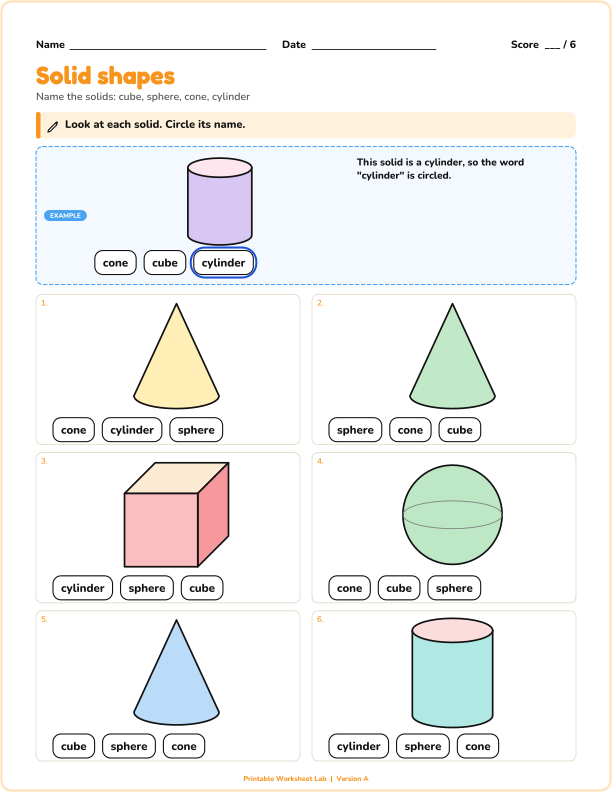
Name cubes, spheres, cones and cylinders, and optionally rectangular prisms and pyramids.
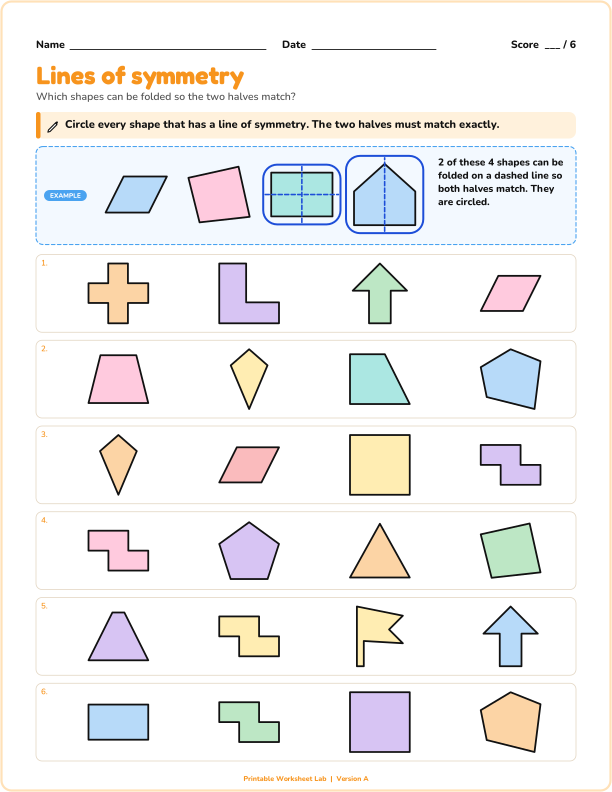
Circle the shapes that have a line of symmetry, or color squares to finish a symmetric picture.
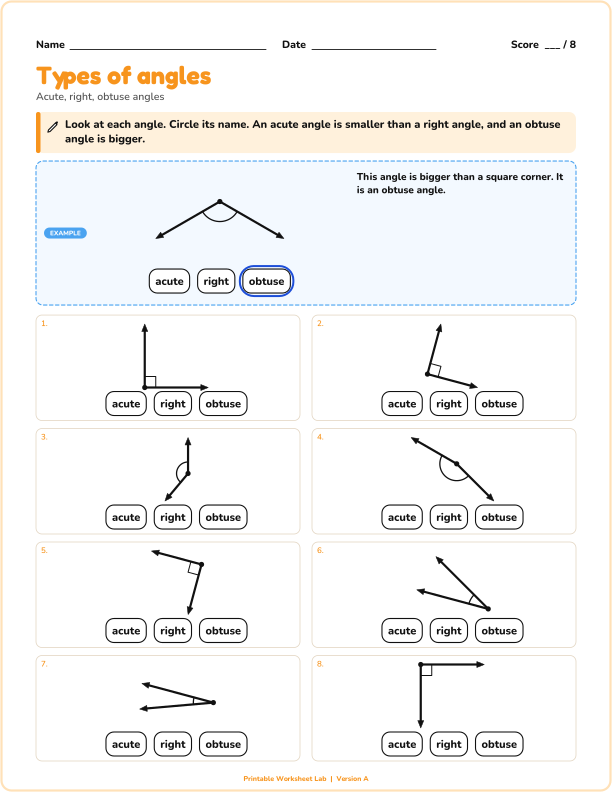
Name each drawn angle: acute, right, obtuse or straight.
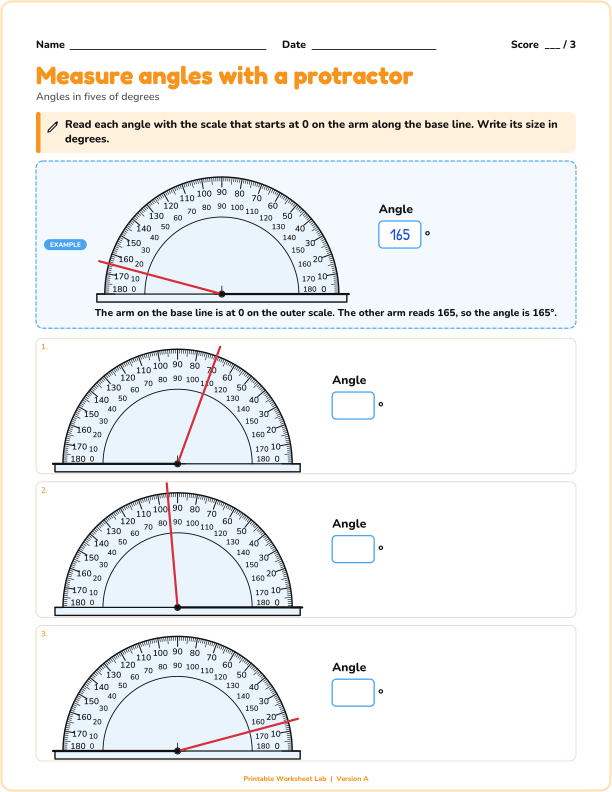
A protractor is drawn with an angle on it. Read the size of the angle in degrees.
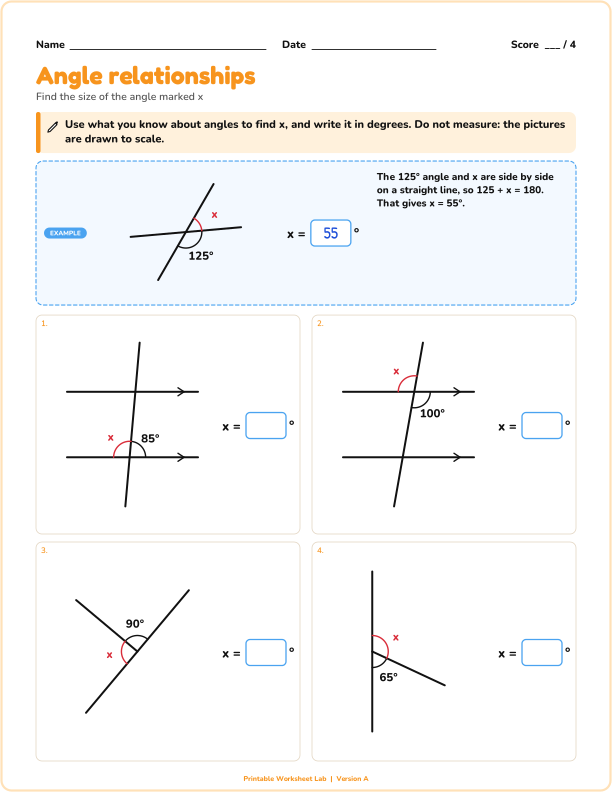
Find an unknown angle: complementary, supplementary, vertical, in a triangle, or between parallel lines.
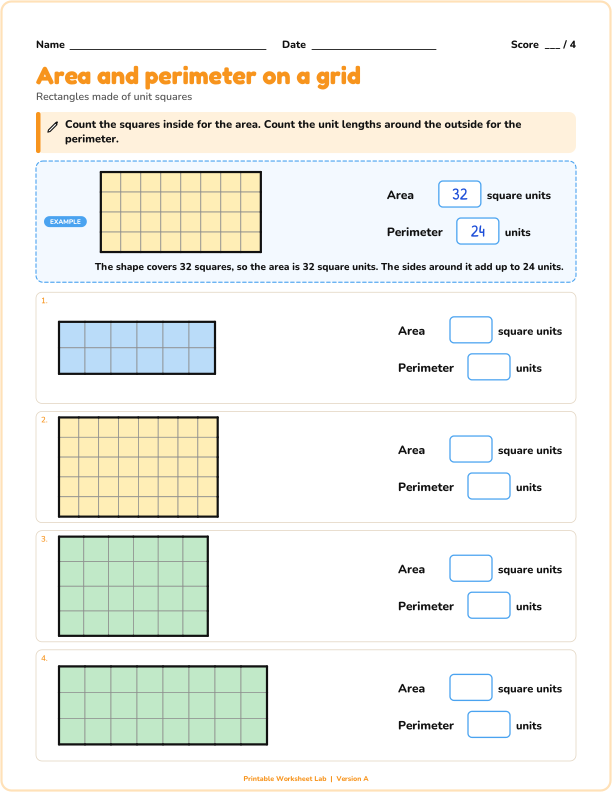
Count squares for area, count edges for perimeter, or find a missing side of a rectangle or L shape.
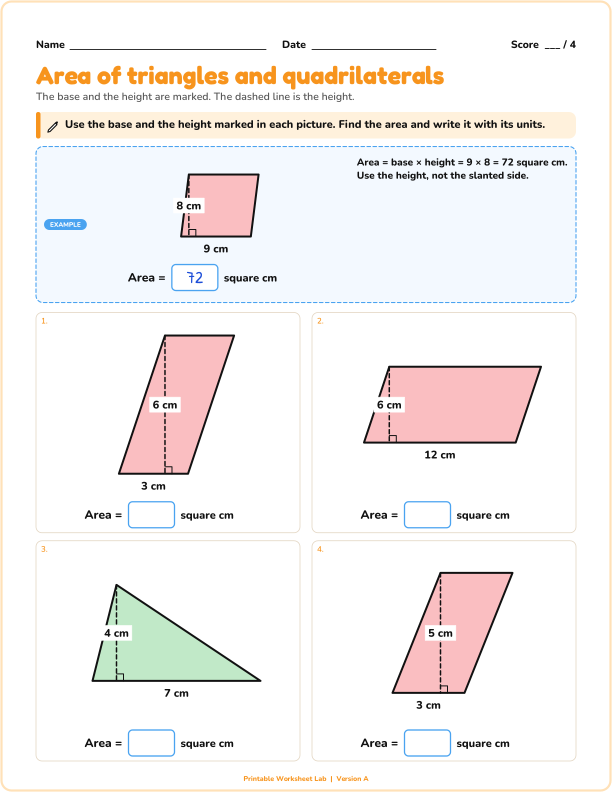
Find the area of a triangle, parallelogram or trapezoid from its marked base and height.
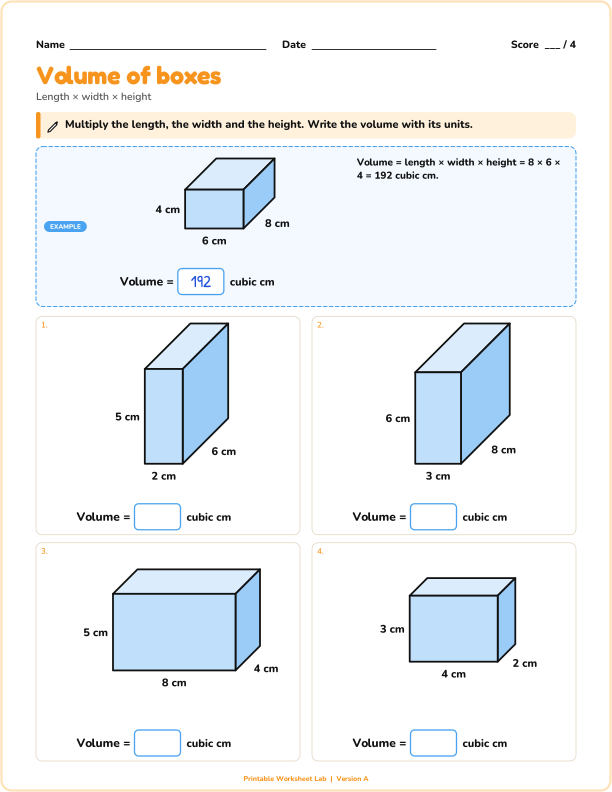
Find the volume of a drawn box from its length, width and height, or find a missing edge.
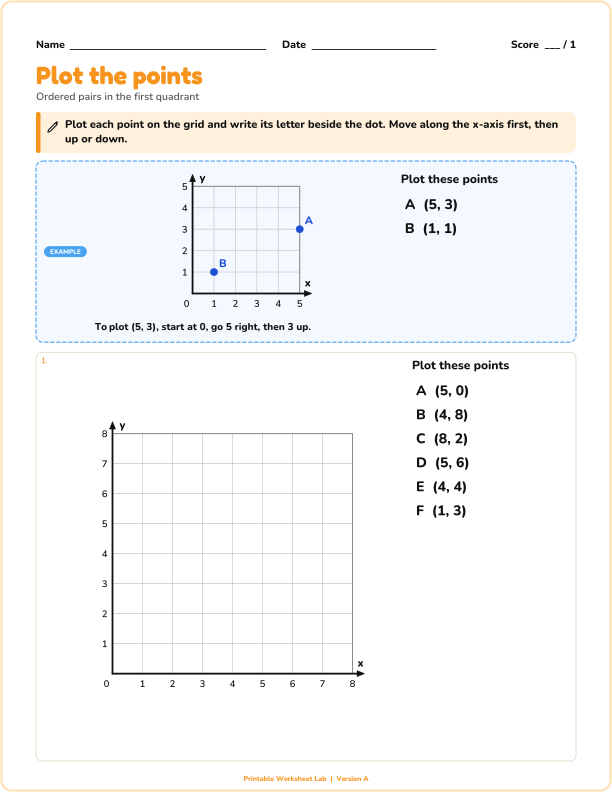
Plot points given as ordered pairs, or read the ordered pairs of marked points, in one quadrant or four.
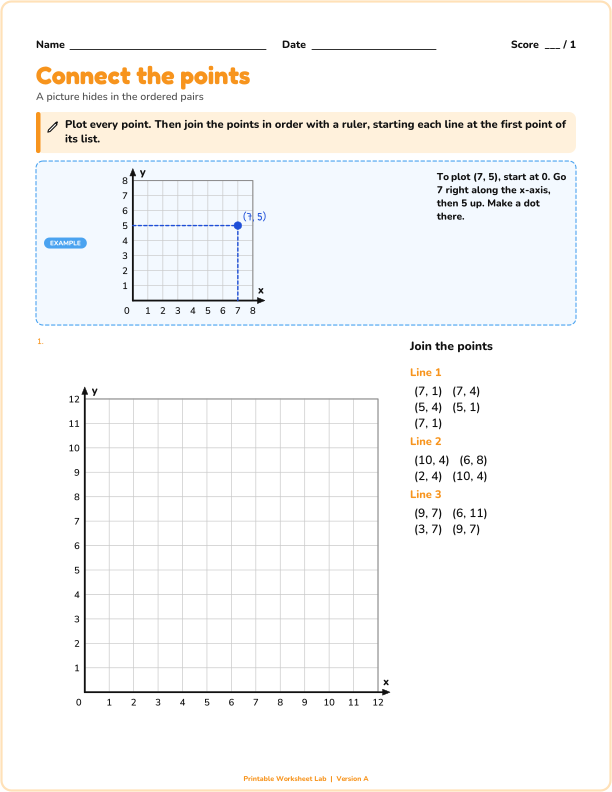
Plot ordered pairs in the first quadrant and join them in order to reveal a picture.
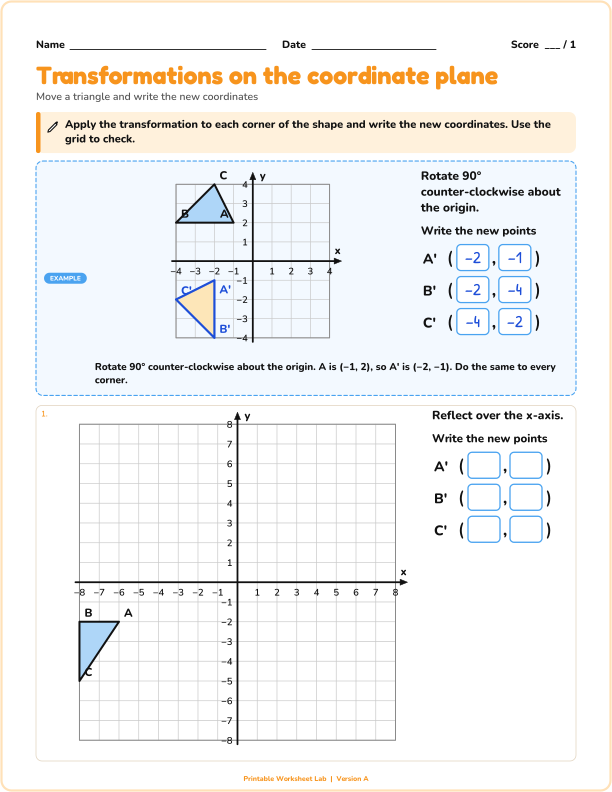
Move a triangle or quadrilateral on the coordinate plane and write the coordinates of its image.
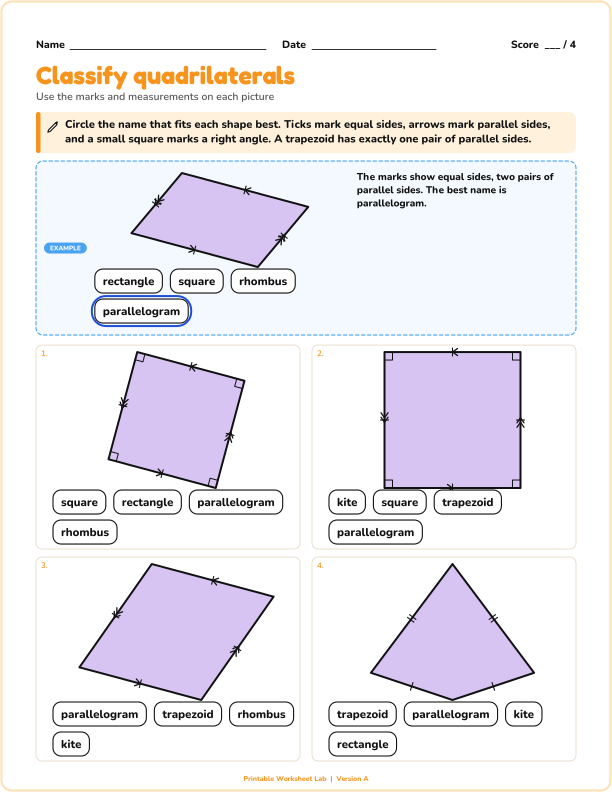
Name triangles by their sides or angles, and quadrilaterals by their marks: square, rectangle, rhombus, parallelogram, trapezoid or kite.
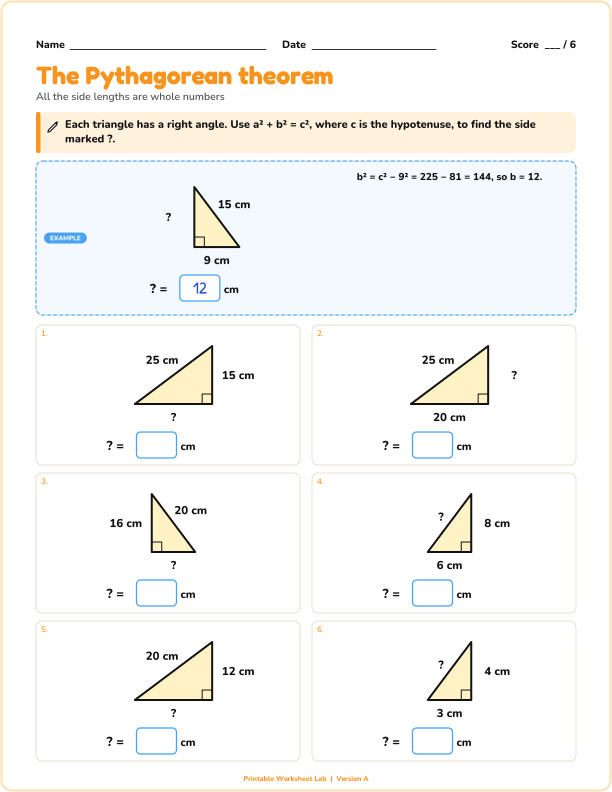
Find the missing side of a right triangle, or test whether three numbers make a Pythagorean triple.
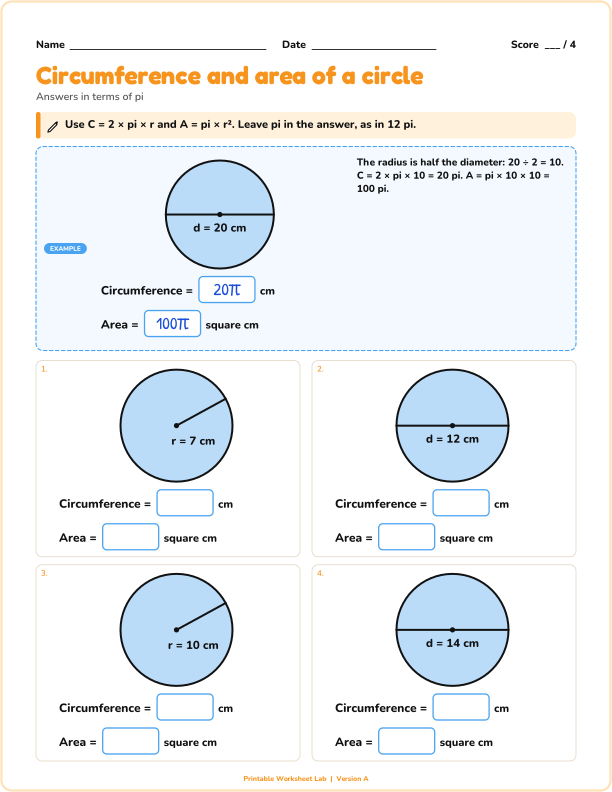
Find the circumference and area of a circle from its radius or diameter, in terms of pi or rounded to the hundredth.
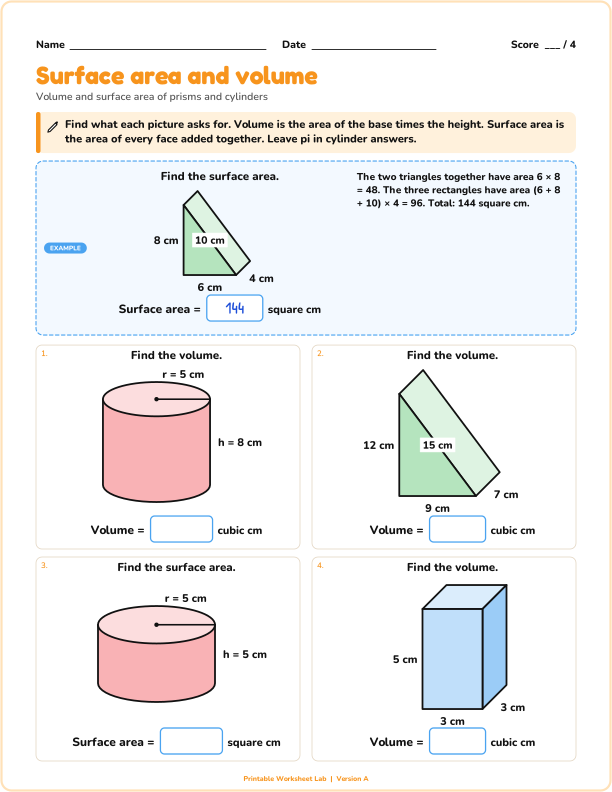
Find the volume or surface area of rectangular prisms, triangular prisms and cylinders.
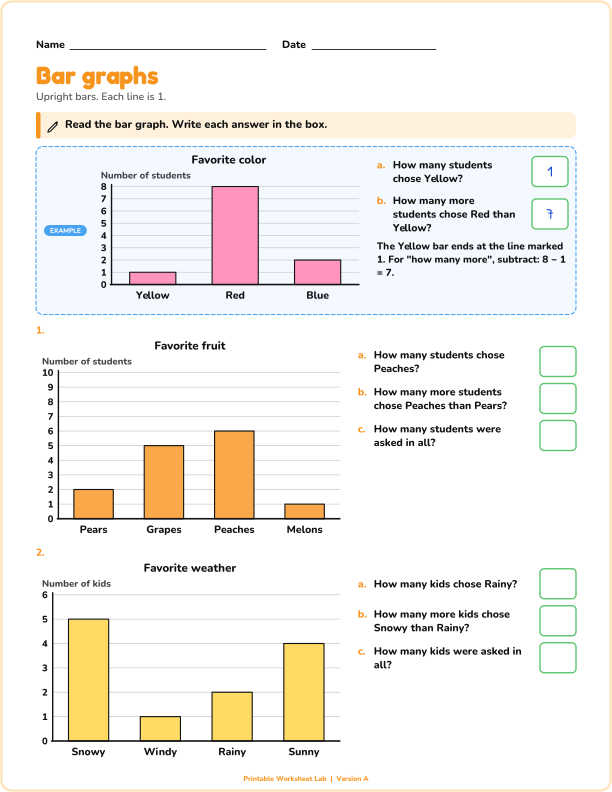
Read a bar graph and answer questions, or shade the bars to match a table.
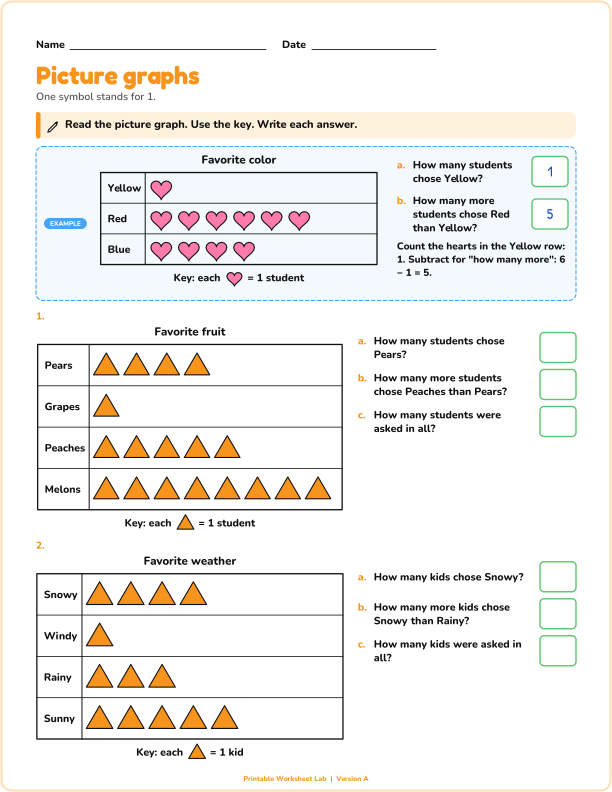
Read a picture graph where one symbol stands for 1, 2, 5 or 10 and answer questions.
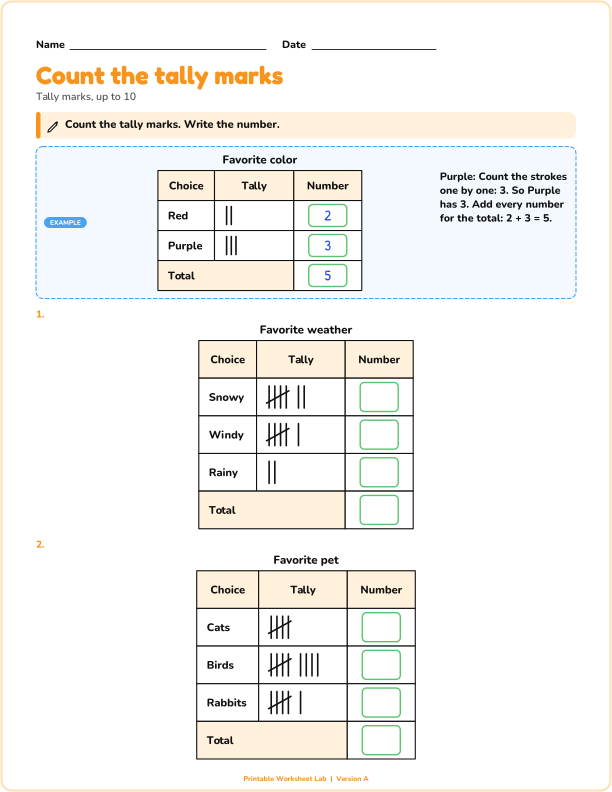
Count tally marks, draw tally marks for a number, or tally a list into a frequency table.
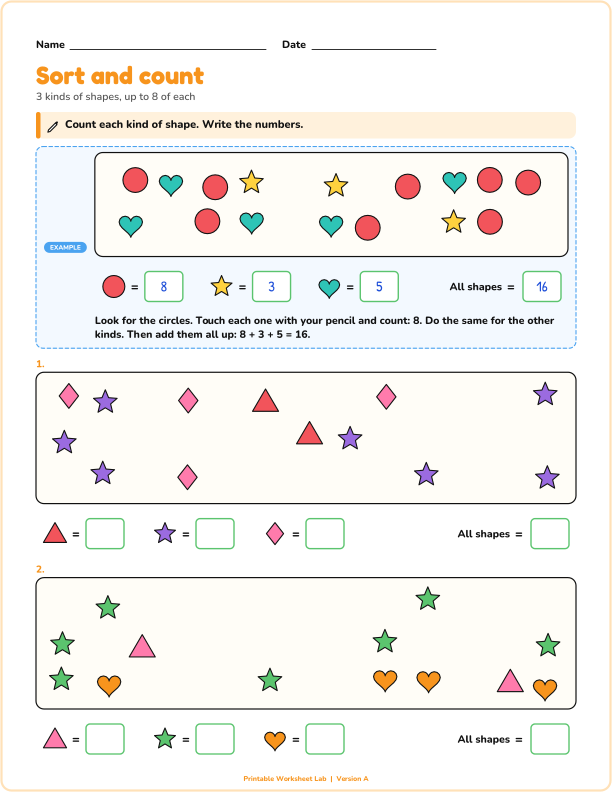
Count each kind of shape in a mixed group and write how many of each, and how many in all.
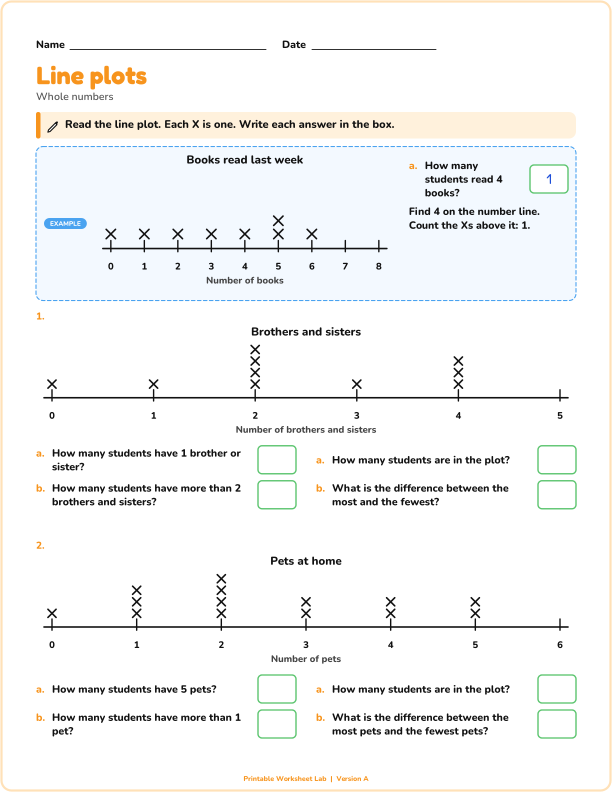
Read a line plot, or mark Xs on a number line, with whole numbers, halves or quarters of an inch.
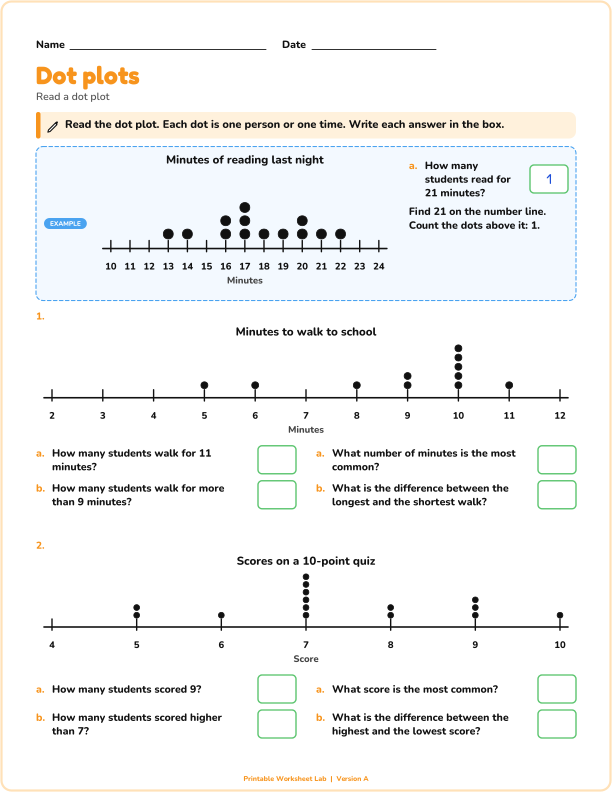
Read a dot plot and find a count, a number of values above a point, the most common value and the range.
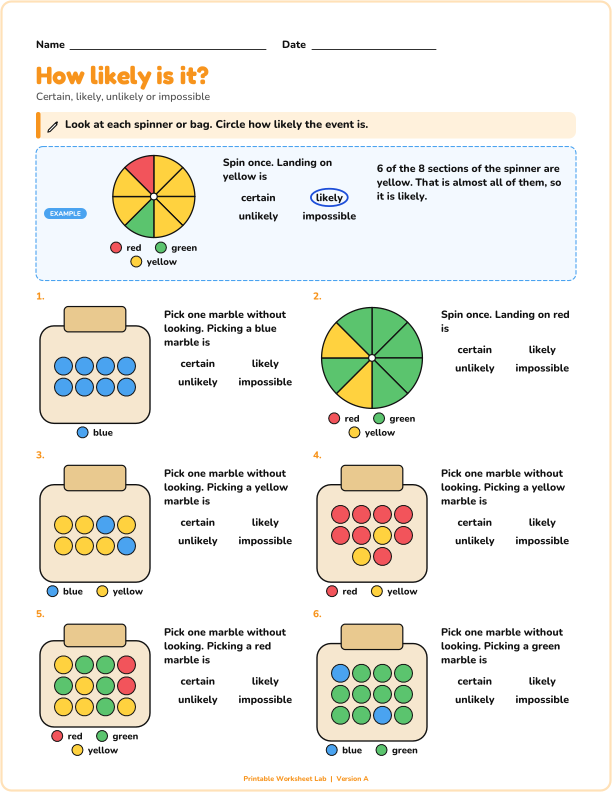
Look at a spinner or a bag of marbles and circle how likely an event is.
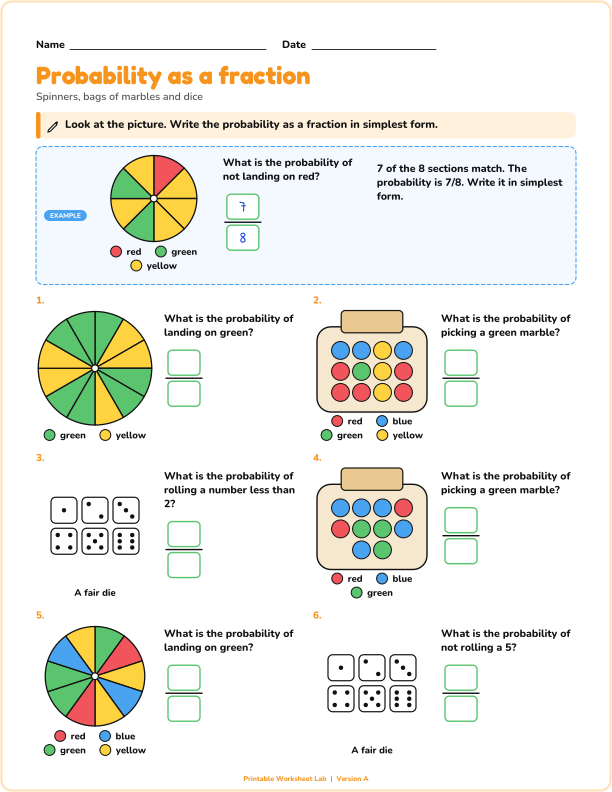
Find the probability of an event for a spinner, a bag of marbles or a die and write it as a fraction.
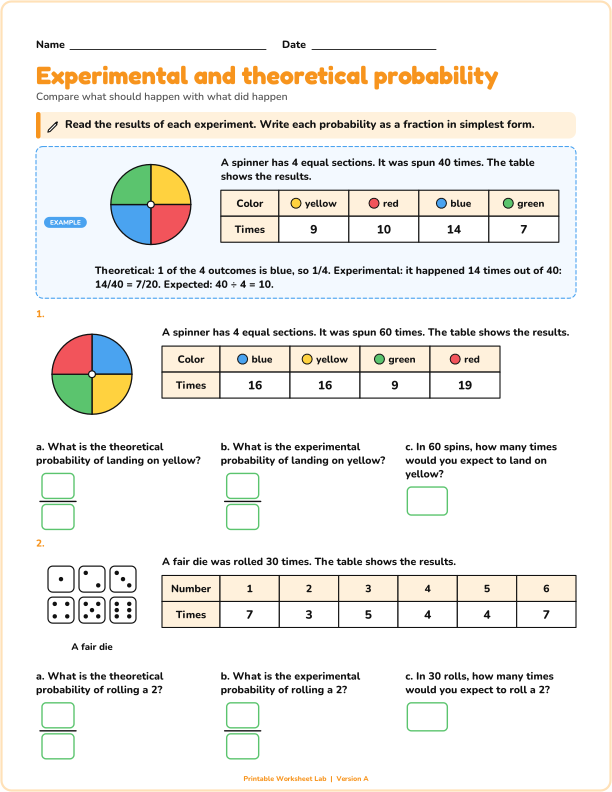
Use a table of results from a spinner, die or coin to compare what should happen with what did happen.
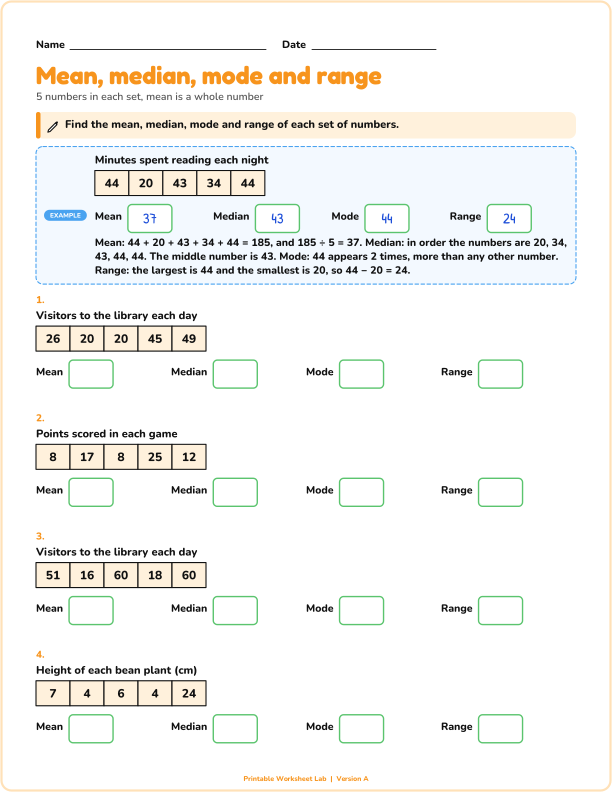
Find the mean, median, mode and range of sets of numbers, one statistic at a time or all four together.
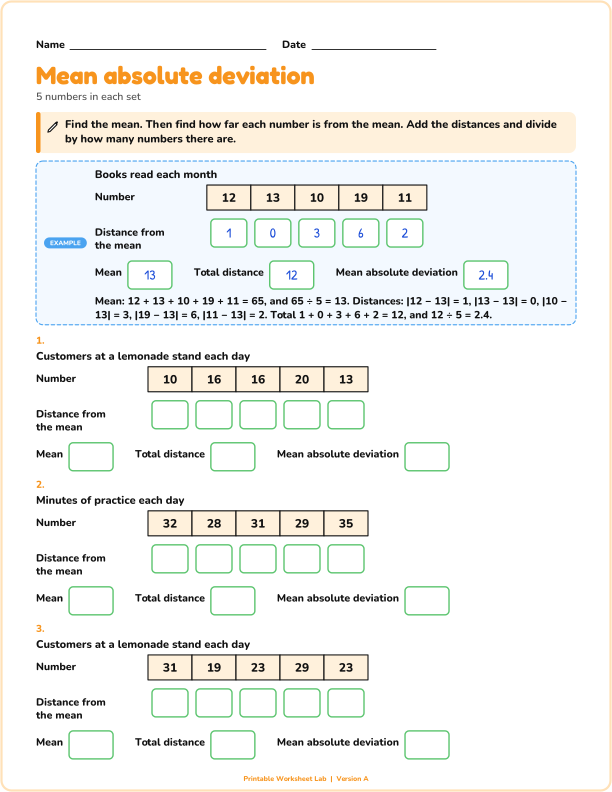
Find the mean, the distance of each number from the mean, and the mean absolute deviation.
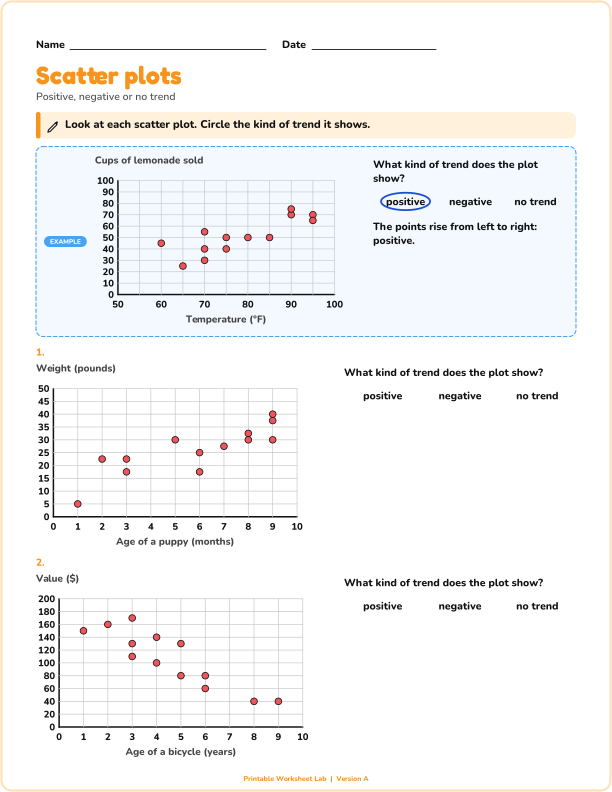
Read the trend of a scatter plot (positive, negative or none) and use a line through the points to estimate a value.
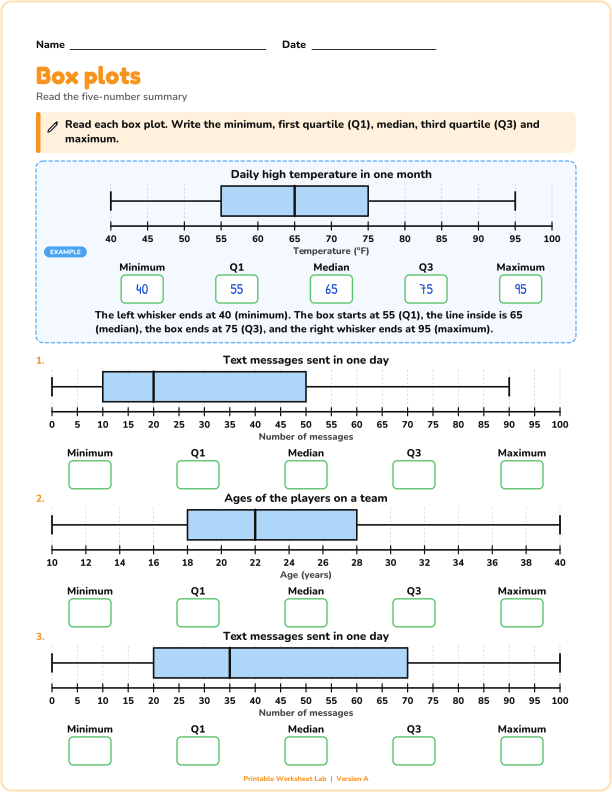
Read a box plot and write the five-number summary, the range and the interquartile range.
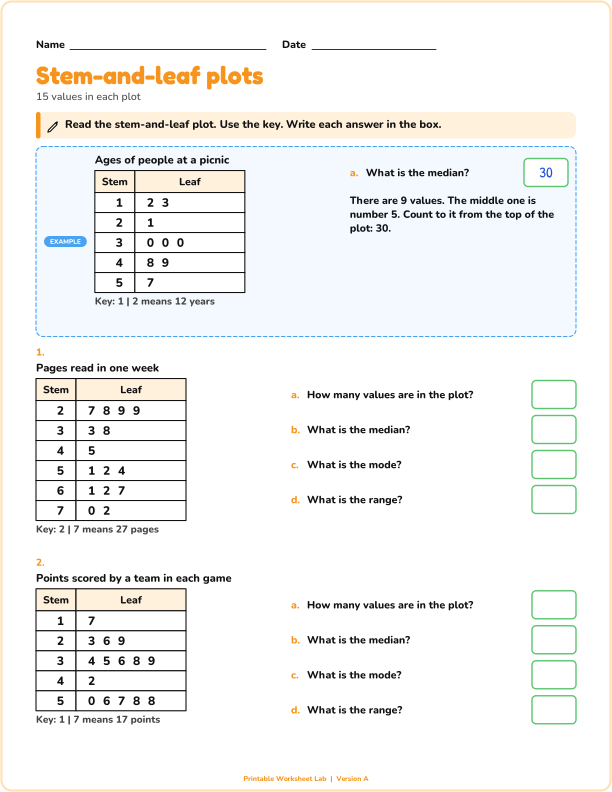
Read a stem-and-leaf plot, or build one from a list of numbers.
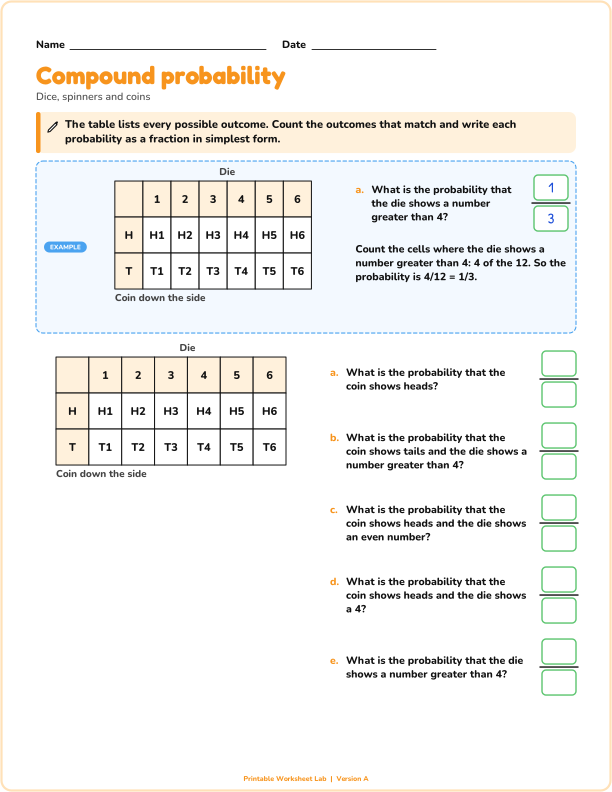
Use a table of every outcome for two dice, two spinners or a coin and a die to find probabilities.
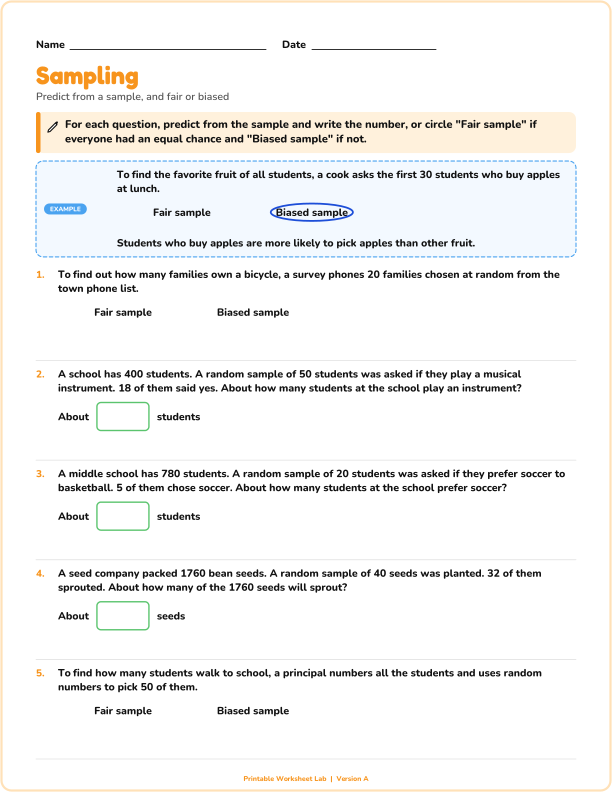
Use a random sample to predict a whole group, and decide whether a sample is fair or biased.
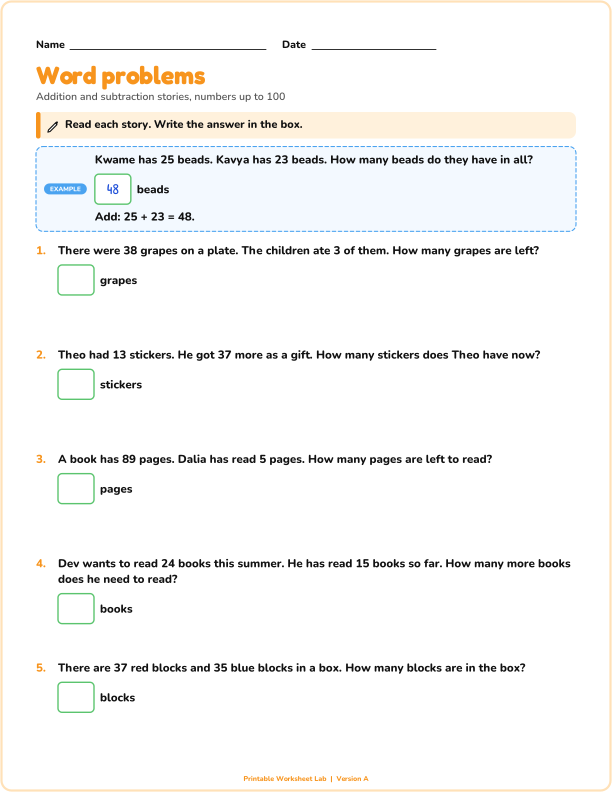
Short one-step stories with different names, objects and settings, each with one numeric answer.
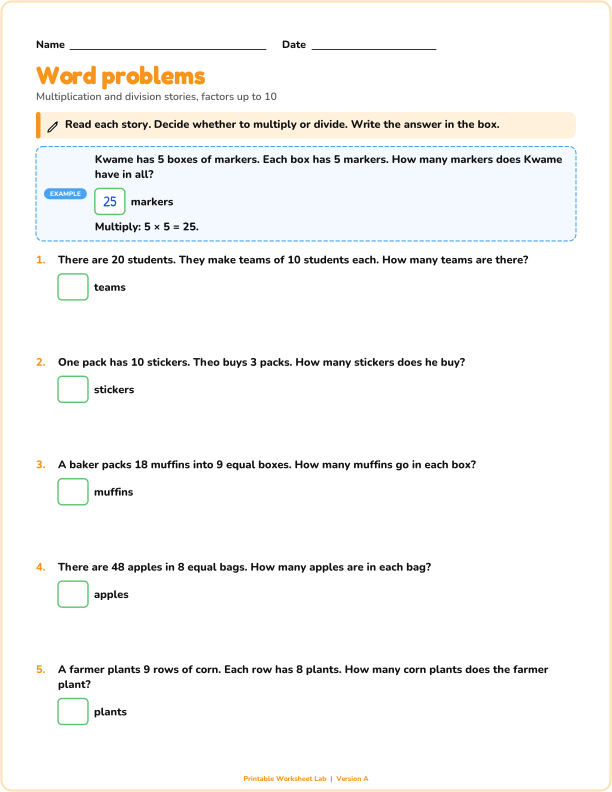
One-step stories about equal groups, rows, sharing and grouping, with factors up to 5, 10 or 12.
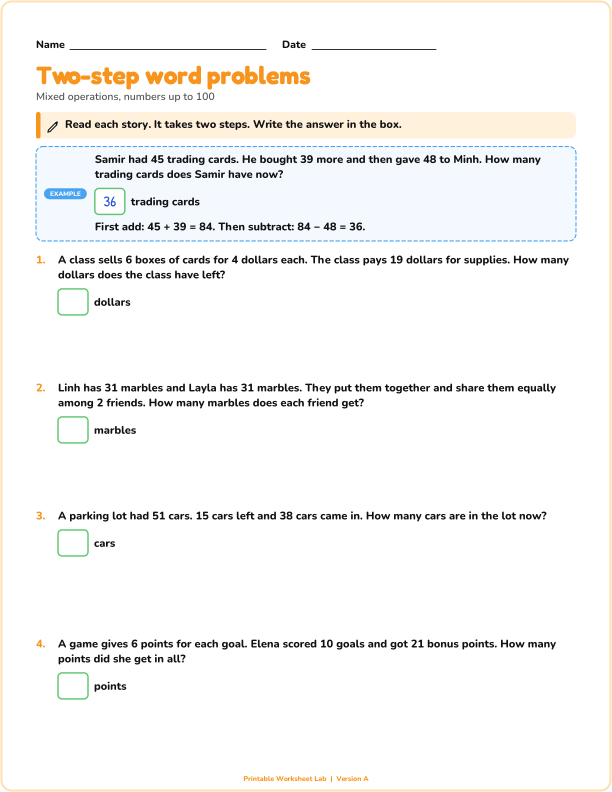
Stories that take two steps: add and subtract, multiply then add or subtract, or divide.
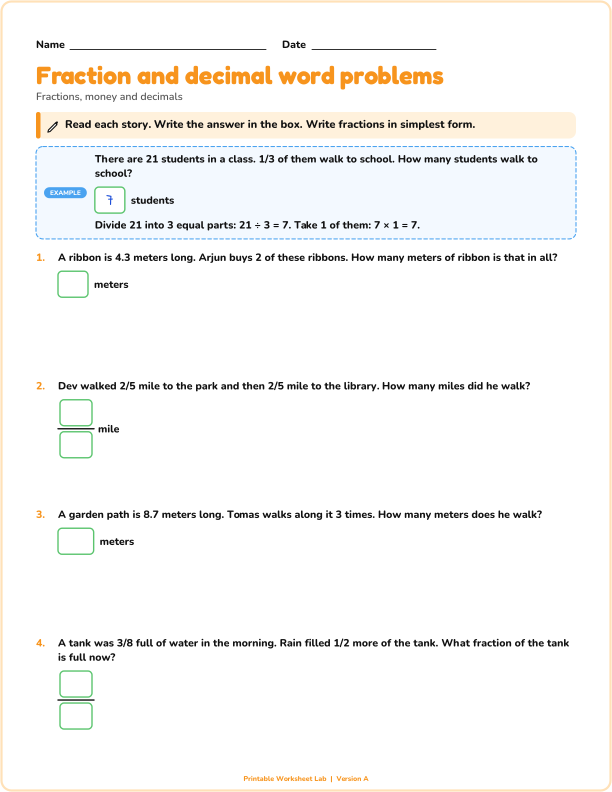
Stories about fractions of an amount, adding and subtracting fractions, and money and decimals.
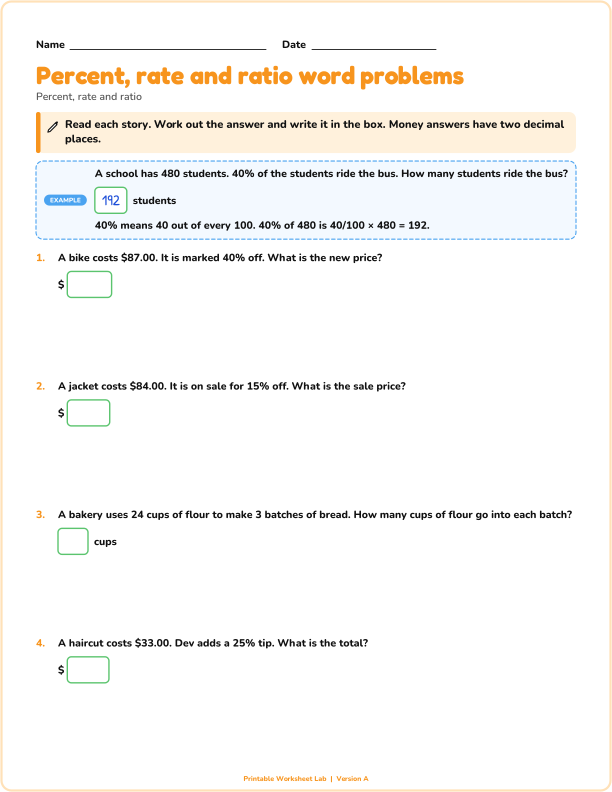
Stories about percent of an amount, discounts and tips, rates and unit rates, and ratios.
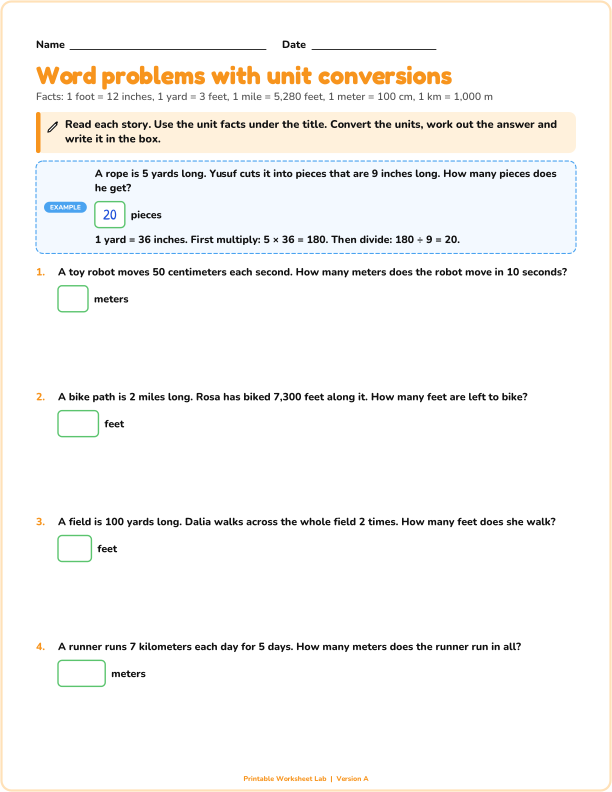
Stories that mix a calculation with a change of units: length, weight and volume, or time.
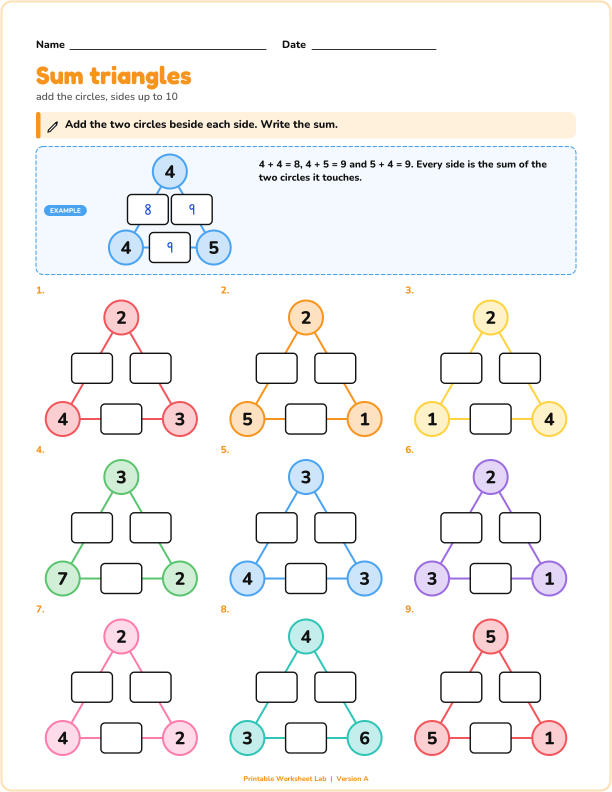
Triangles where each side is the sum of the two circles it joins, to fill in by adding or by working back.
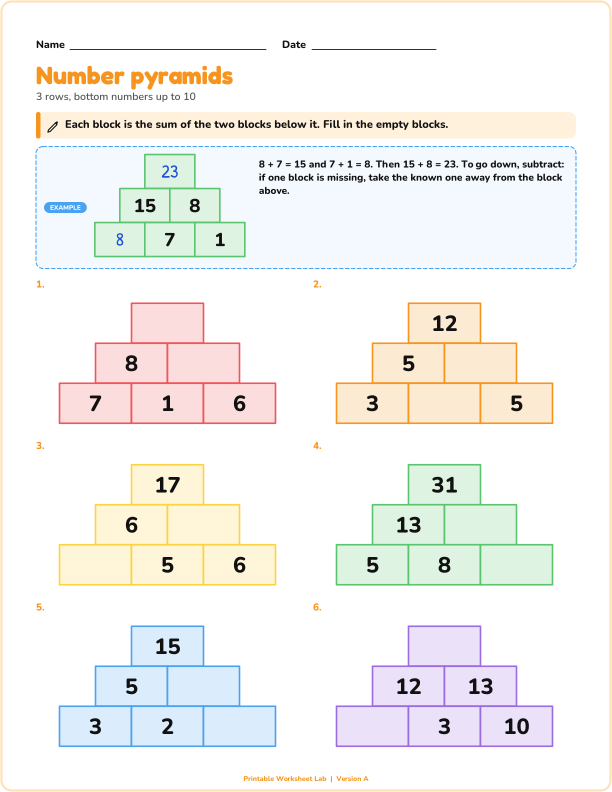
Pyramids where each block is the sum of the two blocks below it, with some blocks given and the rest to work out.
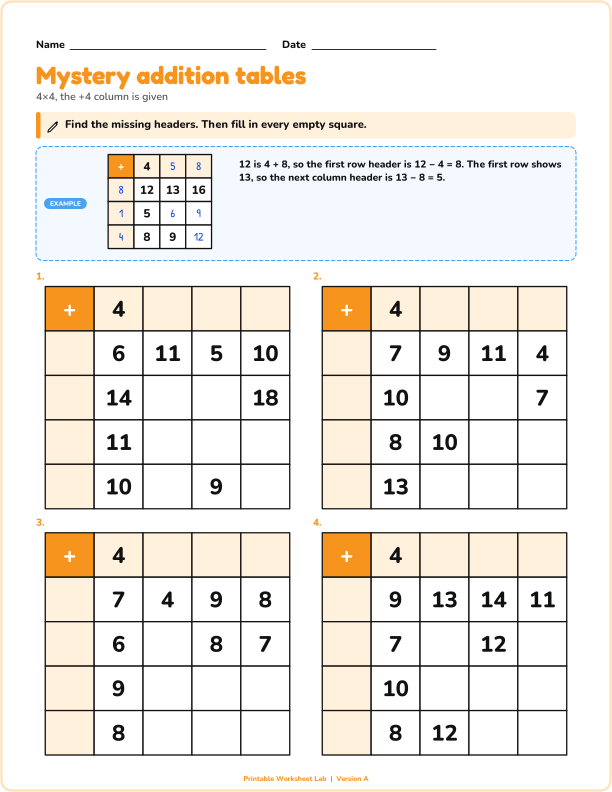
Addition tables with the headers hidden: work out the headers, then fill in the table.
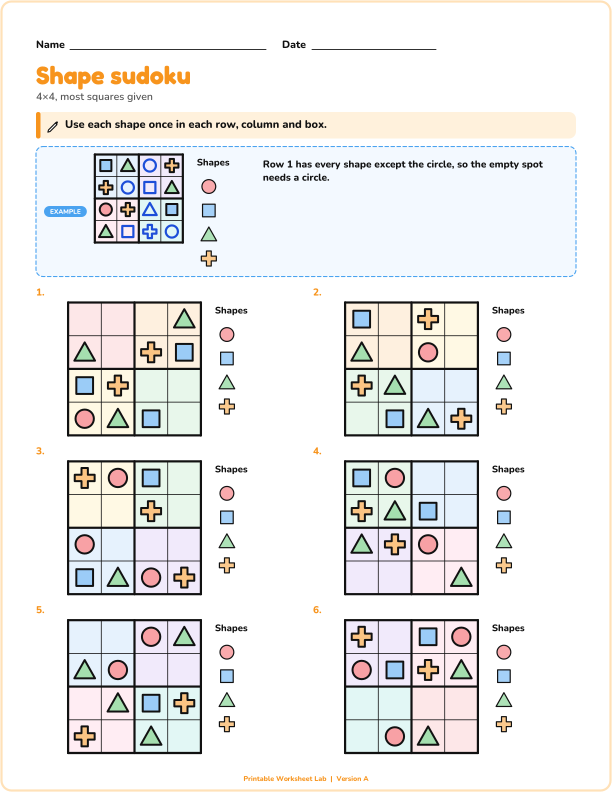
Logic grids with no arithmetic: fill each row, column and box with every shape or number once, with one solution for each puzzle.
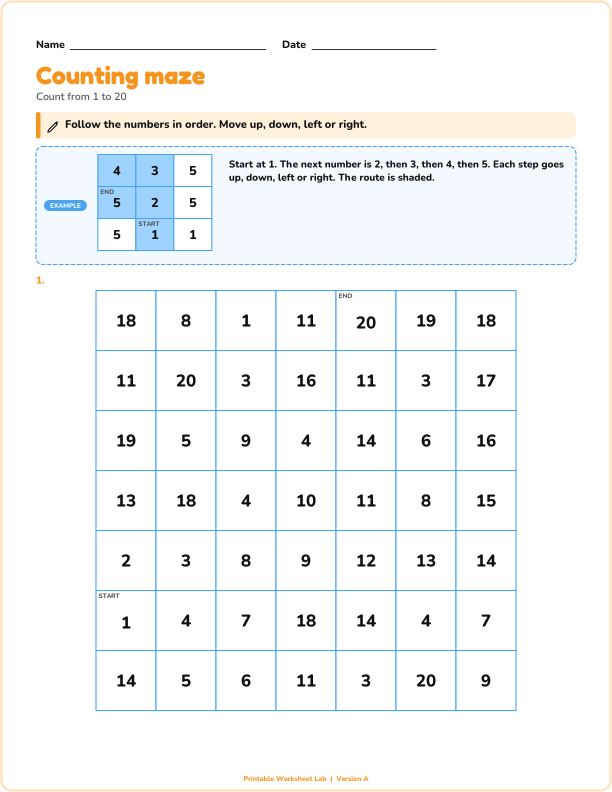
Mazes that follow the counting order: 1 to 20, or skip counting by 2s, 3s, 5s and 10s.
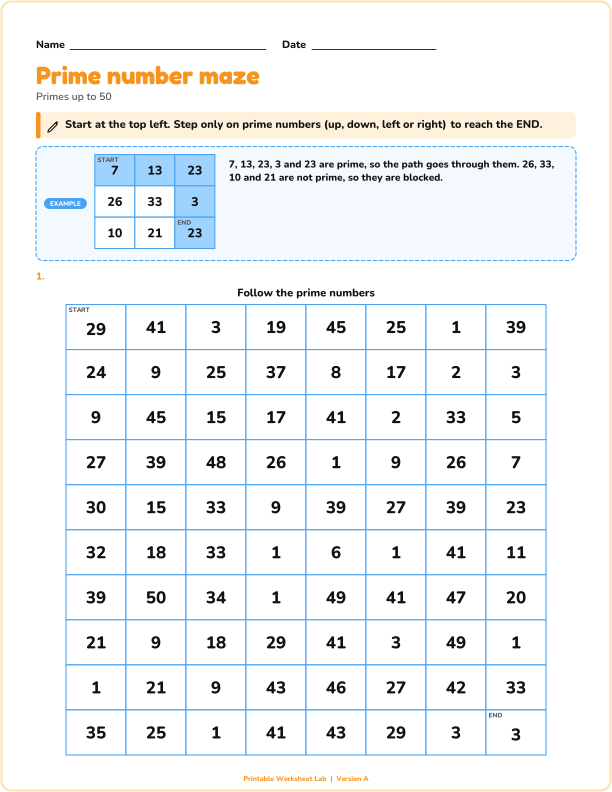
Mazes where you may only step on prime numbers, with one route and no guessing.
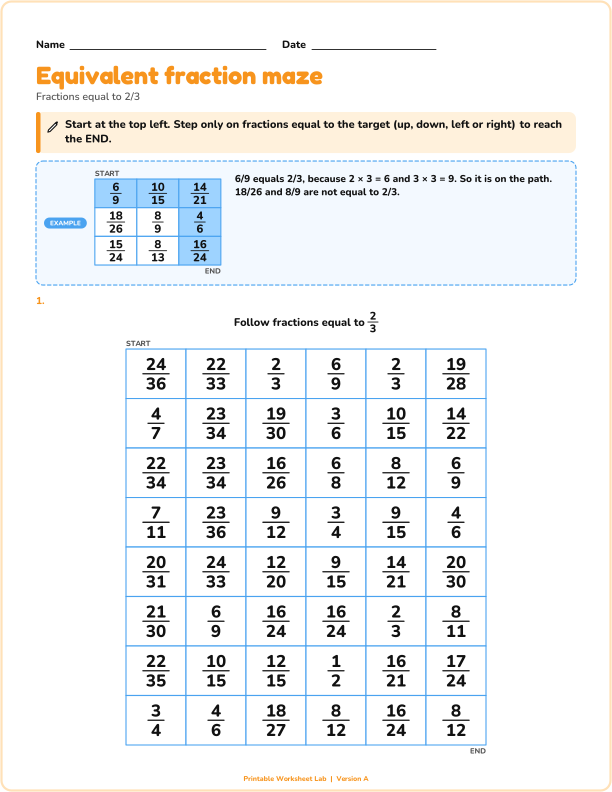
Mazes where you may only step on fractions equal to a target fraction, with one route and no guessing.
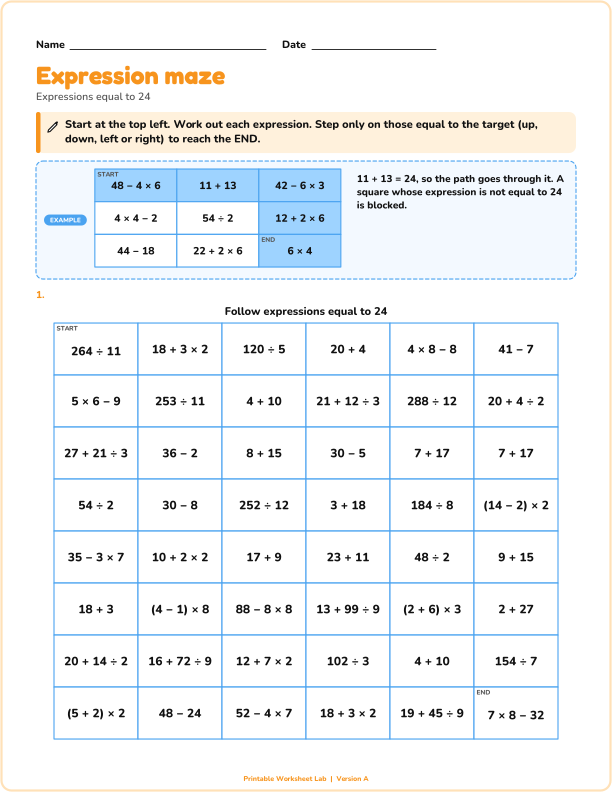
Mazes where every square is an expression and you step only on the ones equal to the target.
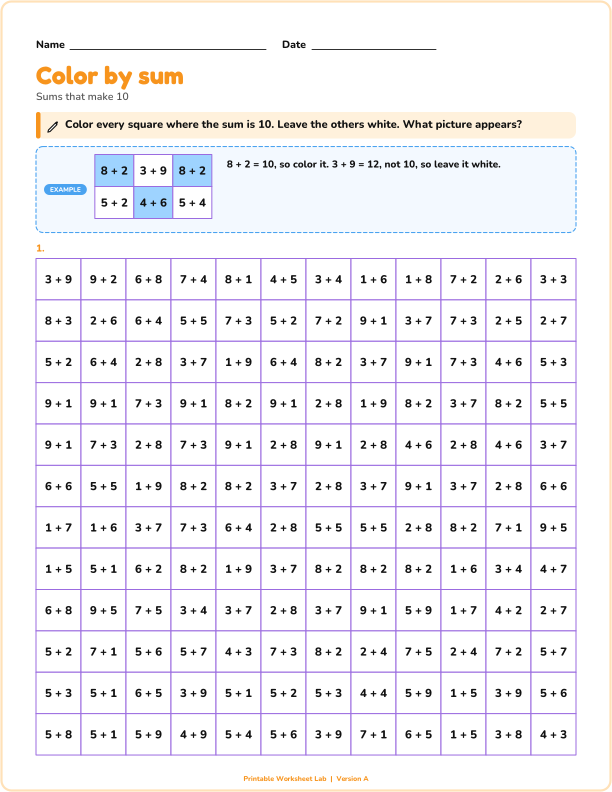
Color every square whose sum makes the target number, for example 10, to reveal a hidden picture.
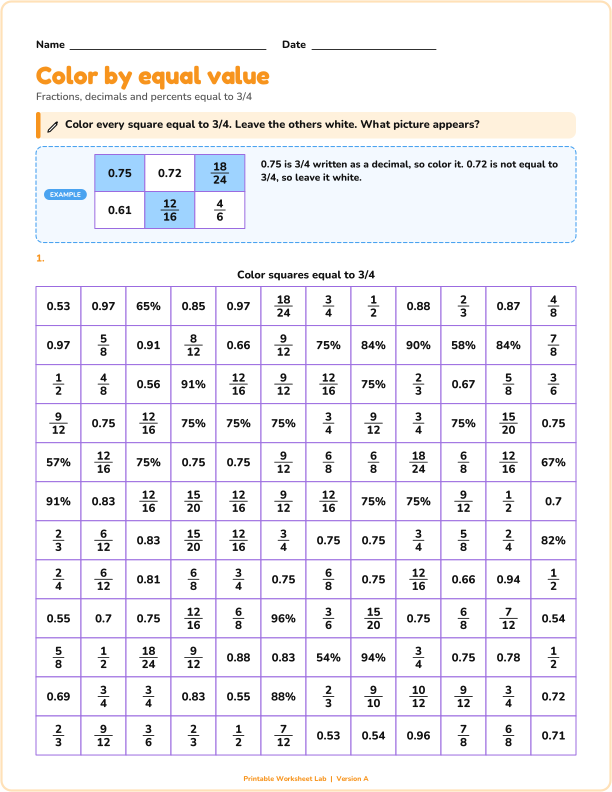
Color every square equal to a target fraction, written as fractions, decimals and percents, to reveal a picture.
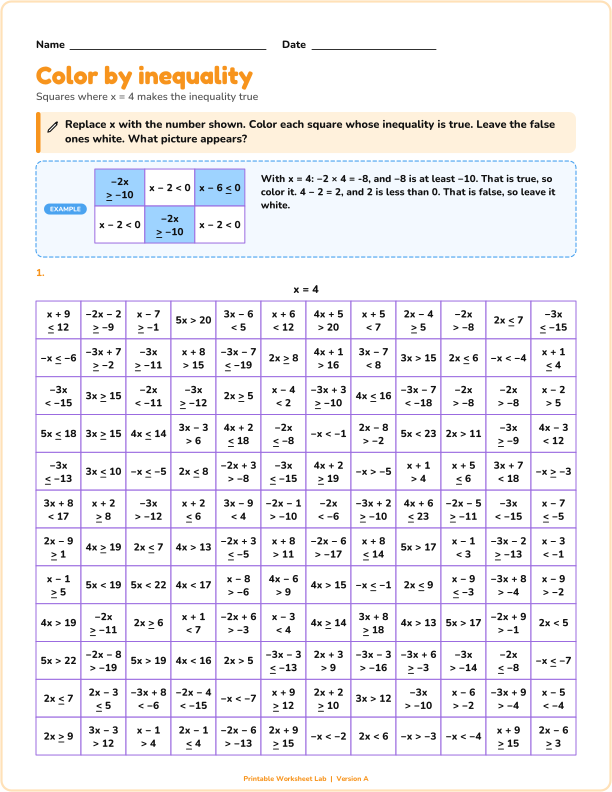
Substitute a value for x and color every square whose inequality is true to reveal a picture.
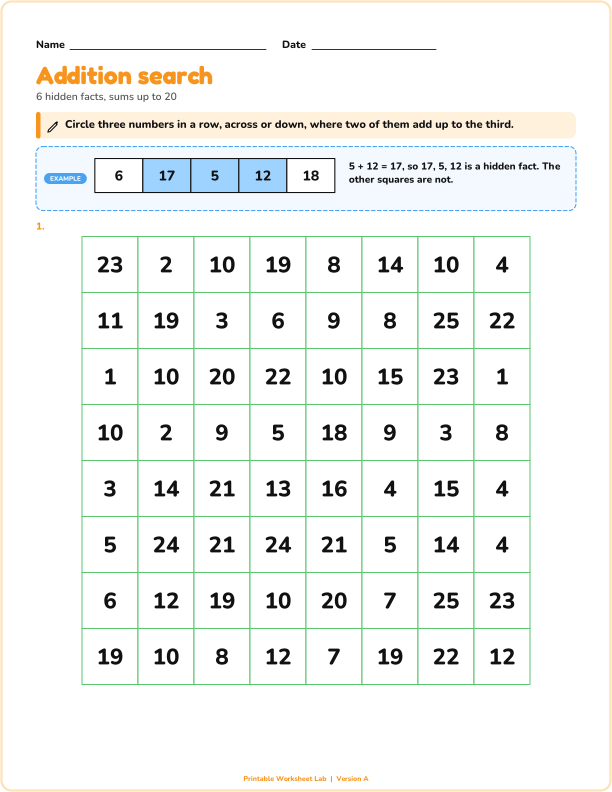
Find hidden addition facts in a grid of numbers: three in a row where two of the numbers add up to the third.
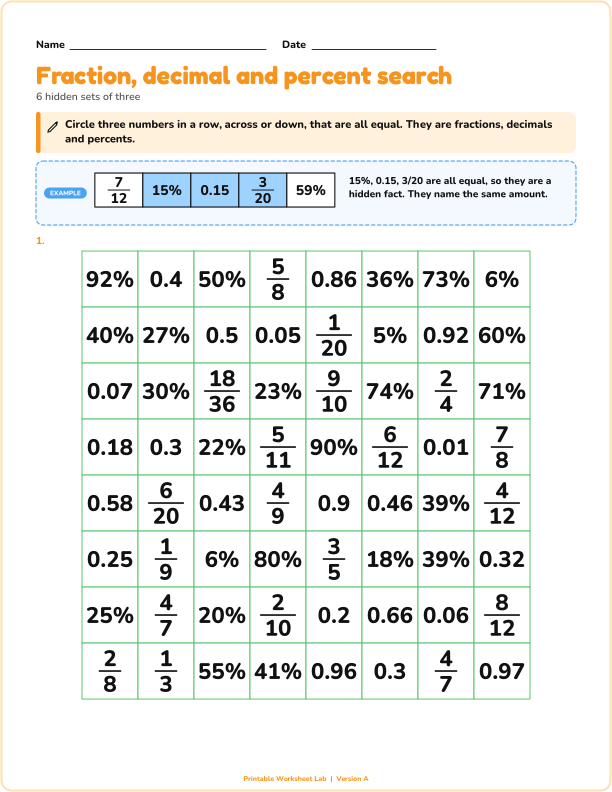
Find three equal numbers in a row, written as fractions, decimals or percents, hidden in a grid.
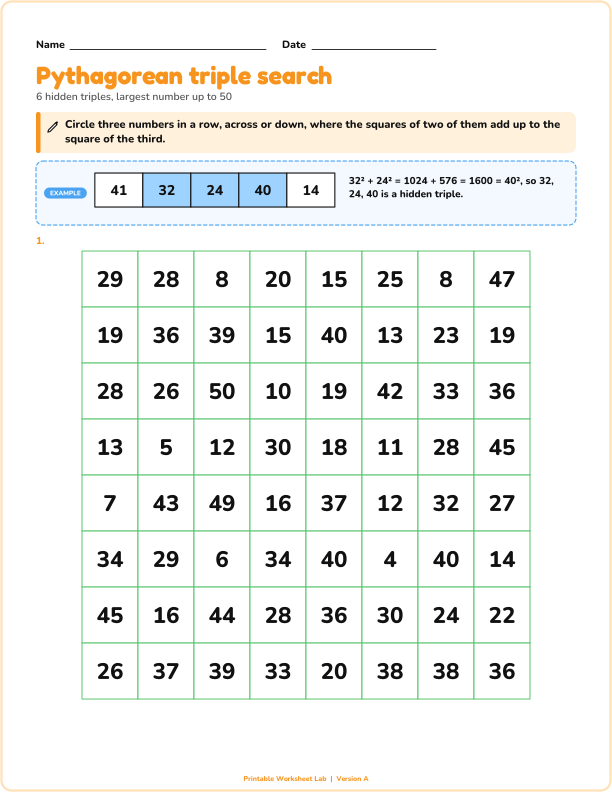
Find hidden Pythagorean triples in a grid of numbers: three in a row where the squares of two add up to the square of the third.
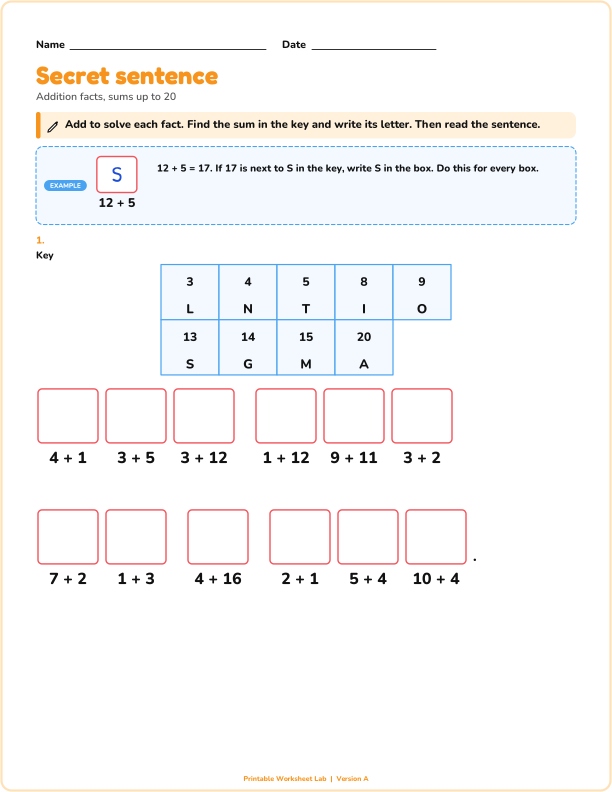
Solve addition facts to decode a short, readable sentence.
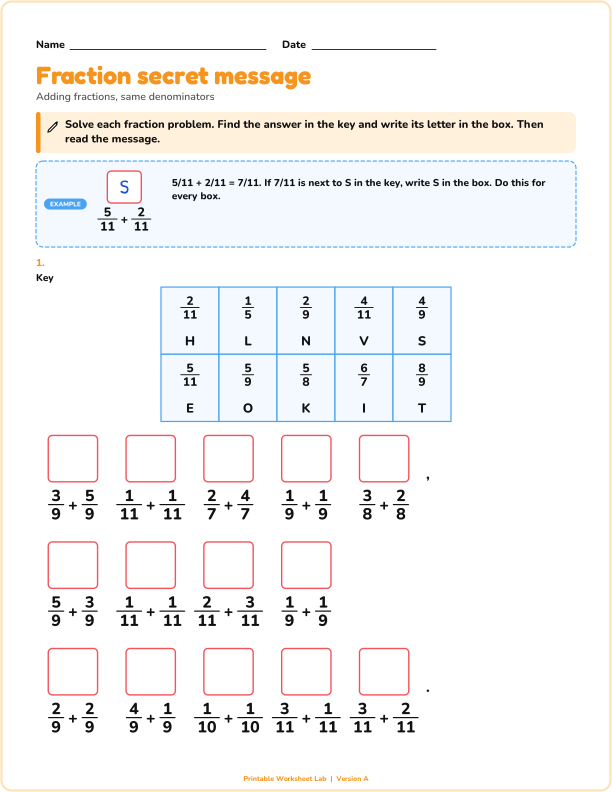
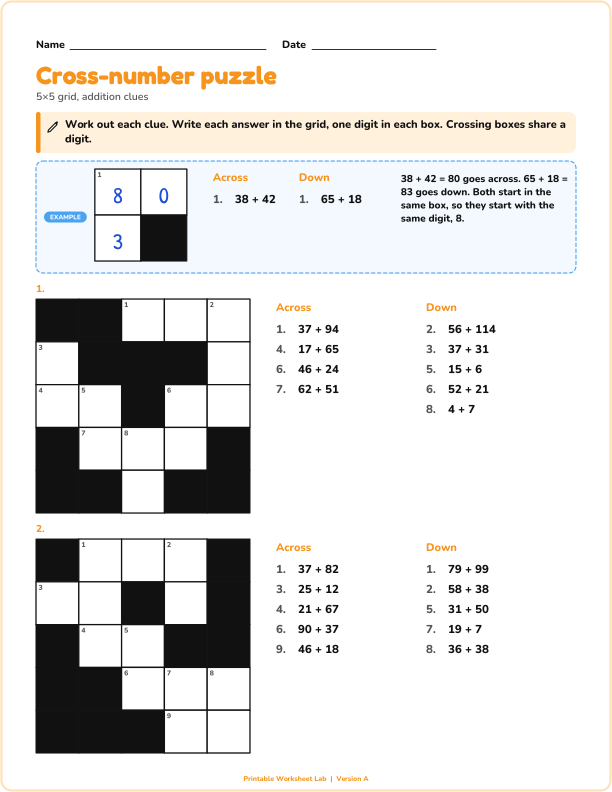
A crossword where every clue is a calculation and every answer is a number written one digit per box.
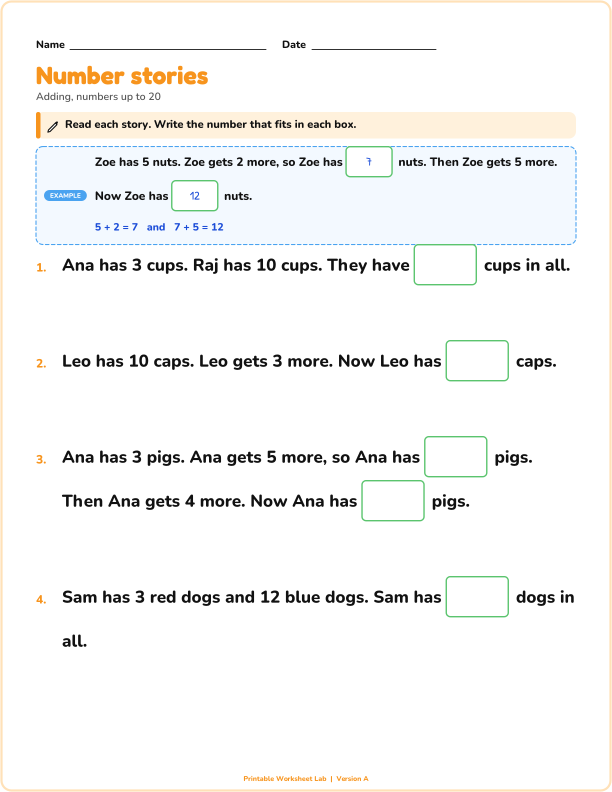
Short stories with boxes to fill: each box is the result of an addition, subtraction, multiplication or division fact.
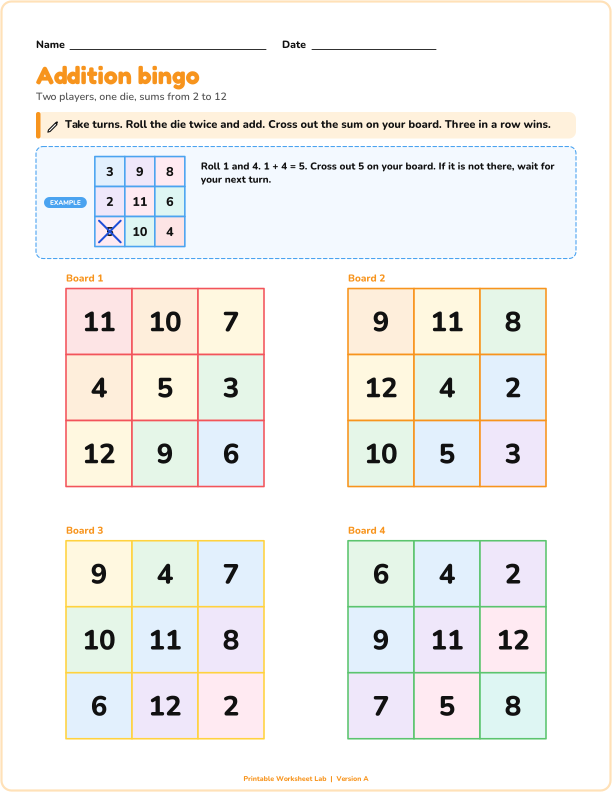
Bingo boards of sums from 2 to 12, played by rolling one die twice, adding and crossing out the sum.
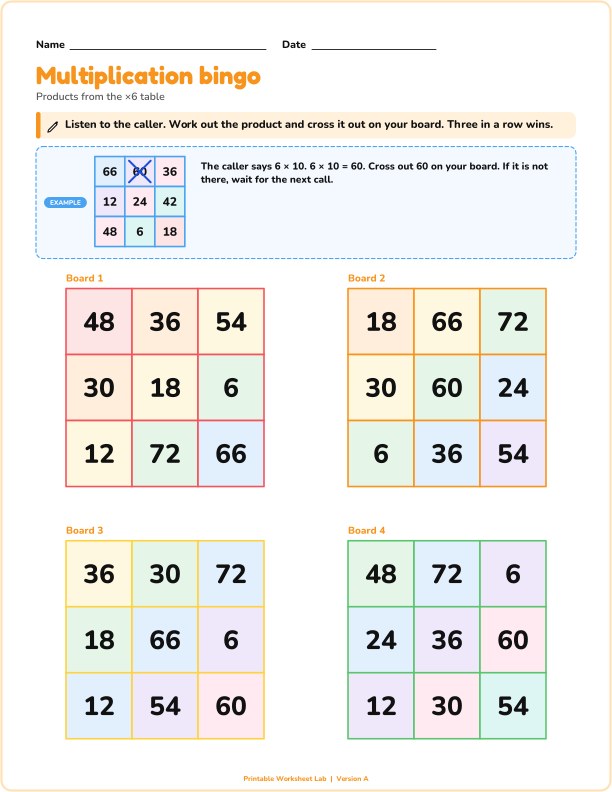
Bingo boards of products for any times table, with a caller's list of facts to read out.
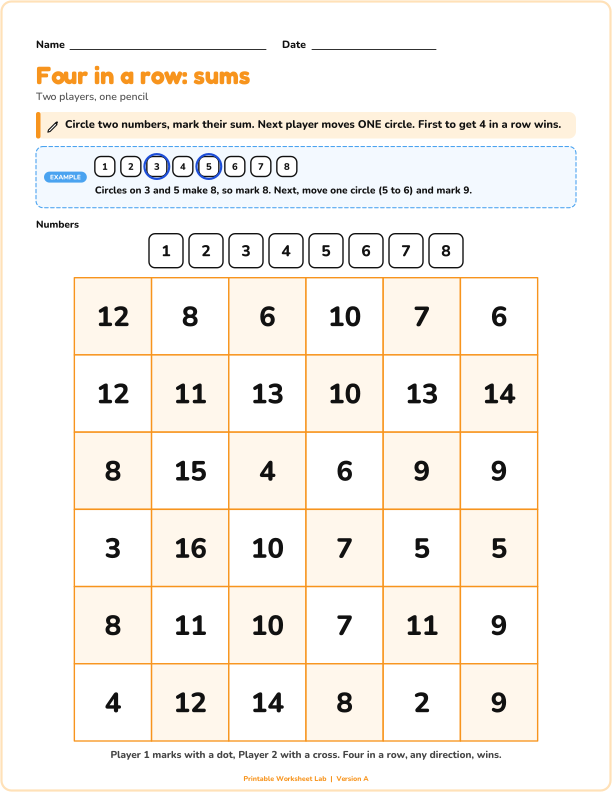
A two-player strategy game: circle two numbers, mark their sum or product, and get four in a row.
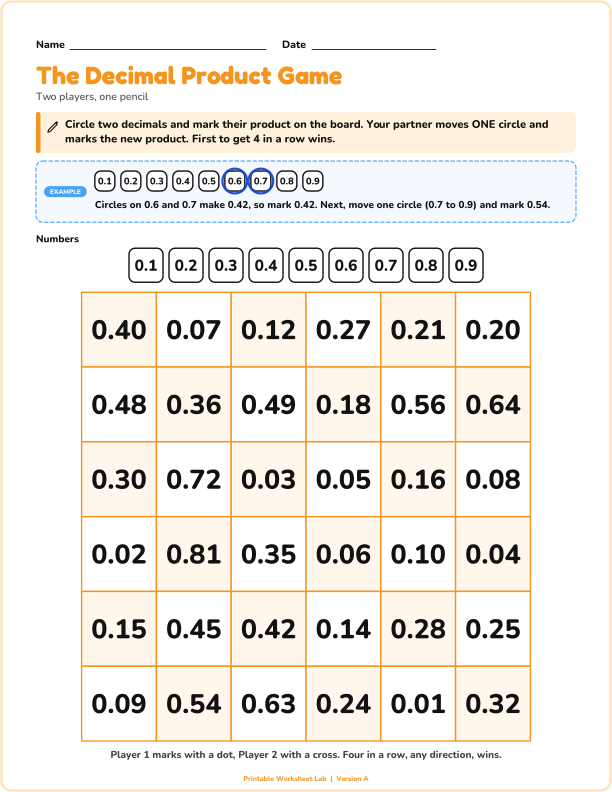
A two-player strategy game with tenths: circle two decimals, mark their product, get four in a row.
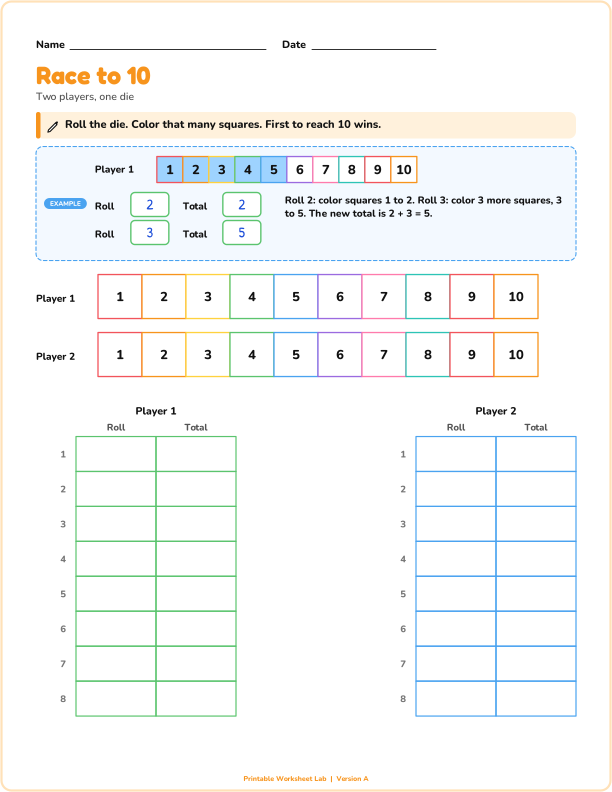
A two-player counting race with one die: roll, color that many squares and write the new total.
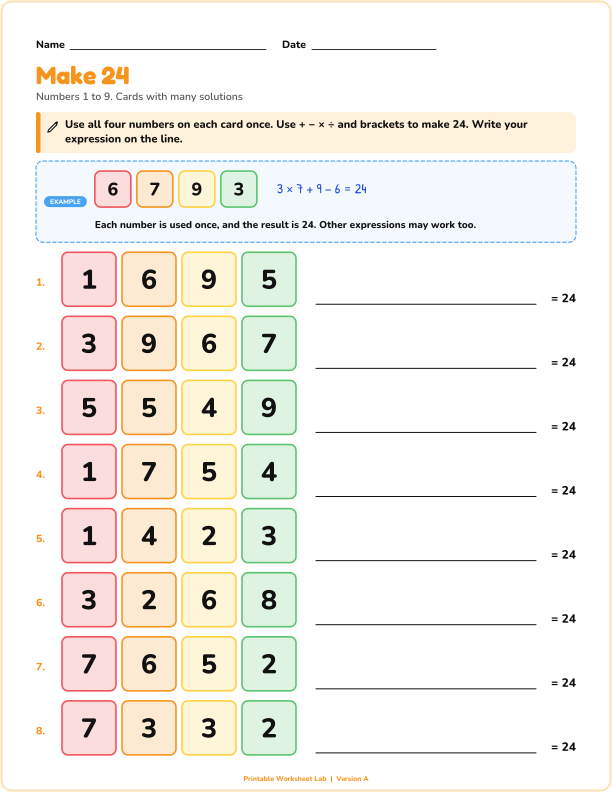
Use four numbers once each, with plus, minus, times, divide and brackets, to make 24 on cards that all have a solution.
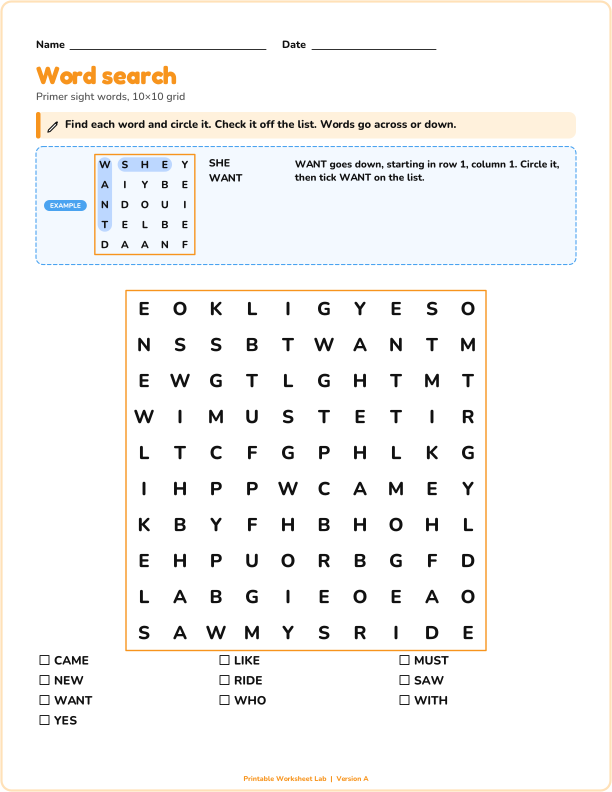
Word searches for sight words, phonics patterns and ten topics, with every word hidden exactly once.
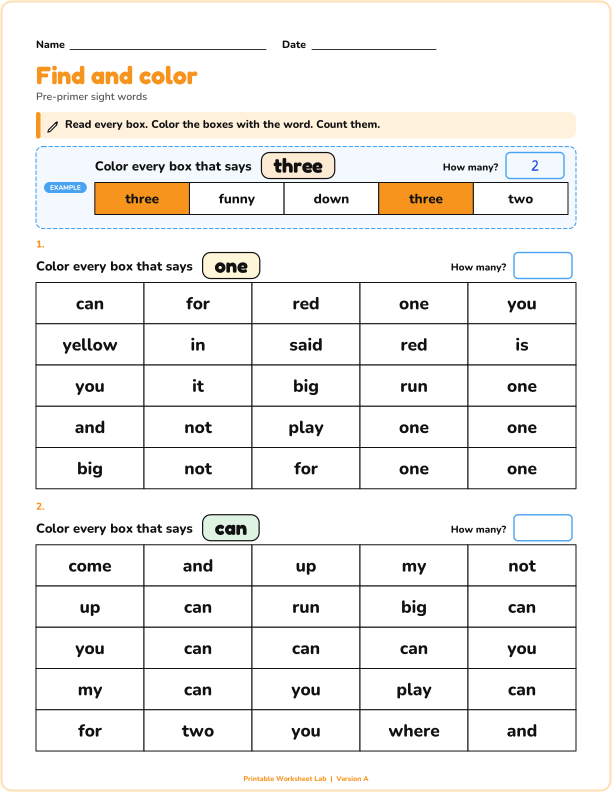
A grid of look-alike words: color every box with the sight word and count them.
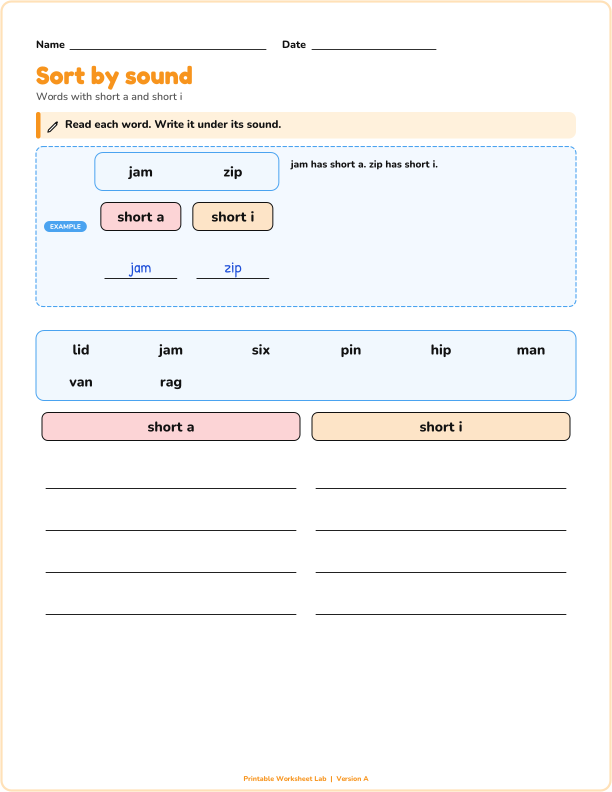
Read each word and write it under its sound: short vowels, long vowels with silent e, vowel teams or digraphs.
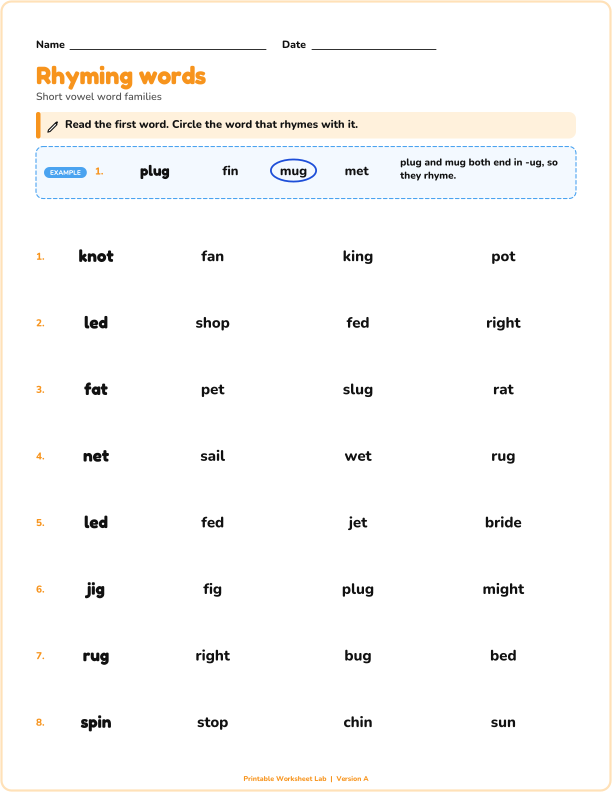
Read a word and circle the one of three words that rhymes with it.
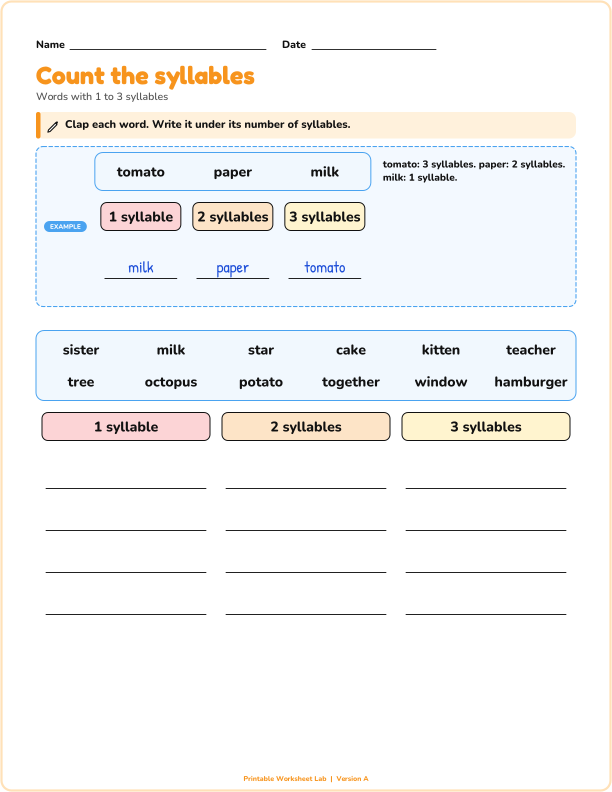
Clap each word and write it under its number of syllables, from one to three or four.
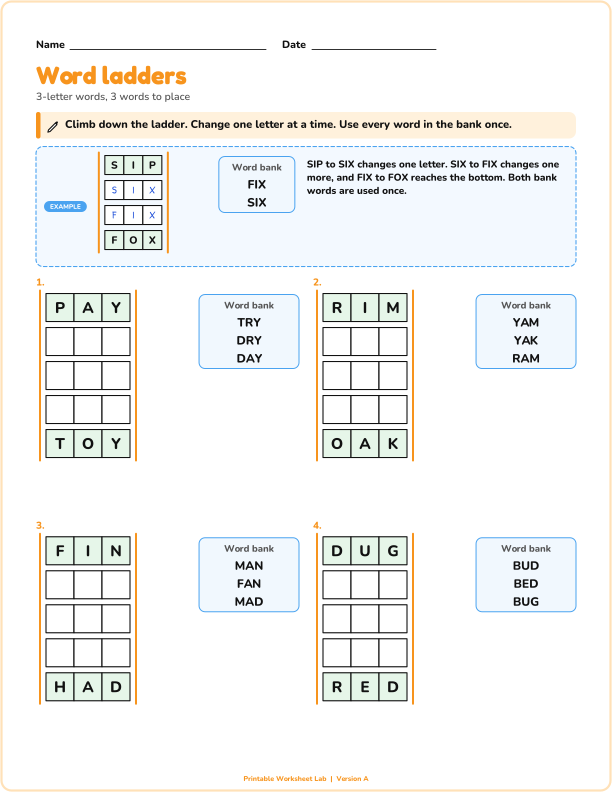
Change one letter at a time to climb from the top word to the bottom word, using the words in the bank.
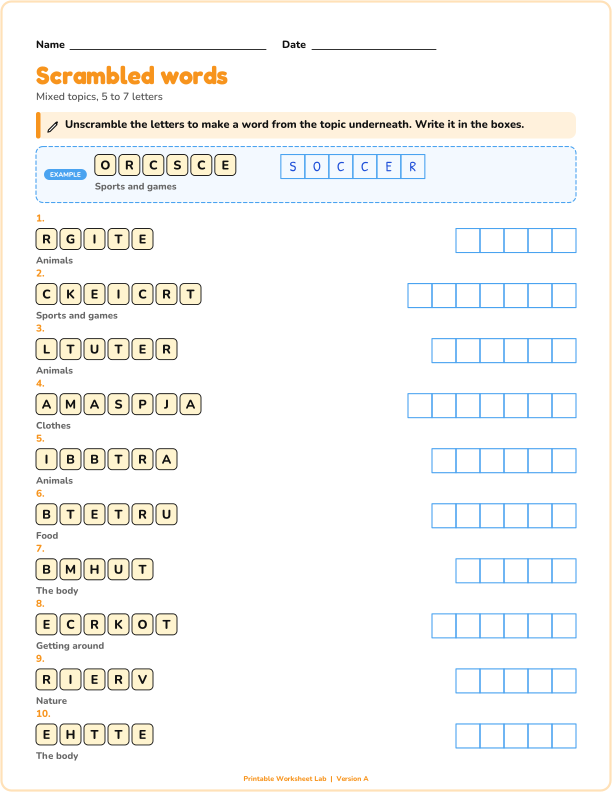
Unscramble the letters to spell a word from a topic, where the letters can spell only that one word.
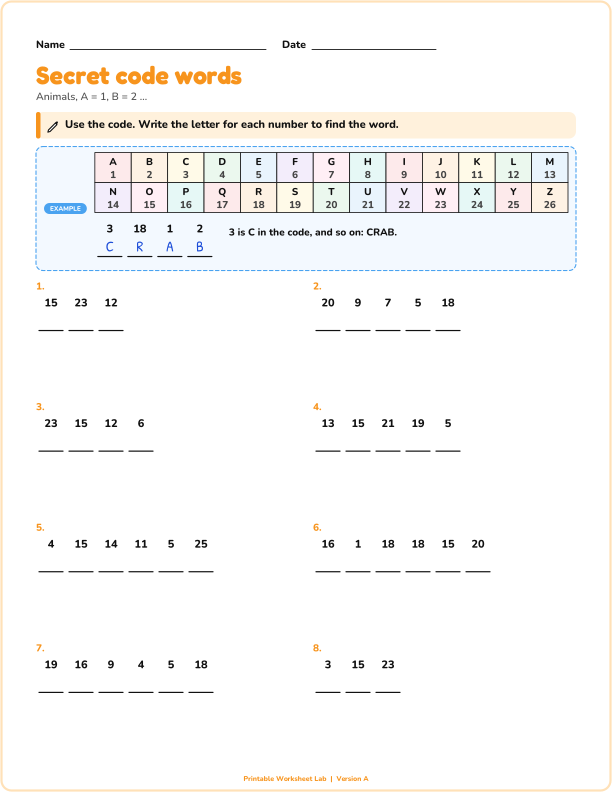
Use a number code to find hidden words from a topic, a phonics pattern or a sight word list.
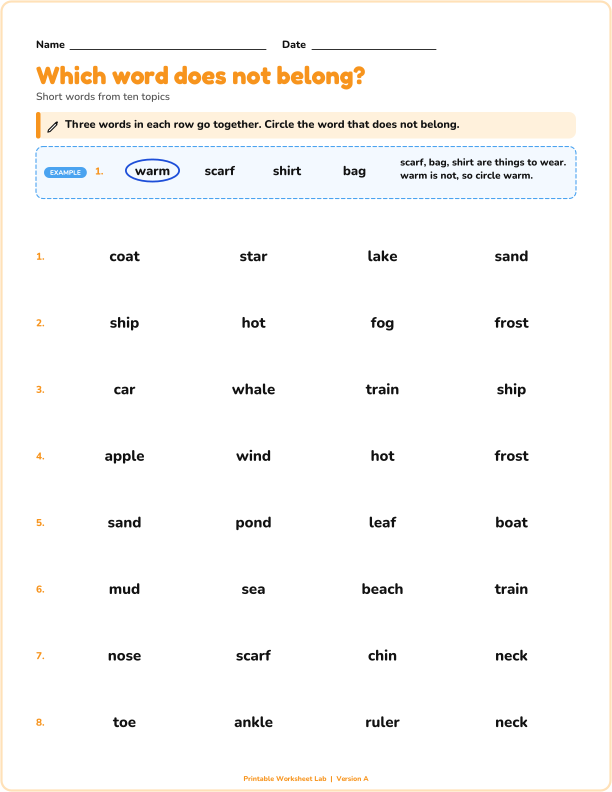
Rows of four words where three go together, and children circle the one that does not belong.
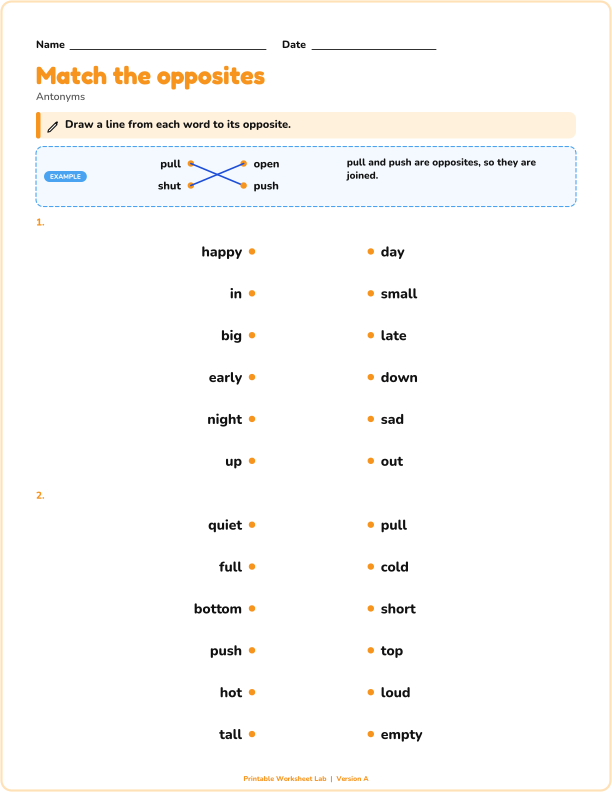
Draw lines to match each word with its opposite (antonym) or a word that means almost the same (synonym).
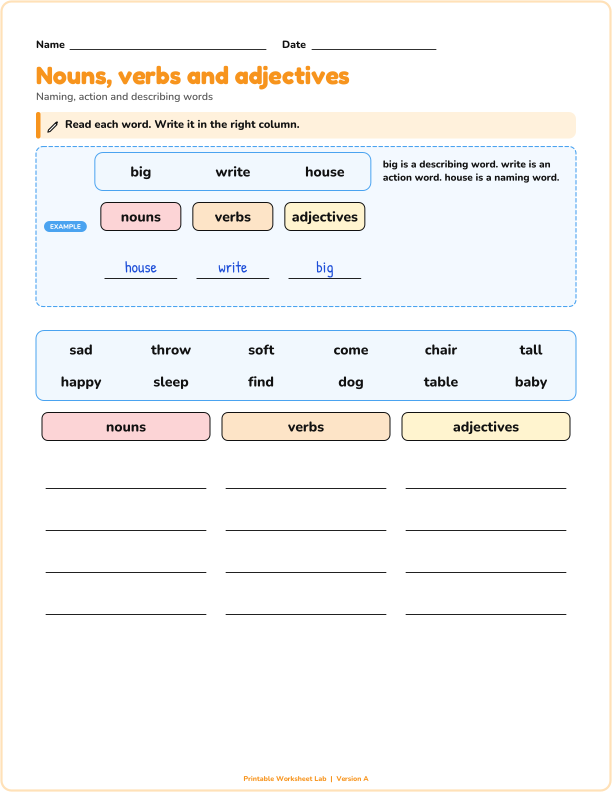
Sort a word bank into naming words (nouns), action words (verbs) and describing words (adjectives).
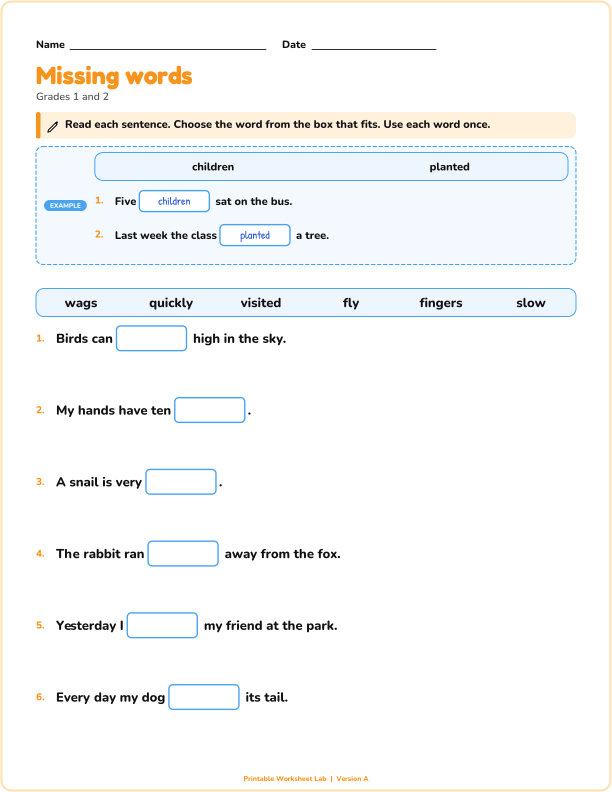
Sentences with one missing word and a word bank in which every word fits only one sentence.
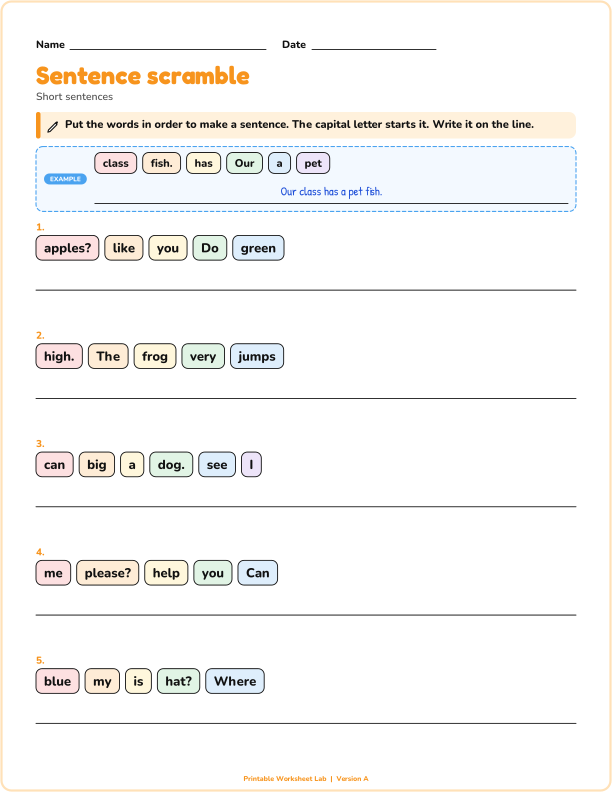
Put the mixed-up words in order to make a sentence, then write it on the line.
No worksheet matches those filters yet. Try another grade.