DrillPre-K to KGrades 1 to 2Grades 3 to 4
Number bonds and complements
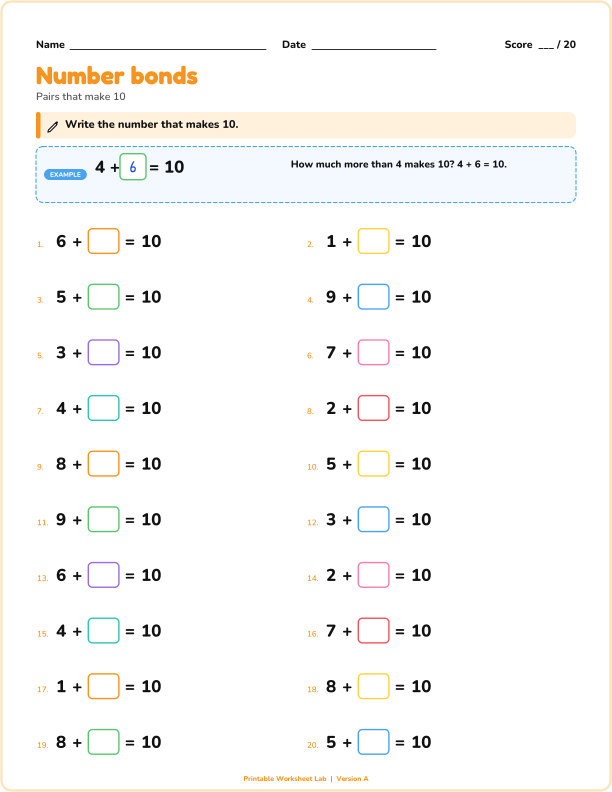
Pairs that make 10, 20, 100 or 1000 (and the 9s, 99s and 999s), as missing-number sums or as subtraction.
Write large and small numbers in scientific notation, and convert them back to standard form.
Scientific notation writes a number as a coefficient from 1 up to (but not including) 10, times a power of 10. Students either change a number such as 45,000 or 0.00032 into scientific notation (4.5 times 10 to the power of 4), or change scientific notation back into standard form.
Choose large numbers, small numbers or both, how many digits the coefficient has (1 to 4), and the largest power of 10. The coefficient never ends in a zero, so there is exactly one correct form for every number. Every sheet has a solved example and an answer key, and there is a large-print version.
US Letter or A4, portrait: choose your paper size above. Print at 100 percent (actual size). Use "Black and white" for the copier, or "Color" for display pages and mini books.
Ready-made settings for common topics.
Pairs that make 10, 20, 100 or 1000 (and the 9s, 99s and 999s), as missing-number sums or as subtraction.
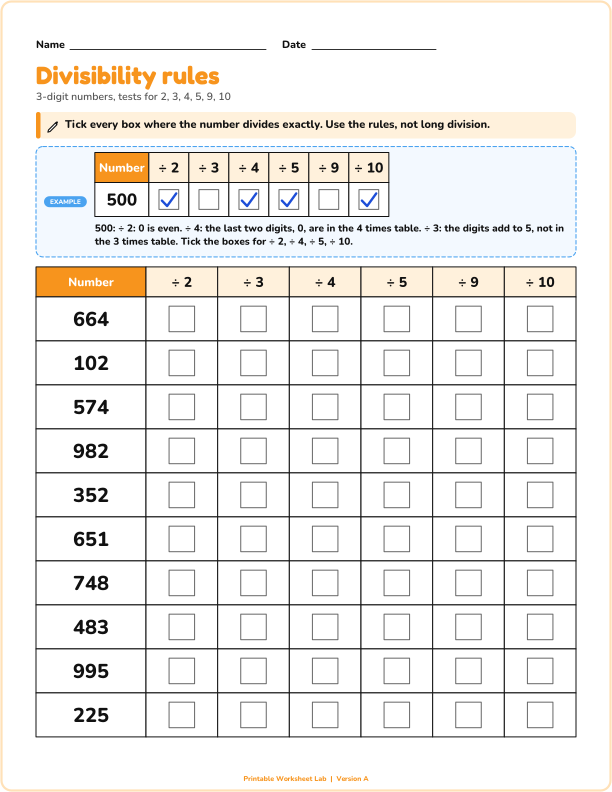
Tick the boxes for every number a given number divides by, using the rules for 2, 3, 4, 5, 6, 8, 9 and 10.
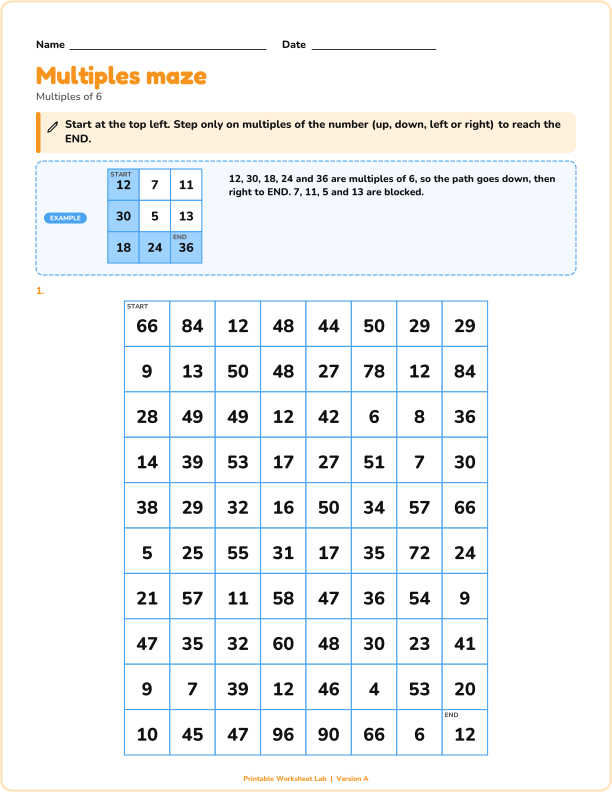
Mazes where you may only step on multiples of a chosen number. One route, no guessing.