DrillPre-K to KGrades 1 to 2Grades 3 to 4
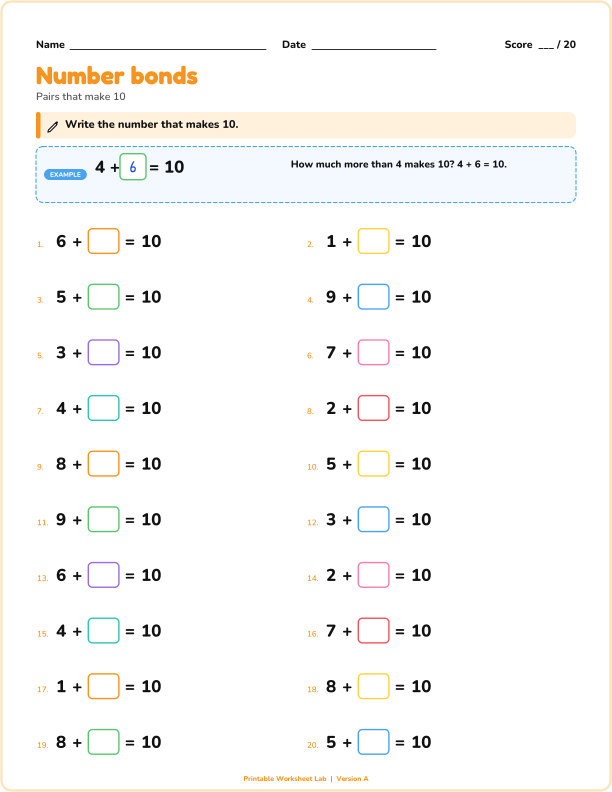
Number bonds and complements
Pairs that make 10, 20, 100 or 1000 (and the 9s, 99s and 999s), as missing-number sums or as subtraction.
Rows of four integers from −100 to 100, and the child numbers the boxes from the greatest to the least.
Rows of four integers from −100 to 100, and the child numbers the boxes from the greatest to the least.
You can change any of these settings above. Press "New problems" for a fresh set with the same settings, or pick Version A to Z to print different sheets for neighboring desks. The answer key always matches.
Each row shows a few numbers with a box under each one. Students write 1 under the least (or greatest) number, then 2, 3 and so on. Because the answer is a rank for every number, there is exactly one right answer and it is easy to check.
Choose whole numbers to 99 up to 999,999, decimals to thousandths, or integers with negatives. "Tricky sets" use numbers that share most of their digits, so students cannot just look at the first digit. Mixed order puts "1 = least" or "1 = greatest" on each row. Every sheet has a solved example and an answer key.
US Letter or A4, portrait: choose your paper size above. Print at 100 percent (actual size). Use "Black and white" for the copier, or "Color" for display pages and mini books.
Pairs that make 10, 20, 100 or 1000 (and the 9s, 99s and 999s), as missing-number sums or as subtraction.
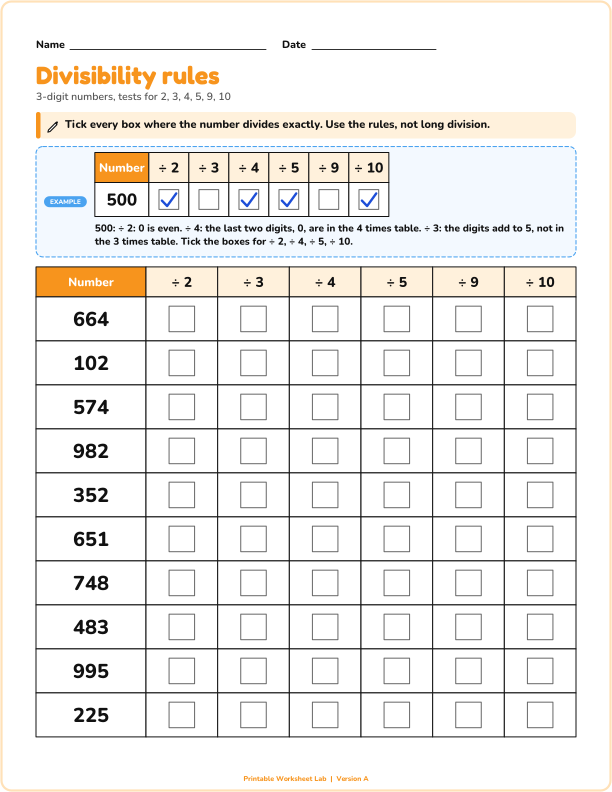
Tick the boxes for every number a given number divides by, using the rules for 2, 3, 4, 5, 6, 8, 9 and 10.
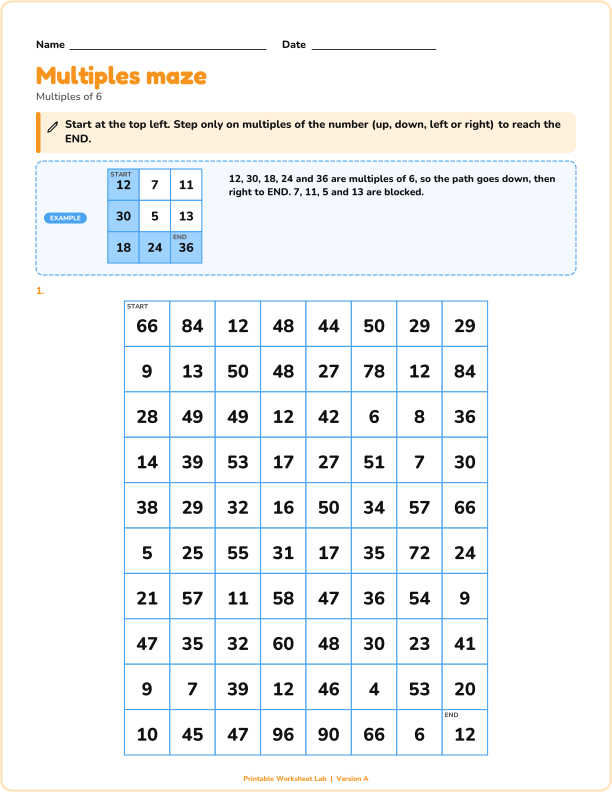
Mazes where you may only step on multiples of a chosen number. One route, no guessing.