DrillPre-K to KGrades 1 to 2Grades 3 to 4
Number bonds and complements
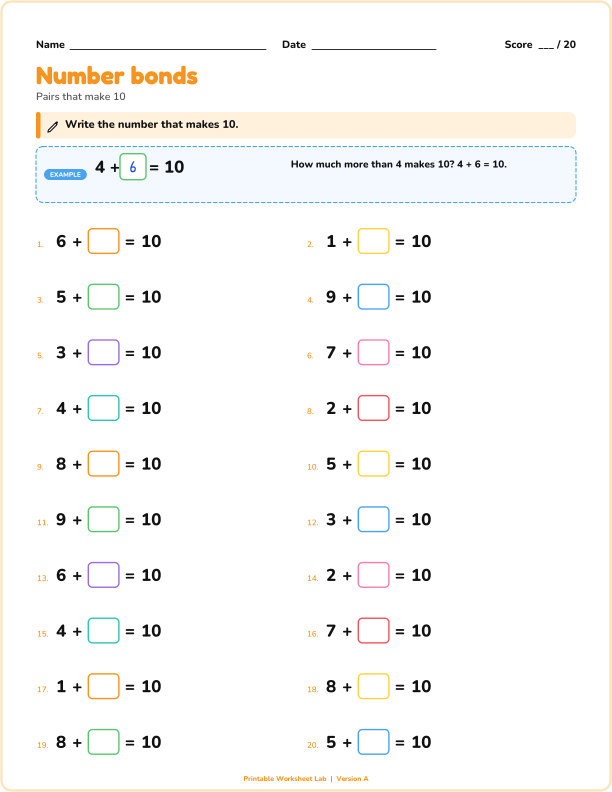
Pairs that make 10, 20, 100 or 1000 (and the 9s, 99s and 999s), as missing-number sums or as subtraction.
Rows of nine numbers that count by 5 with five of them missing, so the child has only four numbers to work from.
Rows of nine numbers that count by 5 with five of them missing, so the child has only four numbers to work from.
You can change any of these settings above. Press "New problems" for a fresh set with the same settings, or pick Version A to Z to print different sheets for neighboring desks. The answer key always matches.
Each row is a run of numbers that goes up or down by the same amount, with some boxes left empty. A small tag at the start of the row shows the step (+5 or −5). Choose the step, the length of each row, how many numbers are missing and how high the numbers may go.
Counting backwards from a multiple of 5 or 10 is one of the best early checks of place value. Every sheet has a solved example and an answer key, and there is a large-print version.
US Letter or A4, portrait: choose your paper size above. Print at 100 percent (actual size). Use "Black and white" for the copier, or "Color" for display pages and mini books.
Pairs that make 10, 20, 100 or 1000 (and the 9s, 99s and 999s), as missing-number sums or as subtraction.
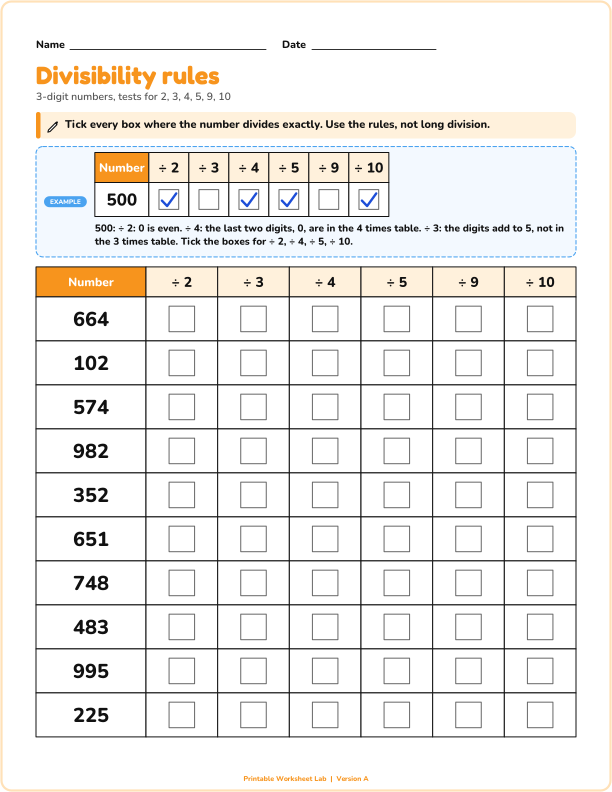
Tick the boxes for every number a given number divides by, using the rules for 2, 3, 4, 5, 6, 8, 9 and 10.
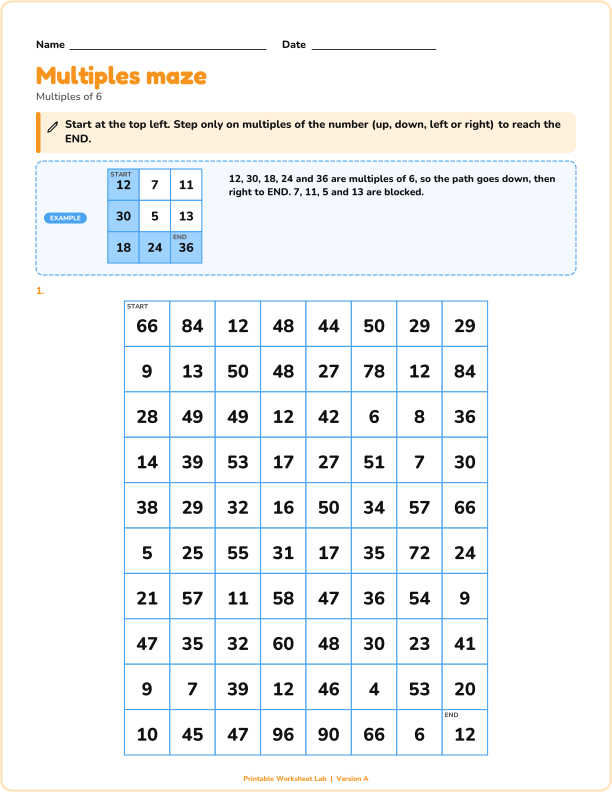
Mazes where you may only step on multiples of a chosen number. One route, no guessing.